
 Savchenko Solutions
    <h3 id="back-link"><a href="/#1.5">$\leftarrow$Back</a></h3>

    <h3> Statement </h3>
    <p>
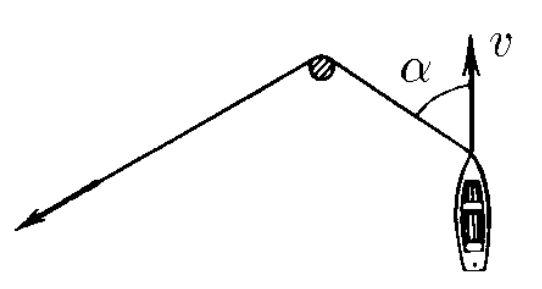
        $1.5.13.$ The rope tied to the boat is pulled by the free end so that it does not sag. The boat moves at a constant speed $v$, forming at some point in time an angle $\alpha$ with the length of rope located between the pole and the boat. How fast should the free end of the rope be pulled at this point in time?
    <h3>Solution</h3>
    <p>
        <center>
      <figure>
        <img src="https://savchenkosolutions.com/1/1.5.13/draw.png"
          loading="lazy" width="250" />
      </figure>
    </center>
  <p>Если веревка не провисает, то</p>
And since all points of the rope have the same speed, the rope must be pulled with exactly the speed
    <h4>Answer:
        $u = v \cos \alpha$</h4>
    <p>


<footer class="row container">
  <br>
    <p>
        <small> © <strong>Savchenko Solutions</strong>, 2023-2024 <br></small>
    </p>
    <p>
        <small>All rights belong to the authors. <br> Commercial use of materials - with the written permission of the authors. <br> alex@savchenkosolutions.com <br></small>
    </p>
</footer>