Statement
2.4.21. [Insert the problem statement]

Solution
Statement
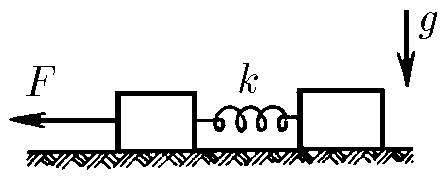
Solution
Let us direct the X-axis along the table in the direction of the force
Since no external forces other than
where
Now let us consider the relative motion of one block with respect to the other. An elastic force
Substituting the acceleration, we obtain:
Let us introduce the relative coordinate
This is a linear non-homogeneous second-order differential equation, whose solution is the sum of the general solution of the homogeneous equation and a particular solution of the non-homogeneous equation. The solution of the homogeneous equation is known:
We will look for a particular solution in the form
From which
Thus, the general solution of the differential equation is:
The amplitude and initial phase of the oscillations are determined by the initial conditions. At the initial moment, the spring is unstretched
Substituting
Hence
Which yields
So, the solution to the differential equation with the initial conditions is:
Returning to the variable
The minimum distance between the blocks occurs when
The maximum distance between the blocks occurs when
Alternative Solution (via CM frame)
Let us shift to a non-inertial frame of reference associated with the center of mass (CM) of the system.
The acceleration of the center of mass of the entire system is:
In this frame of reference, an additional inertial force
Then, in the CM frame, the following effective forces act on the blocks:
- On the left block: the external force
and the inertial force in the opposite direction. The net force is . - On the right block: only the inertial force
, directed in the opposite direction (away from the center of mass).
We get a perfectly symmetric picture: in the CM frame, the blocks are pulled apart by equal effective forces
Let's find the displacement of the equilibrium position in this frame. In the new equilibrium position, the elastic force balances this pulling force:
Since the blocks were initially at rest (their relative velocity is zero), they begin their motion from the extreme point. The oscillations of a harmonic oscillator always occur symmetrically relative to the equilibrium position.
Therefore, the amplitude of these oscillations equals the distance from the initial position to the new equilibrium position:
From this, we immediately obtain the extreme lengths of the spring.
Minimum length (this is our initial extreme point from which the blocks started):
Maximum length (the opposite extreme point on the oscillation plot):
Answer
Answer
[Insert a concise answer or boxed result]