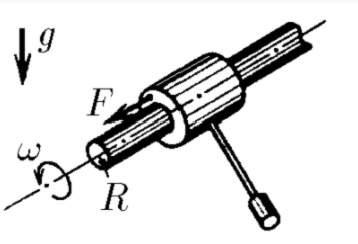
2.1.43∗. The horizontal axis of radius $R$ , which rotates at an angular velocity $\omega$ , is compressed by a sleeve equipped with a counterweight so that it does not rotate when moving along the axis. Determine the steady-state velocity of the bushing under the action of a force $F$ applied to it along the axis. Maximum friction force of the axle against the bushing $F_{tr} > F$.
For problem $2.1.43$
Solution
The shaft ( radius R) spins with angular velocity $\omega$ , but the sleeve (bushing) is prevented from rotating by the counterweight. So at the contact surface between shaft and sleeve there is relative sliding made of two perpendicular components:
a circumferential component, from the shaft's rotation: $u = \omega R$
an axial component, from the sleeve's motion along the shaft: $v$ ( the steady-state velocity we want )
Since these two velocity components are mutually perpendicular ( one is along the surface's circumference, the othe along the axis), the resultant relative sliding speed is: $$u_{rel} = \sqrt{ v^2 + ( \omega R)^2 }$$
Kinetic friction always acts opposite to the relative sliding velocity at the contact, and its magnitutde equals the maximum friction force $F_{tr}$ (given). So the friction force vector has magnitude $F_{tr}$, directed opposite to $\vec{u}_{rel}$ .
The axial component of this friction force (the part that resists the applied force $F$) is the projection of $F_{tr}$ along the axis:
$$F_{tr, axial} = F_{tr} \ \cdot \ \frac{v}{u_{rel}} = F_{tr} \ \cdot \ \frac{v}{\sqrt{ v^2 + (\omega R)^2}}$$ (this follows just from similar triangles: the axial component of friction is to $F_{tr}$ as $v$ to $u_{rel}$)
"Steady-state" means the bushing moves with constant velocity, so the net exial force is zero: the applied force $F$ is exactly balanced by the avial component of friction: