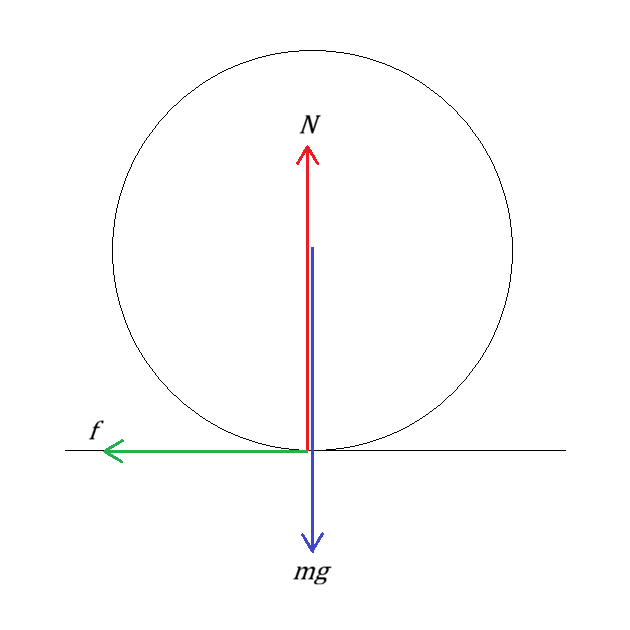
The cylinder will roll without slipping when the speed of its center of mass $v$ is equal to $\omega R$, where $\omega$ is the angular speed of rotation of the cylinder around its axis. This is achieved by friction $f=\mu N=\mu mg$, which decreases the cylinder's linear momentum and at the same time increases its angular momentum. After time interval $t$, linear impulse from friction is $-\mu mgt$, and $v=v_0-\mu gt$. Similarly, angular impulse from friction is $\mu mgRt$, and $\omega=\mu mgRt/I$, where $I$ is the moment of inertia of the cylinder around its axis. Setting $v=\omega R$, we have
which becomes $t=v_0/(3\mu g)$ for $I=mR^2/2$. We also obtain the final speed of the center of mass $v=2v_0/3$. Heat generated from lost kinetic energy is