 Savchenko Solutions
    <h3 id="back-link"><a href="/#2.1">$\leftarrow$Back</a></h3>

    <h3> Statement </h3>
    <p>
        $2.1.33.$ Why does the speed of raindrops not depend on the height of clouds and strongly depends on the size of drops?
    </p>

    <h3>Solution</h3>
    <p>
        <center>
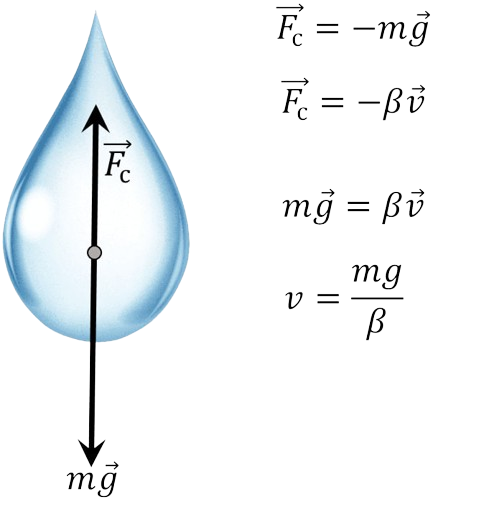
A falling drop is acted upon by two forces: the constant force of gravity, accelerating the drop's movement, and the force of air resistance, slowing its movement and increasing with the drop's speed. The force of air resistance increases until it becomes equal to the force of gravity. Then the speed stops changing, and the drop falls at a constant speed.
As the drop's size increases, the force of gravity increases proportionally to the volume, i.e. proportional to the third power of the radius, and the force of resistance increases proportionally to the cross-section of the drop, i.e. proportional to the square of the radius. Therefore, as the radius of the drop increases, the force of gravity increases faster than the force of air resistance, and therefore the constant speed with which the drop falls to the ground increases as the size of the drop increases.
<footer class="row container">
  <br>
    <p>
        <small> © <strong>Savchenko Solutions</strong>, 2023-2024 <br></small>
    </p>
    <p>
        <small>All rights belong to the authors. <br> Commercial use of materials - with the written permission of the authors. <br> alex@savchenkosolutions.com <br></small>
    </p>
</footer>