
 Savchenko Solutions
    <h3 id="back-link"><a href="/#1.5">$\leftarrow$Back</a></h3>

    <h3> Statement </h3>
    <p>
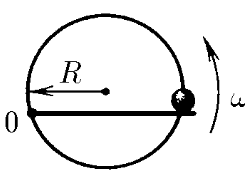
        $1.5.12.$ A bead can move along a ring of radius $R$, pushed by a spoke that rotates uniformly with angular velocity $\omega$ in the plane of the ring. The axis of rotation of the spoke is located on the ring. Determine the acceleration of the bead.
    <h3>Solution</h3>
    <p>
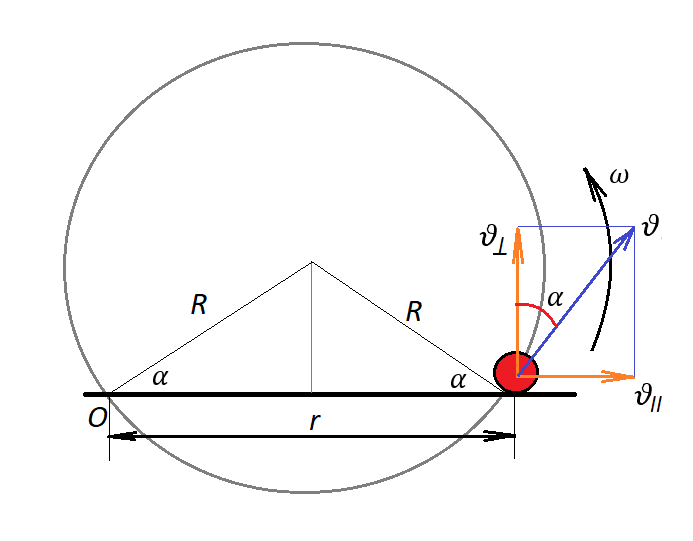
The bead will move along the spoke with the velocity
Then the absolute velocity
On the other hand,
Then the absolute velocity
Since the speed of a bead moving in a circle is directed perpendicular to the radius.
Then
Since the speed does not change in magnitude, the bead has only normal acceleration
    </p>

    <h4>Answer</h4>
    <p>
        $$a_n=4\omega^2R$$
    </p>


<footer class="row container">
  <br>
    <p>
        <small> © <strong>Savchenko Solutions</strong>, 2023-2024 <br></small>
    </p>
    <p>
        <small>All rights belong to the authors. <br> Commercial use of materials - with the written permission of the authors. <br> alex@savchenkosolutions.com <br></small>
    </p>
</footer>