
 Savchenko Solutions
    <h3 id="back-link"><a href="/#1.4">$\leftarrow$Back</a></h3>

    <h3> Statement </h3>
    <p>
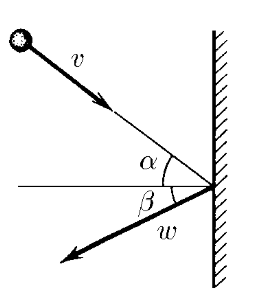
        $1.4.9.$ The body hits the wall with velocity $v$ and angle $\alpha$ to the line perpendicular to the wall. Determine the velocity of the body after an elastic impact if the wall is: </p><p>
a) stationary;
b) moving perpendicular to itself at a speed
c) moving at an angle
    <h3>Solution</h3>
    <p>
        <p>$a)$ Since the collision is elastic, then according to the Law of Conservation of Momentum:</p>
In the frame of reference associated with the wall, the relative velocity of the ball
Working with vector quantities is clearly demonstrated below
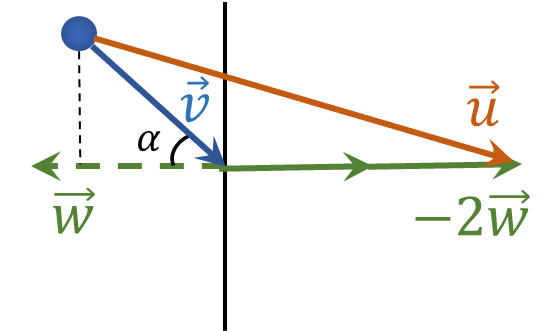
Let's find the projections of the vector
Using the Pythagorean theorem, we find the modulus of the vector
We will show these vectors in the figure
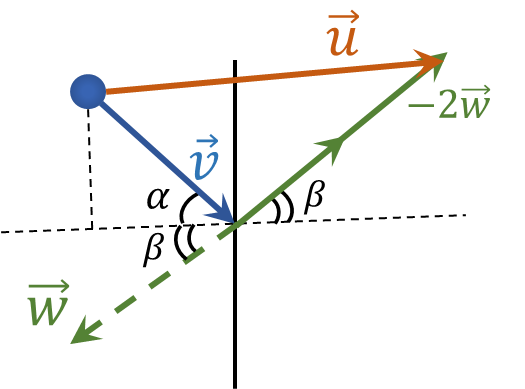
We will find the projections of the vector
Using the Pythagorean equation, we find the modulus of the vector
    </p>

    <h4>Answer</h4>
    <p>
        $\text{a) } u=v.\quad\text{b) } u=\sqrt{v^{2}+4vw\cos\alpha +4w^{2}}.\quad\text{c) } u=\sqrt{v^{2}+4vw\cos\alpha\cos\beta +4w^{2}\cos^{2}\beta}.$
    </p>


<footer class="row container">
  <br>
    <p>
        <small> © <strong>Savchenko Solutions</strong>, 2023-2024 <br></small>
    </p>
    <p>
        <small>All rights belong to the authors. <br> Commercial use of materials - with the written permission of the authors. <br> alex@savchenkosolutions.com <br></small>
    </p>
</footer>