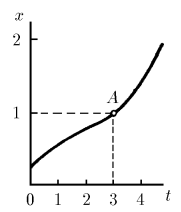
Figure for 1.2.16
The graphs of the coordinate dependence on time is plotted for two particles using two different time
scales. The plotted graphs turn out to be the same (see Figure above). One division of the time axis
$t$ for the graph of the first particle corresponds to $4 \text{ s}$, and for the graph of the
second particle is $1 \text{ s}$. Find the ratio of velocities and the ratio of particle accelerations
for point A of the graph.
Solution
We know the instantaneous velocity and acceleration of any object at a given point can be extracted from a plot using \begin{align*} v &= \lim_{\Delta t \to 0} \frac{\Delta x}{\Delta t} = \frac{d x}{d t} \end{align*} \begin{align*} a &= \lim_{\Delta t \to 0} \frac{\Delta v}{\Delta t} =\frac{d v }{d t} \end{align*} We note that, for any given time, the graphs exactly coincide, so any $\Delta x$ is exactly the same for both particles, and so $dx_1 = dx_2$. Likewise, for any time interval, we know that $\Delta t_1 = 4 \Delta t_2$, so $dt_1 = 4dt_2$. We can then say, for an equivalent Point A on their graphs, that: \begin{align*} v_1 &=\frac{d x_1}{d t_1} = \frac{d x_2}{4 d t_2} = \frac{1}{4} \left( \frac{d x_2}{d t_2} \right) = \frac{1}{4} v_2 \end{align*} Using the same logic, we can then say for the accelerations that: \begin{align*} a_1 &= \frac{d v_1 }{d t_1} = \frac{d \left( \frac{1}{4} v_2 \right)}{4 d t_2} = \frac{1}{16} \left( \frac{d v_2}{d t_2} \right) = \frac{1}{16} a_2 \end{align*} More generally, we can say that, if the time scale divisions are related by $\Delta t_1 / \Delta t_2 = \alpha$, the ratio of velocities are given by: \begin{align*} \frac{v_2}{v_1} = \alpha \end{align*} and the ratio of accelerations is given by: \begin{align*} \frac{a_2}{a_1} = \alpha^2 \end{align*}
Answer
The ratio of velocities is \begin{align} \boxed{ \frac{v_2}{v_1} = 4 } \end{align} And the ratio of the acceleration is \begin{align} \boxed{ \frac{a_2}{a_1} = 4^2 = 16 } \end{align}