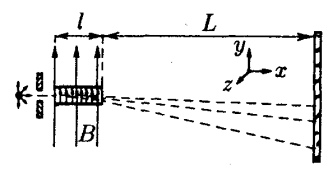
10.1.17. a) In a flat capacitor of length $l$, the electric field strength is $E$, and the magnetic field induction, directed along $E$, is $B$. At the entrance to the capacitor, there is a radioactive source emitting electrons with different velocities. A thin beam is formed from them, which passes through the capacitor and then hits a photographic plate located at a distance $L \gg l$. What line-trace will the electrons "draw" on the photographic plate if their deviations from a straight-line trajectory are small?
b) Find the line-trace of the electrons on the photographic plate for $B = 1$ T, $E = 5 \cdot 10^5$ V/m, $l = 5$ cm, $L = 50$ cm.
c) At a high electron velocity, its mass noticeably changes; according to the Lorentz formula $m = m_e / \sqrt{1 - \beta^2}$, where $\beta$ is the ratio of the electron velocity to the speed of light, $m_e$ is the electron rest mass. Solve problem 10.1.17a taking into account the effect of the electron mass change.
For problem $10.1.17$
Solution
a) Let us introduce a coordinate system as shown in the figure for the problem: the beam flies along the $x$-axis, the fields are directed vertically upwards along the $y$-axis ($\vec{E} = E \hat{j}$,$\vec{B} = B \hat{j}$). The force acting on the electron (with charge $q = -e$) is the Lorentz force: $$\vec{F} = -e\vec{E} - e(\vec{v} \times \vec{B})$$ Since the deviations are small, the time of flight inside the capacitor is $t_1 \approx l/v$. The transverse forces acting on the electron: $F_y = -eE$ (the electric force deflects it downwards, opposite to the $y$-axis) $F_z = -e(v\hat{i} \times B\hat{j})_z = -evB$ (the magnetic force deflects it opposite to the $z$-axis)
The transverse velocity components upon exiting the capacitor: $$v_z = a_z t_1 = -\frac{evB}{m} \frac{l}{v} = -\frac{eBl}{m}$$ $$v_y = a_y t_1 = -\frac{eE}{m} \frac{l}{v} = -\frac{eEl}{mv}$$
Since $L \gg l$, we can neglect the small displacement of the electron inside the capacitor itself and consider the displacement only during the free flight to the screen, where the drift time is $t_2 \approx L/v$: $$z \approx v_z t_2 = -\frac{eBlL}{mv}$$ $$y \approx v_y t_2 = -\frac{eElL}{mv^2}$$
To find the equation of the trajectory on the screen (in coordinates $z, y$), let us express the velocity $v$ from the equation for the horizontal deflection $z$: $$v = -\frac{eBlL}{mz}$$ Let us substitute the obtained expression into the equation for the vertical deflection $y$: $$y = -\frac{eElL}{m} \left( -\frac{mz}{eBlL} \right)^2 = - \frac{mE}{e B^2 l L} z^2$$ The trace on the screen is a branch of a parabola (the electrons fall into the $-z, -y$ quadrant).
b) Let us substitute the numerical values. Using the electron mass $m_e \approx 9.1 \cdot 10^{-31}$ kg and the elementary charge $e \approx 1.6 \cdot 10^{-19}$ C: $$y = - \frac{9.1 \cdot 10^{-31} \cdot 5 \cdot 10^5}{1.6 \cdot 10^{-19} \cdot 1^2 \cdot 0.05 \cdot 0.5} z^2 \approx -1.14 \cdot 10^{-4} \cdot z^2 \; (\text{m})$$
c) For relativistic velocities, it is necessary to use the momentum $\vec{p} = \gamma m_e \vec{v}$. The change in the transverse momentum inside the capacitor is determined by the impulse of the acting forces $\Delta \vec{p} = \vec{F} t_1$: $$p_z = -evB \frac{l}{v} = -eBl$$ $$p_y = -eE \frac{l}{v} = -\frac{eEl}{v}$$
The coordinates on the screen are determined by the velocities $v_z = p_z / (\gamma m_e)$ and $v_y = p_y / (\gamma m_e)$: $$z = v_z \frac{L}{v} = \frac{p_z L}{\gamma m_e v} = -\frac{eBlL}{p}$$ $$y = v_y \frac{L}{v} = \frac{p_y L}{\gamma m_e v} = - \frac{eElL}{p v}$$ where $p = \gamma m_e v$ is the total momentum of the electron.
From these equations, we can express the total momentum $p$ and the product $pv$: $$p = -\frac{eBlL}{z} \quad \text{and} \quad pv = - \frac{eElL}{y}$$ Dividing the second expression by the first, we find the velocity: $$v = \frac{pv}{p} = \frac{E z}{B y}$$
We use the relativistic relation between momentum and velocity: $p = \frac{m_e v}{\sqrt{1 - (v/c)^2}}$. Let us substitute the expressions for $p$ and $v$ into this relation: $$-\frac{eBlL}{z} = \frac{m_e (Ez / By)}{\sqrt{1 - \left( \frac{Ez}{Bcy} \right)^2}}$$ Let us square both sides of the equation to eliminate the square root and the minus sign: $$\frac{e^2 B^2 l^2 L^2}{z^2} \left( 1 - \frac{E^2 z^2}{B^2 c^2 y^2} \right) = \frac{m_e^2 E^2 z^2}{B^2 y^2}$$ Expanding the brackets: $$\frac{e^2 B^2 l^2 L^2}{z^2} - \frac{e^2 E^2 l^2 L^2}{c^2 y^2} = \frac{m_e^2 E^2 z^2}{B^2 y^2}$$ Let us multiply the entire expression by $z^2 y^2$ and express $y^2$: $$e^2 B^2 l^2 L^2 y^2 = \frac{e^2 E^2 l^2 L^2 z^2}{c^2} + \frac{m_e^2 E^2 z^4}{B^2}$$ $$y^2 = \frac{E^2 z^2}{e^2 B^2 l^2 L^2} \left( \frac{e^2 l^2 L^2}{c^2} + \frac{m_e^2 z^2}{B^2} \right)$$ Taking the square root (and choosing the minus sign, since the deflection occurs in the negative direction of the $y$-axis), we get: $$y = - \frac{m_e E}{e B^2 l L} z \sqrt{z^2 + \left( \frac{eBlL}{m_e c} \right)^2}$$
Answer
a) $y = - \frac{m_e E}{e B^2 l L} z^2$
b) $y = -1.14 \cdot 10^{-4} \cdot z^2$ m
c) $y = - \frac{m_e E}{e B^2 l L} z \sqrt{z^2 + \left( \frac{eBlL}{m_e c} \right)^2}$
*Note on the official answer:* When checking against the answers in the original Savchenko problem book, one should note the following typos and inaccuracies:
The minus signs are missing in the problem book. Since the electron carries a negative charge, the displacement of the beam occurs in the negative direction of the $y$ and $z$ axes, but the authors provide the equation of the curve modulo.
In the official answer to part (c), a gross mathematical typo was made: under the square root sign in the first term, a square is missing (it is printed as $z \sqrt{z + \dots}$ instead of $z \sqrt{z^2 + \dots}$). The form presented in the problem book violates the rules of dimensionality of physical quantities.