
Solutions of Savchenko Problems in Physics
    <h3 id="back-link"><a href="/#1.3">$\leftarrow$Back</a></h3>

    <h3> Statement </h3>
    <p>
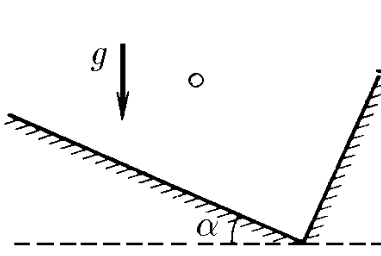
        $1.3.17.$ In a rectangular box, elastically hitting the bottom and the right wall, a ball jumps back and forth along one trajectory. The time interval between hitting the bottom and the wall is $\Delta t$. The bottom of the box forms an angle $\alpha$ with the horizon. Find the speed of the ball immediately after hitting.
    <h3>Solution</h3>
    <p>
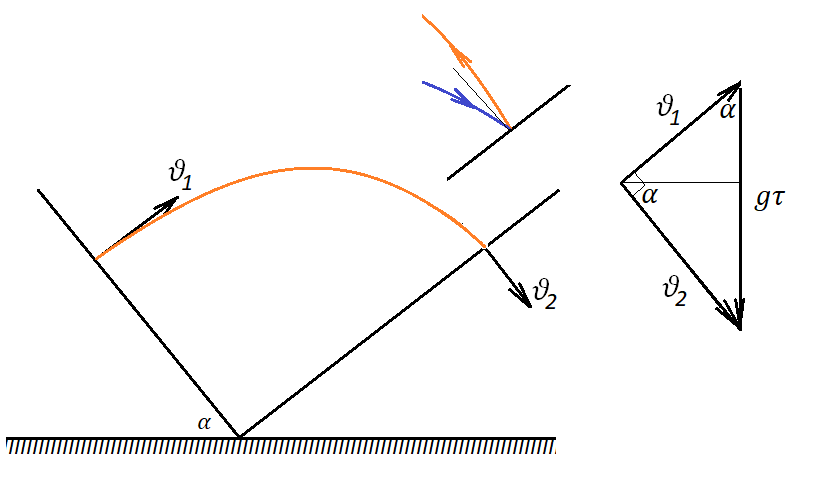
        <p>The most important thing in this problem is that the ball bounces along the same trajectory. Indeed, in an elastic collision, the angle of incidence is equal to the angle of rebound. If the ball falls on the wall of the box so that its speed is not perpendicular to the wall, then when it bounces, its trajectory would differ from the trajectory of its approach - I showed this with an additional small drawing. Therefore, $v_2$ is perpendicular to the wall. And this means that the velocity vectors $v_1$ and $v_2$ are perpendicular to each other.
Let's draw a triangle of velocities.
    <h4>Answer</h4>
    <p>
        $$v_{1}=g\Delta t\sin\alpha\text{, }v_{2}=g\Delta t\cos\alpha$$
    </p>


<footer class="row container">
  <br>
    <p>
        <small> © <strong>Savchenko Solutions</strong>, 2023-2024 <br></small>
    </p>
    <p>
        <small>All rights belong to the authors. <br> Commercial use of materials - with the written permission of the authors. <br> alex@savchenkosolutions.com <br></small>
    </p>
</footer>