
Solutions of Savchenko Problems in Physics
    <h3 id="back-link"><a href="/#2.1">$\leftarrow$Back</a></h3>

    <h3> Statement </h3>
    <p>
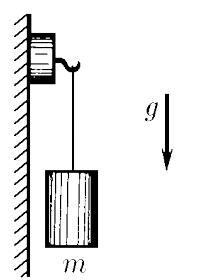
        $2.1.17.$ A light magnet with a hook on a vertical steel plate remains stationary as long as the weight suspended from it does not exceed $m_0$ in mass. What is the magnetic force if the coefficient of friction of the magnet on steel is equal to $\mu$? With what acceleration does the magnetic suspension slide, if the mass of the load is $m > m_0$?
    <h3>Solution</h3>
    <p>
        <center>
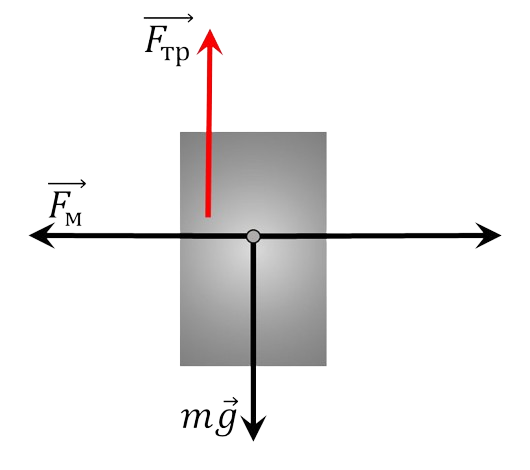
1. The body can be considered as free if the connections are replaced by their reactions. The friction force in this case is caused by the action of the magnetic force, i.e.
    <h4>Answer</h4>
    <p>
                 $$F = m_0g/\mu ;$$
     $$a = g(m − m_0)/m$$
    </p>


<footer class="row container">
  <br>
    <p>
        <small> © <strong>Savchenko Solutions</strong>, 2023-2024 <br></small>
    </p>
    <p>
        <small>All rights belong to the authors. <br> Commercial use of materials - with the written permission of the authors. <br> alex@savchenkosolutions.com <br></small>
    </p>
</footer>