Statement
$12.2.7.$ A plane sinusoidal wave falls on a hole of radius $r$ perpendicular to its plane. The wavelength is $\lambda\ll r$. The wave intensity along the hole axis changes periodically. At what distance from its center is the last maximum? Determine the distance between the intensity maxima at a distance $z_0$ from the center of the hole, if $\frac{r^2}{\lambda}\gg z_0 \gg r$.
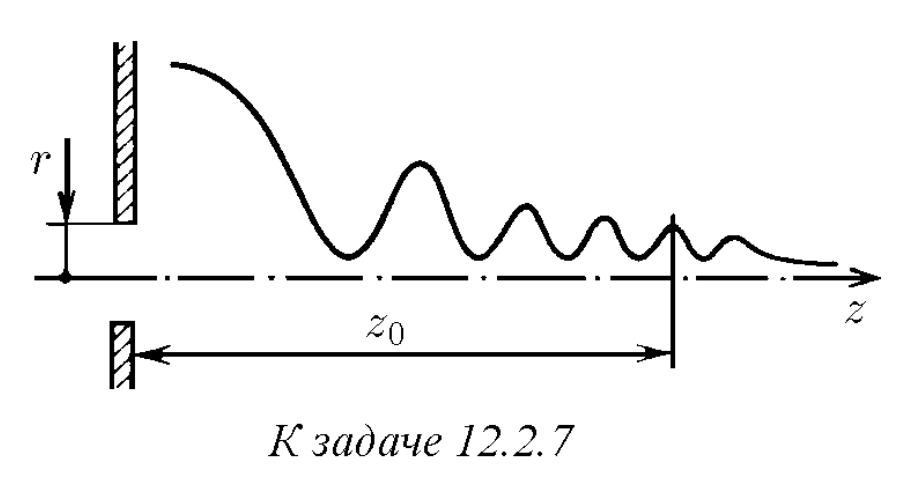
Solution
The approximations allowed by the author reduce the problem to Fresnel diffraction by an aperture . It is usually solved as follows: the plane wavefront is divided into annular zones such that the distances from the zone boundaries to observation point differ by $\lambda/2$. When the radius of the hole coincides with the boundary of an odd zone, the secondary waves arrive in phase, so the amplitude at point $A$ doubles, and an intensity maximum is observed. When the hole opens an even number of zones (the boundary coincides with the end of the second, fourth, etc. zone), waves from adjacent zones arrive in opposite phase and cancel each other, giving almost zero intensity (diffraction minimum).
Find the radii of the Fresnel zones:
$$
\sqrt{r_m^2 + l^2} - l = \frac{m\lambda}{2} \tag{1}
$$
$$
r_m = \sqrt{ml\lambda + \left(\frac{m\lambda}{2}\right)^2} \approx \sqrt{ml\lambda}, \quad m \in N \tag{2}
$$
$$
l = \frac{r^2}{(2m-1)\lambda} \tag{3}
$$
$$
l_{max} = \frac{r^2}{\lambda} \ - \text{last maximum}
$$
The distance between adjacent maxima is obviously:
$$
l_k = l_{k+1} - l_{k} = \frac{2r^2}{\lambda (2k+1) (2k-1)}
$$
$\frac{r^2}{\lambda}\gg z_0 \gg r$ so k is large:
$$
z_0\approx \frac{r^2}{(2k-1)\lambda} \quad\to\quad \frac{r^2}{\lambda}\gg \frac{r^2}{(2k-1)\lambda}\to k\gg1
$$
so
$$
l_k \approx \frac{2r^2}{\lambda (2k+1)^2} \approx\frac{2\lambda z_0^2}{r^2}
$$
Analyzing formula (3), one can note that, generally speaking, there are infinitely many maxima in the interval $z \in [0, l_{max}]$ (in reality our theory still requires $l_k \gg \lambda$, beyond that things are somewhat more complicated), and the distance between them tends to zero as $z \to 0$. Therefore, the author's illustration is essentially incorrect. There are also errors in the answers.
Answer
$$
\boxed{l=\frac{r^2}{\lambda};\quad l_k \approx \frac{2\lambda z_0^2}{r^2} }
$$
Discussion
Log in to join the discussion