
 Savchenko Solutions
    <h3 id="back-link"><a href="/#1.5">$\leftarrow$Back</a></h3>

    <h3> Statement </h3>
    <p>
        $1.5.8.$ Plot the trajectories of the points of the wheel rolling without slipping on the rail. Consider cases where the points are at a distance from the wheel axis: $r > R$, $r = R$, $r < R$. Find the acceleration of these points if the wheel axis is moving at a constant speed $v$. Find the radius of curvature of the trajectory of a point located in the highest and lowest positions at a distance $r \ne R$ from the wheel axis.
    </p>

    <h3>Solution</h3>
    <p>
        <center>
In this case, the motion of the points is the sum of the translational velocity of the wheel center and the rotational velocity relative to this center, and the acceleration of the point is calculated using the usual formula for centripetal acceleration
For the case of
Knowing the acceleration
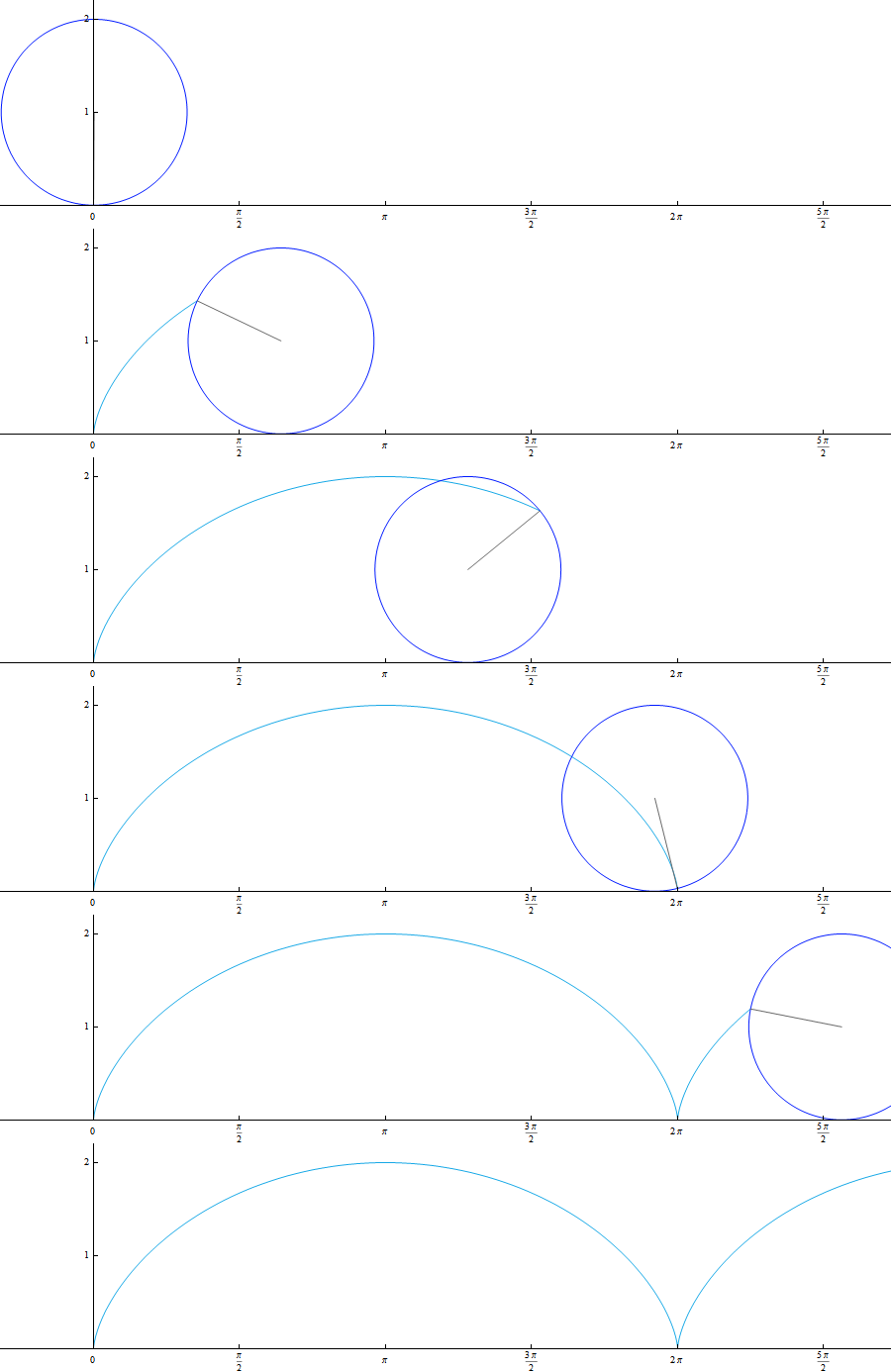
For better understanding, I offer an illustration of the movement:
    <h4>Answer</h4>
    <p>
        $$a=(v^2/R^2)r; r_{in}=(R+r)^2/r, r_{out}=(R-r)^2/r$$
    </p>


    <p style="text-align: right; font-style: italic; font-size: 14;">
      Aliaksandr Melnichenka<br>
    </p>
        <footer class="row container">
  <br>
    <p>
        <small> © <strong>Savchenko Solutions</strong>, 2023-2024 <br></small>
    </p>
    <p>
        <small>All rights belong to the authors. <br> Commercial use of materials - with the written permission of the authors. <br> alex@savchenkosolutions.com <br></small>
    </p>
</footer>