| ### Statement | | ### Statement |
| | | |
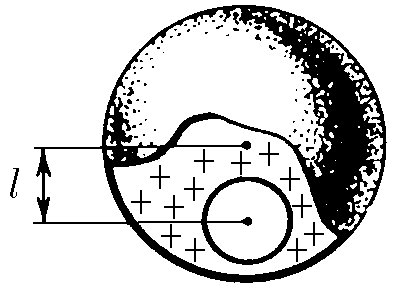
| $6.2.13.$ In a uniformly charged ball of radius $R$, a spherical cavity of radius $r$ was cut out, the center of which is located at a distance $l$ from the center of the ball. Bulk charge density is $\rho$. Find the electric field strength along a straight line passing through the center of the cavity and the center of the ball. Prove that the electric field in the cavity is homogeneous. | | $6.2.13.$ In a uniformly charged ball of radius $R$, a spherical cavity of radius $r$ was cut out, the center of which is located at a distance $l$ from the center of the ball. Bulk charge density is $\rho$. Find the electric field strength along a straight line passing through the center of the cavity and the center of the ball. Prove that the electric field in the cavity is homogeneous. |
| | | |
|  | |  |
| | | |
| ### Solution | | ### Solution |
| | | |
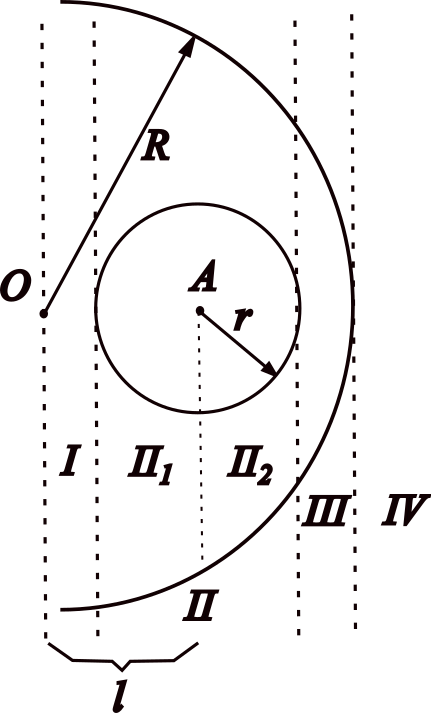
| Here, the idea for solving the problem is to use superposition's principle: considering a sphere of radius $R$ (bigger one) with bulk charge density $\rho$ and smaller one with bulk charge density $-\rho$, such that when superposition occurs, the cavity have no charge. Moreover, let's consider the following figure for organizing the solving process. | | Here, the idea for solving the problem is to use superposition's principle: considering a sphere of radius $R$ (bigger one) with bulk charge density $\rho$ and smaller one with bulk charge density $-\rho$, such that when superposition occurs, the cavity have no charge. Moreover, let's consider the following figure for organizing the solving process. |
| | | |
|  Regions for analysis | |  Regions for analysis |
| | | |
| Above picture shows four regions to study. Let's begin with first one... Applying Gauss's Law for bigger sphere (without cavity) at distance $x$ from its center, $$E_b(x)\cdot 4\pi x^2 = \frac{q_{enc}}{\varepsilon_0} = \frac{\rho\cdot 4\pi x^3}{3\varepsilon_0}$$ $$E_b(x) = \frac{\rho x}{3\varepsilon_0} \;(1)$$ while for smaller one, $$E_s(r')\cdot 4\pi r'^2 = \frac{q_{enc}'}{\varepsilon_0} = \frac{\rho\cdot 4\pi r^3}{3\varepsilon_0}$$ $$E_s(r') = \frac{\rho r^3}{3 r'^2 \varepsilon_0} \;(2)$$ In this region $\vec{E_b}\uparrow\uparrow \vec{E_s}$, overlapping $$E(x,r') = E_s(r') + E_b(x) \;(3)$$ Putting (1) and (2) into (3), $$E(x,r') = \frac{\rho}{3\varepsilon_0}\left(x+\frac{r^3}{r'^2}\right)$$ but $r' = l-x$, so | | Above picture shows four regions to study. Let's begin with first one... Applying Gauss's Law for bigger sphere (without cavity) at distance $x$ from its center, $$E_b(x)\cdot 4\pi x^2 = \frac{q_{enc}}{\varepsilon_0} = \frac{\rho\cdot 4\pi x^3}{3\varepsilon_0}$$ $$E_b(x) = \frac{\rho x}{3\varepsilon_0} \;(1)$$ while for smaller one, $$E_s(r')\cdot 4\pi r'^2 = \frac{q_{enc}'}{\varepsilon_0} = \frac{\rho\cdot 4\pi r^3}{3\varepsilon_0}$$ $$E_s(r') = \frac{\rho r^3}{3 r'^2 \varepsilon_0} \;(2)$$ In this region $\vec{E_b}\uparrow\uparrow \vec{E_s}$, overlapping $$E(x,r') = E_s(r') + E_b(x) \;(3)$$ Putting (1) and (2) into (3), $$E(x,r') = \frac{\rho}{3\varepsilon_0}\left(x+\frac{r^3}{r'^2}\right)$$ but $r' = l-x$, so |
| | | |
| #### Answer 1 | | #### Answer 1 |
| | | |
| $$E_I(x) = \frac{\rho}{3\varepsilon_0}\left[x+\frac{r^3}{(l-x)^2}\right]$$ for $0\leq x\leq l-r$. | | $$E_I(x) = \frac{\rho}{3\varepsilon_0}\left[x+\frac{r^3}{(l-x)^2}\right]$$ for $0\leq x\leq l-r$. |
| | | |
| For region II, let's separate region in two subregions II$_1$ and II$_2$. For first subregion, field generated by bigger sphere (without cavity) is given by (1). While for smaller one, $$E_s(r')\cdot 4\pi r'^2 = \frac{q_{enc}'}{\varepsilon_0} = \frac{\rho\cdot 4\pi r'^3}{3\varepsilon_0}$$ $$E_s(r') = \frac{\rho r'}{3\varepsilon_0} \;(4)$$ In this subregion, $\vec{E_s}\uparrow\uparrow \vec{E_b}$, so overlapping $$E_{II_1}(x,r') = E_s(r') + E_b(x) \;(5)$$ Substituting (1) and (4) into (5), $$E_{II_1}(x,r') = \frac{\rho}{3\varepsilon_0}(x+r')$$ but $l=x+r'$, hence $$E_{II_1} = \frac{\rho l}{3\varepsilon_0}$$ For second subregion, field generated by bigger sphere (without cavity) still given by (1) and the generated one by smaller sphere is given by (4), but $\vec{E_s}\uparrow\downarrow\vec{E_b}$, so overlapping $$E_{II_2}(x,r') = E_b(x) - E_s(r') \;(6)$$ Putting (1) and (4) into (6) $$E_{II_2}(x,r') = \frac{\rho}{3\varepsilon_0}(x-r')$$ but in this case $l = x-r'$, $$E_{II_2} = \frac{\rho l}{3\varepsilon_0}$$ Finally, $E_{II_1} = E_{II_2} = E_{II}$ | | For region II, let's separate region in two subregions II$_1$ and II$_2$. For first subregion, field generated by bigger sphere (without cavity) is given by (1). While for smaller one, $$E_s(r')\cdot 4\pi r'^2 = \frac{q_{enc}'}{\varepsilon_0} = \frac{\rho\cdot 4\pi r'^3}{3\varepsilon_0}$$ $$E_s(r') = \frac{\rho r'}{3\varepsilon_0} \;(4)$$ In this subregion, $\vec{E_s}\uparrow\uparrow \vec{E_b}$, so overlapping $$E_{II_1}(x,r') = E_s(r') + E_b(x) \;(5)$$ Substituting (1) and (4) into (5), $$E_{II_1}(x,r') = \frac{\rho}{3\varepsilon_0}(x+r')$$ but $l=x+r'$, hence $$E_{II_1} = \frac{\rho l}{3\varepsilon_0}$$ For second subregion, field generated by bigger sphere (without cavity) still given by (1) and the generated one by smaller sphere is given by (4), but $\vec{E_s}\uparrow\downarrow\vec{E_b}$, so overlapping $$E_{II_2}(x,r') = E_b(x) - E_s(r') \;(6)$$ Putting (1) and (4) into (6) $$E_{II_2}(x,r') = \frac{\rho}{3\varepsilon_0}(x-r')$$ but in this case $l = x-r'$, $$E_{II_2} = \frac{\rho l}{3\varepsilon_0}$$ Finally, $E_{II_1} = E_{II_2} = E_{II}$ |
| | | |
| #### Answer 2 | | #### Answer 2 |
| | | |
| $$E_{II} = \frac{\rho l}{3\varepsilon_0}$$ for $l-r\leq x \leq l+r$ | | $$E_{II} = \frac{\rho l}{3\varepsilon_0}$$ for $l-r\leq x \leq l+r$ |
| | | |
| For region III, smaller-sphere's field is given by (2), while bigger-sphere's field is given by (1), as $\vec{E_s}\uparrow\downarrow\vec{E_b}$, overlapping $$E_{III}(r',x) = E_b(x) - E_s(r') \;(7)$$ Putting (1) and (2) into (7) $$E_{III}(x,r') = \frac{\rho}{3\varepsilon_0}\left(x - \frac{r^3}{r'^2}\right)$$ as $r' = x-l$, | | For region III, smaller-sphere's field is given by (2), while bigger-sphere's field is given by (1), as $\vec{E_s}\uparrow\downarrow\vec{E_b}$, overlapping $$E_{III}(r',x) = E_b(x) - E_s(r') \;(7)$$ Putting (1) and (2) into (7) $$E_{III}(x,r') = \frac{\rho}{3\varepsilon_0}\left(x - \frac{r^3}{r'^2}\right)$$ as $r' = x-l$, |
| | | |
| #### Answer 3 | | #### Answer 3 |
| | | |
| $$E_{III}(x) = \frac{\rho}{3\varepsilon_0}\left[x-\frac{r^3}{(x-l)^2}\right]$$ for $l+r \leq x \leq R$. | | $$E_{III}(x) = \frac{\rho}{3\varepsilon_0}\left[x-\frac{r^3}{(x-l)^2}\right]$$ for $l+r \leq x \leq R$. |
| | | |
| For region IV (points outside bigger sphere), applying Gauss's Law for bigger sphere, $$E_b(x) \cdot 4\pi x^2 = \frac{q_{enc}}{\varepsilon_0} = \frac{\rho\cdot 4\pi R^3}{3\varepsilon_0}$$ $$E_b(x) = \frac{\rho R^3}{3\varepsilon_0 x^2} \;(8)$$ while for smaller one, field is given by (4). Since $\vec{E_s}\uparrow\downarrow\vec{E_b}$, overlapping $$E_{IV}(x,r') = E_b(x) - E_s(r') \;(9)$$ Putting (4) and (8) into (9) $$E_{IV}(x,r') = \frac{\rho}{3\varepsilon_0}\left(\frac{R^3}{x^2}-\frac{r^3}{r'^2}\right)$$ but $l = x-r'$, | | For region IV (points outside bigger sphere), applying Gauss's Law for bigger sphere, $$E_b(x) \cdot 4\pi x^2 = \frac{q_{enc}}{\varepsilon_0} = \frac{\rho\cdot 4\pi R^3}{3\varepsilon_0}$$ $$E_b(x) = \frac{\rho R^3}{3\varepsilon_0 x^2} \;(8)$$ while for smaller one, field is given by (4). Since $\vec{E_s}\uparrow\downarrow\vec{E_b}$, overlapping $$E_{IV}(x,r') = E_b(x) - E_s(r') \;(9)$$ Putting (4) and (8) into (9) $$E_{IV}(x,r') = \frac{\rho}{3\varepsilon_0}\left(\frac{R^3}{x^2}-\frac{r^3}{r'^2}\right)$$ but $l = x-r'$, |
| | | |
| #### Answer 4 | | #### Answer 4 |
| | | |
| $$E_{IV}(x) = \frac{\rho}{3\varepsilon_0}\left[\frac{R^3}{x^2}-\frac{r^3}{(x-l)^2}\right]$$ for $x > R$. | | $$E_{IV}(x) = \frac{\rho}{3\varepsilon_0}\left[\frac{R^3}{x^2}-\frac{r^3}{(x-l)^2}\right]$$ for $x > R$. |
| | | |
| For proofing the homogenity of field inside cavity, let's consider any point P inside cavity. Absolute value of bigger-sphere's field is given by (1) and directed over $\hat{x}$ direction, while absolute value of smaller-sphere's field is given by (4) and directed over $-\hat{r'}$ direction. Overlapping $$\vec{E}(x,r') = \vec{E_b}(x) + \vec{E_s}(r') = E_b(x) \hat{x} - E_s(r') \hat{r'} \;(10)$$ Substituting (1) and (4) into (10) $$\vec{E}(x,r') = \frac{\rho}{3\varepsilon_0}(x\hat{x}-r'\hat{r'})$$ $$\vec{E}(\vec{x},\vec{r'}) = \frac{\rho}{3\varepsilon_0}(\vec{x}-\vec{r'})$$ but $\vec{l} = \vec{x} -\vec{r'}$, hence $$\vec{E} = \frac{\rho\vec{l}}{3\varepsilon_0}$$ | | For proofing the homogenity of field inside cavity, let's consider any point P inside cavity. Absolute value of bigger-sphere's field is given by (1) and directed over $\hat{x}$ direction, while absolute value of smaller-sphere's field is given by (4) and directed over $-\hat{r'}$ direction. Overlapping $$\vec{E}(x,r') = \vec{E_b}(x) + \vec{E_s}(r') = E_b(x) \hat{x} - E_s(r') \hat{r'} \;(10)$$ Substituting (1) and (4) into (10) $$\vec{E}(x,r') = \frac{\rho}{3\varepsilon_0}(x\hat{x}-r'\hat{r'})$$ $$\vec{E}(\vec{x},\vec{r'}) = \frac{\rho}{3\varepsilon_0}(\vec{x}-\vec{r'})$$ but $\vec{l} = \vec{x} -\vec{r'}$, hence $$\vec{E} = \frac{\rho\vec{l}}{3\varepsilon_0}$$ |