Edit to “Solution”

en/1.1.16.md
+2 −2
| ### Statement | |||
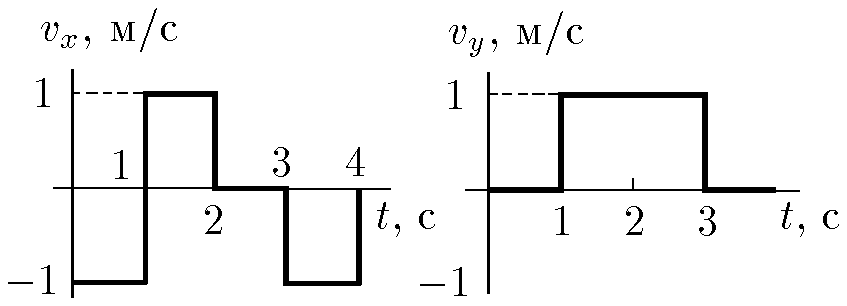
| $1.1.16.$ A particle moves in one plane. From the graphs of the time dependence of the velocity projections $v_x$ and $v_y$ plot the trajectory of the particle if $x_{(0)} = 2$ m, $y_{(0)} = 1$ m. | |||
|  | |||
| ### Solution | |||
| Taking into account the physical meaning of the area under the graph of velocity versus time, we obtain the graphs of the dependence of coordinate versus time. | |||
| 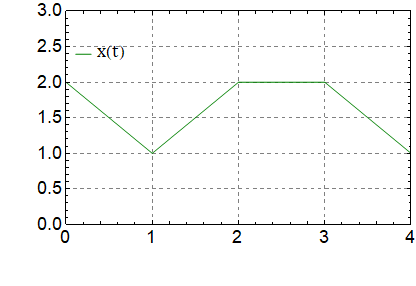 Graph of dependence $x(t)$ 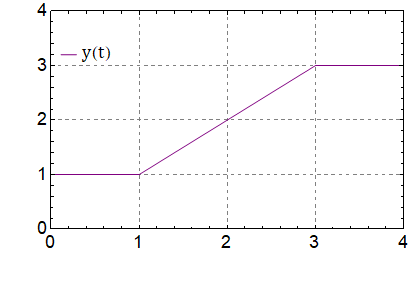 Graph of dependence $y(t)$ | |||
| @@ -12,9 +12,9 @@Solution | |||
| Overlaying the graph of the dependence of $x(t)$ and $y(t)$ on each other at the corresponding time intervals, we obtain: | |||
| − | \ | ||
| + | \( | ||
| das | |||
| − | \ | ||
| + | \) | ||
| 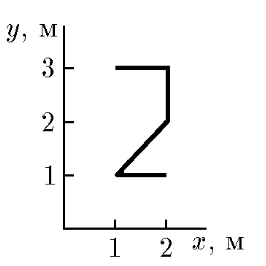 Trajectory of movement | |||
| #### Answer | |||
| See figure. | |||
| unchanged lines 3 | |||
| ### Statement | ### Statement | ||
| $1.1.16.$ A particle moves in one plane. From the graphs of the time dependence of the velocity projections $v_x$ and $v_y$ plot the trajectory of the particle if $x_{(0)} = 2$ m, $y_{(0)} = 1$ m. | $1.1.16.$ A particle moves in one plane. From the graphs of the time dependence of the velocity projections $v_x$ and $v_y$ plot the trajectory of the particle if $x_{(0)} = 2$ m, $y_{(0)} = 1$ m. | ||
|  |  | ||
| ### Solution | ### Solution | ||
| Taking into account the physical meaning of the area under the graph of velocity versus time, we obtain the graphs of the dependence of coordinate versus time. | Taking into account the physical meaning of the area under the graph of velocity versus time, we obtain the graphs of the dependence of coordinate versus time. | ||
|  Graph of dependence $x(t)$  Graph of dependence $y(t)$ |  Graph of dependence $x(t)$  Graph of dependence $y(t)$ | ||
| @@ -12,9 +12,9 @@Solution | |||
| Overlaying the graph of the dependence of $x(t)$ and $y(t)$ on each other at the corresponding time intervals, we obtain: | Overlaying the graph of the dependence of $x(t)$ and $y(t)$ on each other at the corresponding time intervals, we obtain: | ||
| \ |
\( | ||
| das | das | ||
| \ |
\) | ||
|  Trajectory of movement |  Trajectory of movement | ||
| #### Answer | #### Answer | ||
| See figure. | See figure. | ||
| unchanged lines 3 | |||