Edit to “Solution”

en/1.1.19.md
+1 −1
| ### Statement | |||
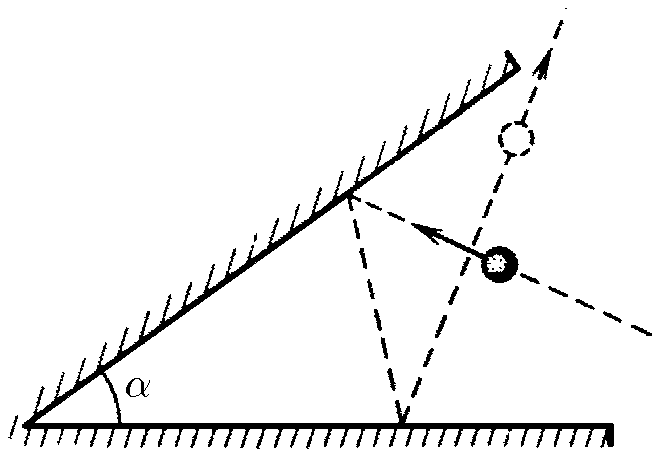
| $1.1.19.$ By what angle will the direction of velocity of the ball change after two elastic impacts on the walls, the angle between which is equal to $\alpha$? How will the ball fly if the angle $\alpha = \pi /2$? The motion occurs in a plane perpendicular to the walls. In an elastic collision with a smooth stationary wall, the angle of incidence of the ball is equal to the angle of reflection. | |||
|  | |||
| ### Solution | |||
| @@ -8,7 +8,7 @@Solution | |||
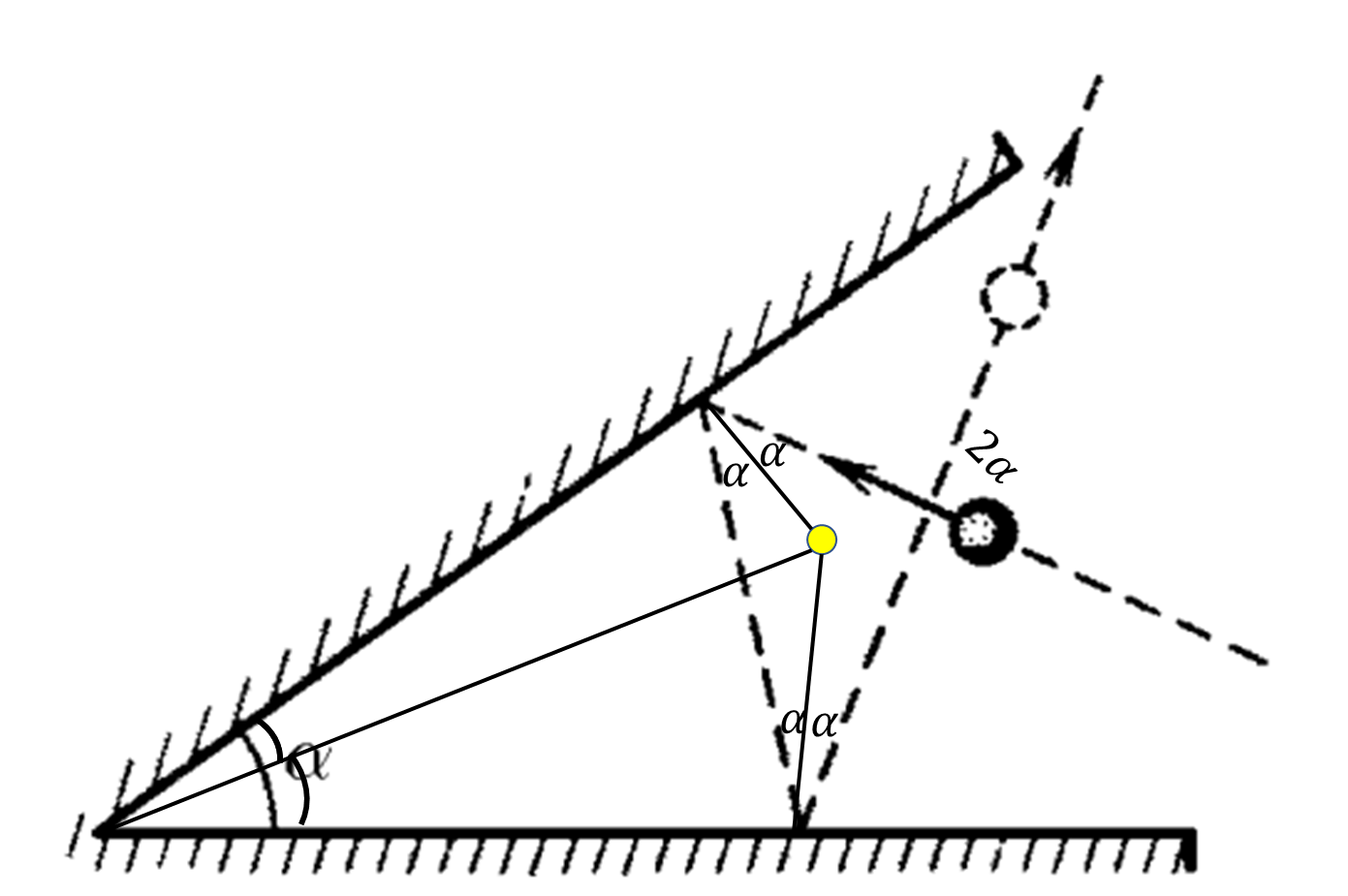
| When falling elastically on a horizontal plane, the angle of incidence is equal to the angle of reflection. | |||
| − |  | ||
| + |  | ||
| Thus, the direction of velocity of the ball after two elastic impacts will change by the angle $\beta = 2\alpha$ | |||
| When $\alpha =\pi /2$, $\beta = \pi$, i.e., the ball will fly in the opposite direction.. | |||
| #### Answer | |||
| $\beta = 2\alpha$. In the direction opposite to the initial | |||
| unchanged lines 5 | |||
| ### Statement | ### Statement | ||
| $1.1.19.$ By what angle will the direction of velocity of the ball change after two elastic impacts on the walls, the angle between which is equal to $\alpha$? How will the ball fly if the angle $\alpha = \pi /2$? The motion occurs in a plane perpendicular to the walls. In an elastic collision with a smooth stationary wall, the angle of incidence of the ball is equal to the angle of reflection. | $1.1.19.$ By what angle will the direction of velocity of the ball change after two elastic impacts on the walls, the angle between which is equal to $\alpha$? How will the ball fly if the angle $\alpha = \pi /2$? The motion occurs in a plane perpendicular to the walls. In an elastic collision with a smooth stationary wall, the angle of incidence of the ball is equal to the angle of reflection. | ||
|  |  | ||
| ### Solution | ### Solution | ||
| @@ -8,7 +8,7 @@Solution | |||
| When falling elastically on a horizontal plane, the angle of incidence is equal to the angle of reflection. | When falling elastically on a horizontal plane, the angle of incidence is equal to the angle of reflection. | ||
|  |
 | ||
| Thus, the direction of velocity of the ball after two elastic impacts will change by the angle $\beta = 2\alpha$ | Thus, the direction of velocity of the ball after two elastic impacts will change by the angle $\beta = 2\alpha$ | ||
| When $\alpha =\pi /2$, $\beta = \pi$, i.e., the ball will fly in the opposite direction.. | When $\alpha =\pi /2$, $\beta = \pi$, i.e., the ball will fly in the opposite direction.. | ||
| #### Answer | #### Answer | ||
| $\beta = 2\alpha$. In the direction opposite to the initial | $\beta = 2\alpha$. In the direction opposite to the initial | ||
| unchanged lines 5 | |||