Edit to “Solution”

en/2.1.5.md
+1 −1
| ### Statement | |||
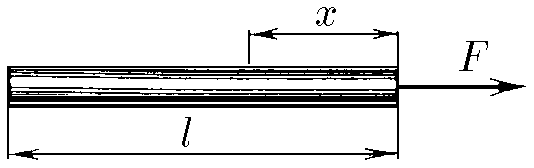
| $2.1.5.$ What force acts in the cross-section of a homogeneous rod of length $l$ at a distance $x$ from the end to which the force $F$ is applied along the rod? | |||
|  | |||
| ### Solution | |||
|  | |||
| @@ -10,7 +10,7 @@Solution | |||
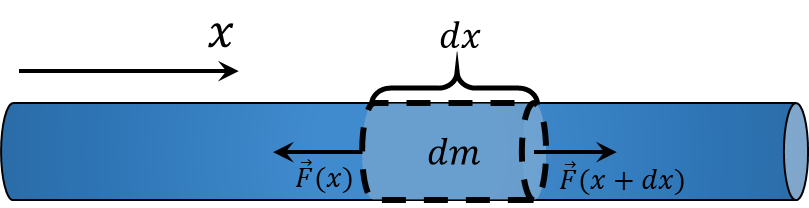
| If we consider a rod of mass $m$ as a single whole, then it will move with acceleration $$ a = \frac{F}{m} $$ Since the rod is inextensible, the acceleration of all its parts is the same and equal to $a$ | |||
| − | Let's consider a small section of the rod of length $dx$ and mass $dm$. Since the rod is homogeneous $$ dm = m \frac{dx}{l} $$ Let's write down Newton's second law for this section. $$ a\, dm = F(x+dx) - F(x) | ||
| + | Let's consider a small section of the rod of length $dx$ and mass $dm$. Since the rod is homogeneous $$ dm = m \frac{dx}{l} $$ Let's write down Newton's second law for this section. $$ a\, dm = F(x+dx) - F(x)\tag{1} $$ Where $F(x+dx)$ and $F(x)$ are the interaction forces with neighbors | ||
| Let's integrate expression $(1)$ along the horizontal coordinate $x$: $$ \int_x^l am\frac{dx}{l} = \int_x^l dF $$ $$ F(x) = ma\frac{l-x}{l} $$ $$ F(x) = \fbox{$F\left(1-\frac{x}{l}\right)$} $$ | |||
| #### Answer | |||
| $$T = F(1 − x/l)$$ | |||
| unchanged lines 3 | |||
| ### Statement | ### Statement | ||
| $2.1.5.$ What force acts in the cross-section of a homogeneous rod of length $l$ at a distance $x$ from the end to which the force $F$ is applied along the rod? | $2.1.5.$ What force acts in the cross-section of a homogeneous rod of length $l$ at a distance $x$ from the end to which the force $F$ is applied along the rod? | ||
|  |  | ||
| ### Solution | ### Solution | ||
|  |  | ||
| @@ -10,7 +10,7 @@Solution | |||
| If we consider a rod of mass $m$ as a single whole, then it will move with acceleration $$ a = \frac{F}{m} $$ Since the rod is inextensible, the acceleration of all its parts is the same and equal to $a$ | If we consider a rod of mass $m$ as a single whole, then it will move with acceleration $$ a = \frac{F}{m} $$ Since the rod is inextensible, the acceleration of all its parts is the same and equal to $a$ | ||
| Let's consider a small section of the rod of length $dx$ and mass $dm$. Since the rod is homogeneous $$ dm = m \frac{dx}{l} $$ Let's write down Newton's second law for this section. $$ a\, dm = F(x+dx) - F(x) |
Let's consider a small section of the rod of length $dx$ and mass $dm$. Since the rod is homogeneous $$ dm = m \frac{dx}{l} $$ Let's write down Newton's second law for this section. $$ a\, dm = F(x+dx) - F(x)\tag{1} $$ Where $F(x+dx)$ and $F(x)$ are the interaction forces with neighbors | ||
| Let's integrate expression $(1)$ along the horizontal coordinate $x$: $$ \int_x^l am\frac{dx}{l} = \int_x^l dF $$ $$ F(x) = ma\frac{l-x}{l} $$ $$ F(x) = \fbox{$F\left(1-\frac{x}{l}\right)$} $$ | Let's integrate expression $(1)$ along the horizontal coordinate $x$: $$ \int_x^l am\frac{dx}{l} = \int_x^l dF $$ $$ F(x) = ma\frac{l-x}{l} $$ $$ F(x) = \fbox{$F\left(1-\frac{x}{l}\right)$} $$ | ||
| #### Answer | #### Answer | ||
| $$T = F(1 − x/l)$$ | $$T = F(1 − x/l)$$ | ||
| unchanged lines 3 | |||