Edit to “Solution”

en/2.1.13.md
+1 −1
| ### Statement | |||
| $2.1.13.$ A system of three identical balls connected by identical springs is suspended on a thread. The thread is burned out. Find the acceleration of the balls immediately after burning the thread. | |||
| ### Solution | |||
| 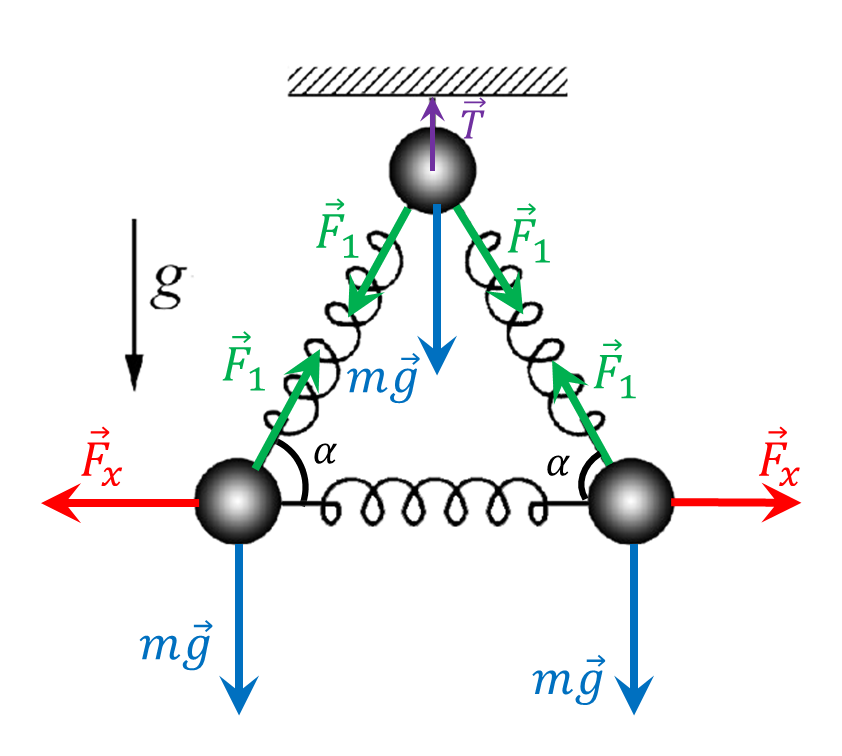 | |||
| Let's write the equilibrium condition for the two lower balls on the vertical and horizontal axes $$ \left\\{\begin{matrix} mg = F_1 \sin\alpha\\\ F_x = F_1 \cos\alpha& \end{matrix}\right. $$ where $P$ is the painter's pressure force on the chair. | |||
| And for the upper ball $$ T = mg + 2F_1 \sin\alpha$$ $$ T = 3mg $$ Accordingly, when the thread burns out, the upper ball will be acted upon downwards by a force of $T=3mg$. From Newton's second law, we find its initial acceleration as $$ a = \frac{T}{m} = 3g $$ The lower balls will be acted upon in the horizontal direction by the force $F_x$, which will be compensated by the force $F_1 \cos\alpha$, and the force of gravity $mg$ — $F_1 \sin\alpha$ | |||
| @@ -13,7 +13,7 @@Solution | |||
| Thus, the lower balls will be in zero gravity $$ a=0 $$ | |||
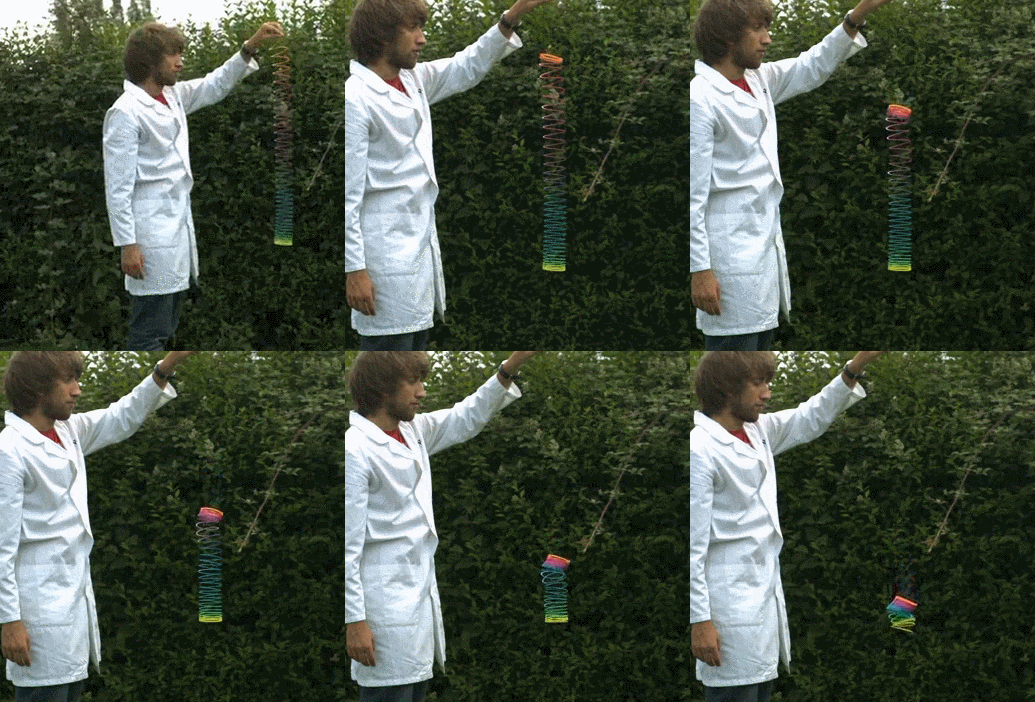
| __NO__: Something similar happens when a Slinky falls | |||
| − |  | ||
| + |  | ||
| I recommend an interesting problem about Slinky [IPhO 2019 "Springs and Slinky"](https://s3.eu-central-1.amazonaws.com/physprob.com/files/ipho/2019_Israel_p1.pdf) | |||
| #### Answer | |||
| The acceleration of the upper ball is $3g$, and the acceleration of the lower balls is zero. | |||
| unchanged lines 3 | |||
| ### Statement | ### Statement | ||
| $2.1.13.$ A system of three identical balls connected by identical springs is suspended on a thread. The thread is burned out. Find the acceleration of the balls immediately after burning the thread. | $2.1.13.$ A system of three identical balls connected by identical springs is suspended on a thread. The thread is burned out. Find the acceleration of the balls immediately after burning the thread. | ||
| ### Solution | ### Solution | ||
|  |  | ||
| Let's write the equilibrium condition for the two lower balls on the vertical and horizontal axes $$ \left\\{\begin{matrix} mg = F_1 \sin\alpha\\\ F_x = F_1 \cos\alpha& \end{matrix}\right. $$ where $P$ is the painter's pressure force on the chair. | Let's write the equilibrium condition for the two lower balls on the vertical and horizontal axes $$ \left\\{\begin{matrix} mg = F_1 \sin\alpha\\\ F_x = F_1 \cos\alpha& \end{matrix}\right. $$ where $P$ is the painter's pressure force on the chair. | ||
| And for the upper ball $$ T = mg + 2F_1 \sin\alpha$$ $$ T = 3mg $$ Accordingly, when the thread burns out, the upper ball will be acted upon downwards by a force of $T=3mg$. From Newton's second law, we find its initial acceleration as $$ a = \frac{T}{m} = 3g $$ The lower balls will be acted upon in the horizontal direction by the force $F_x$, which will be compensated by the force $F_1 \cos\alpha$, and the force of gravity $mg$ — $F_1 \sin\alpha$ | And for the upper ball $$ T = mg + 2F_1 \sin\alpha$$ $$ T = 3mg $$ Accordingly, when the thread burns out, the upper ball will be acted upon downwards by a force of $T=3mg$. From Newton's second law, we find its initial acceleration as $$ a = \frac{T}{m} = 3g $$ The lower balls will be acted upon in the horizontal direction by the force $F_x$, which will be compensated by the force $F_1 \cos\alpha$, and the force of gravity $mg$ — $F_1 \sin\alpha$ | ||
| @@ -13,7 +13,7 @@Solution | |||
| Thus, the lower balls will be in zero gravity $$ a=0 $$ | Thus, the lower balls will be in zero gravity $$ a=0 $$ | ||
| __NO__: Something similar happens when a Slinky falls | __NO__: Something similar happens when a Slinky falls | ||
|  |
 | ||
| I recommend an interesting problem about Slinky [IPhO 2019 "Springs and Slinky"](https://s3.eu-central-1.amazonaws.com/physprob.com/files/ipho/2019_Israel_p1.pdf) | I recommend an interesting problem about Slinky [IPhO 2019 "Springs and Slinky"](https://s3.eu-central-1.amazonaws.com/physprob.com/files/ipho/2019_Israel_p1.pdf) | ||
| #### Answer | #### Answer | ||
| The acceleration of the upper ball is $3g$, and the acceleration of the lower balls is zero. | The acceleration of the upper ball is $3g$, and the acceleration of the lower balls is zero. | ||
| unchanged lines 3 | |||