Edit to “Solution”

en/9.2.7.md
+1 −1
| ### Statement | |||
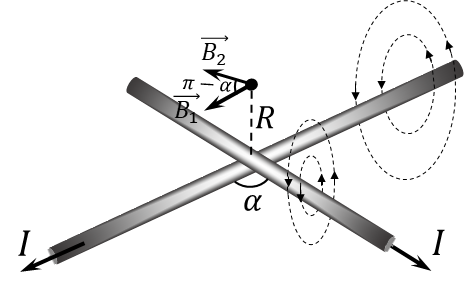
| $9.2.7.$ Long straight wires with current intersect at an angle $\alpha$. Find the magnetic field induction on a straight line passing through the point of intersection of the wires perpendicular to both of them. The current in the wires is $I$. | |||
| ### Solution | |||
| @@ -6,8 +6,8 @@Solution | |||
|  | |||
| − | We find the total vector of magnetic induction as the sum of the vectors of magnetic induction created by each of the vectors $$ \vec{B} = \vec{B_1} + \vec{B_2} | ||
| + | We find the total vector of magnetic induction as the sum of the vectors of magnetic induction created by each of the vectors $$ \vec{B} = \vec{B_1} + \vec{B_2}\tag{1} $$ According to the right-hand rule, we can determine the direction of the magnetic induction lines and notice that $\vec{B_1}$ and $\vec{B_2}$ lie in the same plane, parallel to the plane of the wires, at an angle of $\pi - \alpha$. Then, the total magnetic induction vector $\vec{B}$ from the expression $(1)$, then when adding through the cosine theorem will be an adjacent angle — $\alpha$ $$ \boxed{B=\sqrt{B_1^2+B_2^2 - 2B_1B_2\cos\alpha}}\tag{2} $$ We will find the magnetic induction of each of them as the induction of an infinite single-horned wire. $$ B_1 = B_2 = \frac{\mu_0 I}{2\pi R}\tag{3} $$ We substitute the obtained expression $(3)$ into $(2)$ and obtain the desired magnetic field induction $$ B = \frac{\mu_0 I}{2\pi R} \sqrt{2-2\cos\alpha} \Rightarrow \boxed{B = \frac{\mu_0 I}{\pi R}\sin\left(\frac{\alpha}{2}\right)} $$ | ||
| #### Answer | |||
| $$B = \frac{\mu_0 I}{\pi R}\sin\left(\frac{\alpha}{2}\right)$$ | |||
| ### Statement | ### Statement | ||
| $9.2.7.$ Long straight wires with current intersect at an angle $\alpha$. Find the magnetic field induction on a straight line passing through the point of intersection of the wires perpendicular to both of them. The current in the wires is $I$. | $9.2.7.$ Long straight wires with current intersect at an angle $\alpha$. Find the magnetic field induction on a straight line passing through the point of intersection of the wires perpendicular to both of them. The current in the wires is $I$. | ||
| ### Solution | ### Solution | ||
| @@ -6,8 +6,8 @@Solution | |||
|  |  | ||
| We find the total vector of magnetic induction as the sum of the vectors of magnetic induction created by each of the vectors $$ \vec{B} = \vec{B_1} + \vec{B_2} |
We find the total vector of magnetic induction as the sum of the vectors of magnetic induction created by each of the vectors $$ \vec{B} = \vec{B_1} + \vec{B_2}\tag{1} $$ According to the right-hand rule, we can determine the direction of the magnetic induction lines and notice that $\vec{B_1}$ and $\vec{B_2}$ lie in the same plane, parallel to the plane of the wires, at an angle of $\pi - \alpha$. Then, the total magnetic induction vector $\vec{B}$ from the expression $(1)$, then when adding through the cosine theorem will be an adjacent angle — $\alpha$ $$ \boxed{B=\sqrt{B_1^2+B_2^2 - 2B_1B_2\cos\alpha}}\tag{2} $$ We will find the magnetic induction of each of them as the induction of an infinite single-horned wire. $$ B_1 = B_2 = \frac{\mu_0 I}{2\pi R}\tag{3} $$ We substitute the obtained expression $(3)$ into $(2)$ and obtain the desired magnetic field induction $$ B = \frac{\mu_0 I}{2\pi R} \sqrt{2-2\cos\alpha} \Rightarrow \boxed{B = \frac{\mu_0 I}{\pi R}\sin\left(\frac{\alpha}{2}\right)} $$ | ||
| #### Answer | #### Answer | ||
| $$B = \frac{\mu_0 I}{\pi R}\sin\left(\frac{\alpha}{2}\right)$$ | $$B = \frac{\mu_0 I}{\pi R}\sin\left(\frac{\alpha}{2}\right)$$ | ||