Edit to “Solution”

en/2.3.44.md
+1 −1
| ### Statement | |||
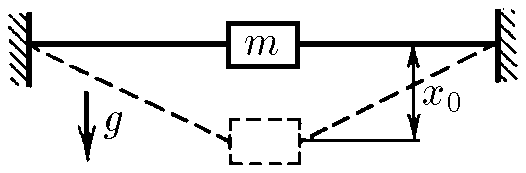
| $2.3.44.$ An unstretched rubber cord of length $2l$ is attached to the walls by its ends. A weight of mass $m$ was attached to the middle of the cord, which was then released without a push. When vibrations occur, the greatest distance to which the load is lowered is $x_0$. What is the stiffness of this cord? | |||
|  | |||
| ### Solution | |||
|  | |||
| Potential energy of the weight: | |||
| $$ | |||
| E_p = -mgx_0 | |||
| $$ | |||
| @@ -17,7 +17,7 @@Solution | |||
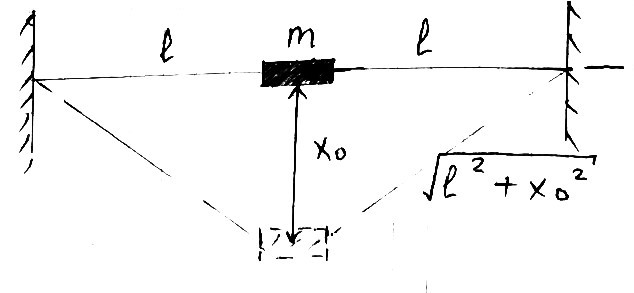
| Potential energy of rubber cord | |||
| $$ | |||
| − | E_p' = k' \frac{(\sqrt{l^2 + x_0^2} - l)^2}{2} | ||
| + | E_p' = k' \frac{\left(\sqrt{l^2 + x_0^2} - l\right)^2}{2} | ||
| $$ | |||
| From the law of conservation of energy, the total energy of the system must equal zero | |||
| $$ | |||
| E = 0 = E_p + E_p' + E_p' | |||
| $$ | |||
| It follows from the figure that the stretching of the cord is | |||
| $$ | |||
| \Delta L = \sqrt{l^2 + x_0^2} - l | |||
| $$ | |||
| Since we now consider them as separate springs, cords, we use superposition: | |||
| $$ | |||
| \frac{1}{k} = \frac{1}{k'} + \frac{1}{k'} \implies k' = 2k | |||
| $$ | |||
| From where stiffness of the cord could be found as | |||
| $$ | |||
| mgx_0 = \frac{2 \cdot 2k \cdot \left(\sqrt{l^2 + x_0^2} - l \right)^2}{2} | |||
| $$ | |||
| $$ | |||
| \boxed{k = \frac{mgx_0}{2 \cdot \left( \sqrt{l^2 + x_0^2} - l \right)^2}} | |||
| $$ | |||
| #### Answer | |||
| $$ | |||
| k = \frac{mgx_0}{2 \cdot \left( \sqrt{l^2 + x_0^2} - l \right)^2} | |||
| $$ | |||
| unchanged lines 32 | |||
| ### Statement | ### Statement | ||
| $2.3.44.$ An unstretched rubber cord of length $2l$ is attached to the walls by its ends. A weight of mass $m$ was attached to the middle of the cord, which was then released without a push. When vibrations occur, the greatest distance to which the load is lowered is $x_0$. What is the stiffness of this cord? | $2.3.44.$ An unstretched rubber cord of length $2l$ is attached to the walls by its ends. A weight of mass $m$ was attached to the middle of the cord, which was then released without a push. When vibrations occur, the greatest distance to which the load is lowered is $x_0$. What is the stiffness of this cord? | ||
|  |  | ||
| ### Solution | ### Solution | ||
|  |  | ||
| Potential energy of the weight: | Potential energy of the weight: | ||
| $$ | $$ | ||
| E_p = -mgx_0 | E_p = -mgx_0 | ||
| $$ | $$ | ||
| @@ -17,7 +17,7 @@Solution | |||
| Potential energy of rubber cord | Potential energy of rubber cord | ||
| $$ | $$ | ||
| E_p' = k' \frac{(\sqrt{l^2 + x_0^2} - l)^2}{2} | E_p' = k' \frac{\left(\sqrt{l^2 + x_0^2} - l\right)^2}{2} | ||
| $$ | $$ | ||
| From the law of conservation of energy, the total energy of the system must equal zero | From the law of conservation of energy, the total energy of the system must equal zero | ||
| $$ | $$ | ||
| E = 0 = E_p + E_p' + E_p' | E = 0 = E_p + E_p' + E_p' | ||
| $$ | $$ | ||
| It follows from the figure that the stretching of the cord is | It follows from the figure that the stretching of the cord is | ||
| $$ | $$ | ||
| \Delta L = \sqrt{l^2 + x_0^2} - l | \Delta L = \sqrt{l^2 + x_0^2} - l | ||
| $$ | $$ | ||
| Since we now consider them as separate springs, cords, we use superposition: | Since we now consider them as separate springs, cords, we use superposition: | ||
| $$ | $$ | ||
| \frac{1}{k} = \frac{1}{k'} + \frac{1}{k'} \implies k' = 2k | \frac{1}{k} = \frac{1}{k'} + \frac{1}{k'} \implies k' = 2k | ||
| $$ | $$ | ||
| From where stiffness of the cord could be found as | From where stiffness of the cord could be found as | ||
| $$ | $$ | ||
| mgx_0 = \frac{2 \cdot 2k \cdot \left(\sqrt{l^2 + x_0^2} - l \right)^2}{2} | mgx_0 = \frac{2 \cdot 2k \cdot \left(\sqrt{l^2 + x_0^2} - l \right)^2}{2} | ||
| $$ | $$ | ||
| $$ | $$ | ||
| \boxed{k = \frac{mgx_0}{2 \cdot \left( \sqrt{l^2 + x_0^2} - l \right)^2}} | \boxed{k = \frac{mgx_0}{2 \cdot \left( \sqrt{l^2 + x_0^2} - l \right)^2}} | ||
| $$ | $$ | ||
| #### Answer | #### Answer | ||
| $$ | $$ | ||
| k = \frac{mgx_0}{2 \cdot \left( \sqrt{l^2 + x_0^2} - l \right)^2} | k = \frac{mgx_0}{2 \cdot \left( \sqrt{l^2 + x_0^2} - l \right)^2} | ||
| $$ | $$ | ||
| unchanged lines 32 | |||