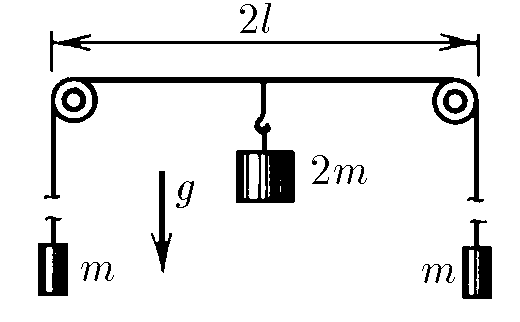
$2.4.9^*.$ At the ends of a long thread, weights of mass $m$ each are suspended. The thread is spanned over two light little blocks located at a distance of $2l$ from each other. A $2m$ weight is attached to it in the middle between the blocks, and the system starts moving. Find the speed of loads after a sufficiently long period of time has elapsed.
### Solution
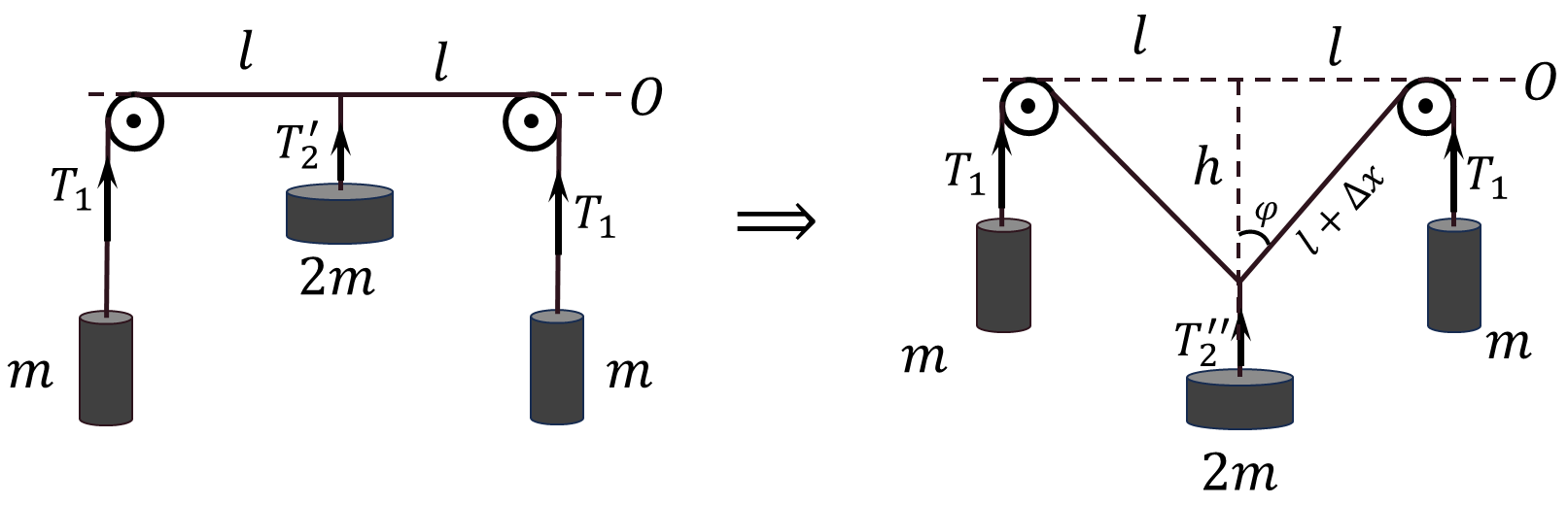
From the geometry of the drawing, a trigonometric expression can be obtained by
Over the long period of time the $2m$ weight would go down infinitely ($h\to\infty$) From $(1)$, we obtain that as $h$ increases $\tan\varphi$ decreases
$$
\tan\varphi\to 0;\quad\varphi\to 0
$$
For the small angle $\varphi$ we could use an approximation to the second order of magnitude
As they are connected by the same inextensible thread, their acceleration will be equal
$$
@@ -98,13 +98,13 @@Solution
\left|a\right|=\left|a^*\right|\Rightarrow v=v^*
$$
−
Given that the system is being run from a stationary state $(v_0=v_0^*=0)$, let's substitute into $(3)$
+
Given that the system is being run from a stationary state $(v_0=v_0^*=0)$, let's substitute into $(4)$
$$
2v^2=2g\left(h-\Delta x\right)
$$
−
Taking into consideration $(2)$
+
Taking into consideration $(3)$
$$
v^2=gl\Rightarrow\boxed{v=\sqrt{gl}}
$$
#### Answer
$$
v=\sqrt{gl}
$$
unchanged lines 7
### Statement
### Statement
$2.4.9^*.$ At the ends of a long thread, weights of mass $m$ each are suspended. The thread is spanned over two light little blocks located at a distance of $2l$ from each other. A $2m$ weight is attached to it in the middle between the blocks, and the system starts moving. Find the speed of loads after a sufficiently long period of time has elapsed.
$2.4.9^*.$ At the ends of a long thread, weights of mass $m$ each are suspended. The thread is spanned over two light little blocks located at a distance of $2l$ from each other. A $2m$ weight is attached to it in the middle between the blocks, and the system starts moving. Find the speed of loads after a sufficiently long period of time has elapsed.


### Solution
### Solution


From the geometry of the drawing, a trigonometric expression can be obtained by
From the geometry of the drawing, a trigonometric expression can be obtained by
Over the long period of time the $2m$ weight would go down infinitely ($h\to\infty$) From $(1)$, we obtain that as $h$ increases $\tan\varphi$ decreases
Over the long period of time the $2m$ weight would go down infinitely ($h\to\infty$) From $(1)$, we obtain that as $h$ increases $\tan\varphi$ decreases
$$
$$
\tan\varphi\to 0;\quad\varphi\to 0
\tan\varphi\to 0;\quad\varphi\to 0
$$
$$
For the small angle $\varphi$ we could use an approximation to the second order of magnitude
For the small angle $\varphi$ we could use an approximation to the second order of magnitude
