| ### Statement | | ### Statement |
| | | |
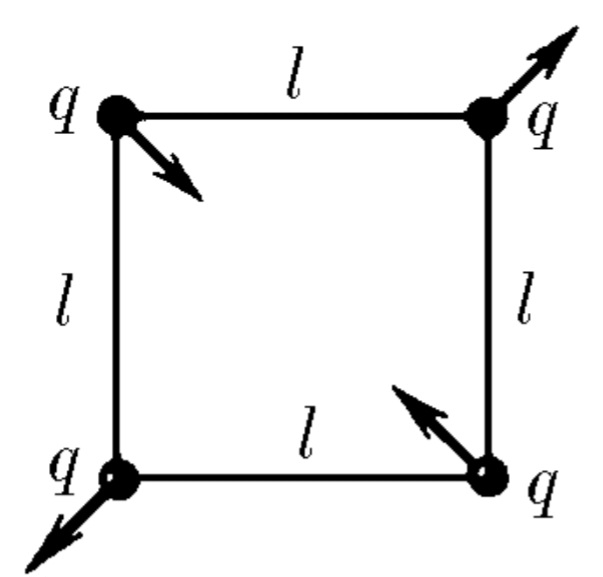
| $7.4.35.$ What is the period of small vibrations of four charged bodies connected by | | $7.4.35.$ What is the period of small vibrations of four charged bodies connected by |
| identical filaments of length l and moving as shown in the figure? Mass and | | identical filaments of length l and moving as shown in the figure? Mass and |
| charge of the body m and q. | | charge of the body m and q. |
| | | |
|  | |  |
| | | |
| | | |
| | | |
| ### Solution | | ### Solution |
| The First Way | | The First Way |
| | | |
| Force Way | | Force Way |
| | | |
| The diagonal | | The diagonal |
| $$ | | $$ |
| d=l\times\sqrt(2) | | d=l\times\sqrt(2) |
| $$ | | $$ |
| $$ | | $$ |
| d1=d-x | | d1=d-x |
| $$ | | $$ |
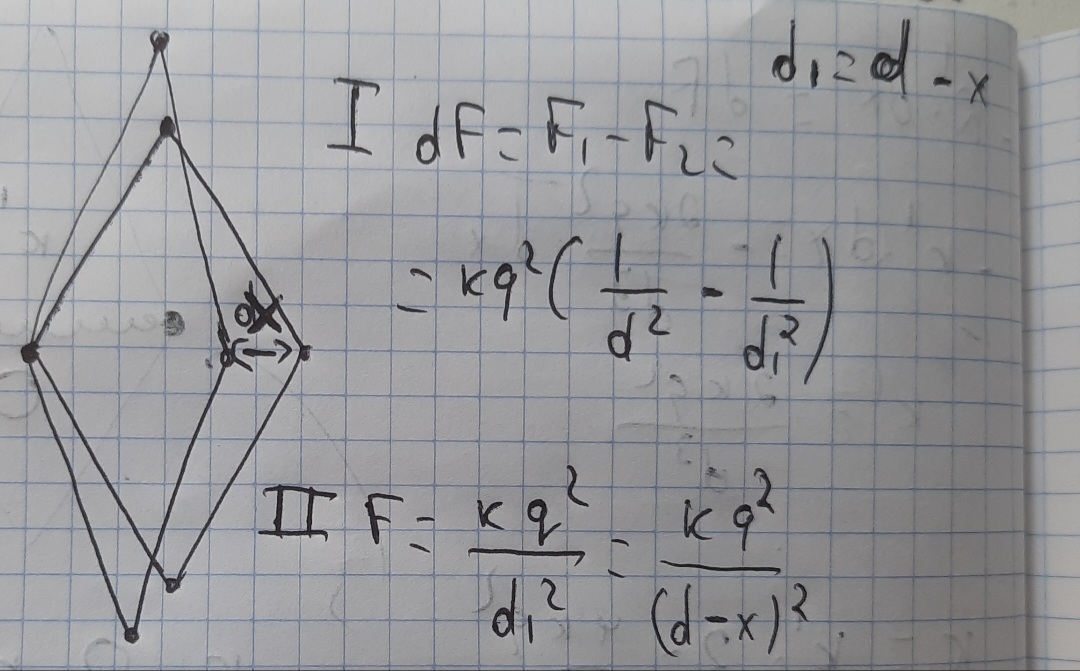
| There are 2 ways to find out difference of force | | There are 2 ways to find out difference of force |
| first | | first |
| $$ | | $$ |
| \Delta F=F2-F1=k×q×q×(1/(d×d)-1(d1×d1)) | | \Delta F=F2-F1=k×q×q×(1/(d×d)-1(d1×d1)) |
| $$ | | $$ |
| The second way | | The second way |
| $$ | | $$ |
| F=k×q×q/(d1×d1) | | F=k×q×q/(d1×d1) |
| $$ | | $$ |
| $$ | | $$ |
| dF/dx=-2k×q×q/(d-x)\wedge3 | | dF/dx=-2k×q×q/(d-x)\wedge3 |
| $$ | | $$ |
| There is picture for dF | | There is picture for dF |
|  | |  |
| | | |
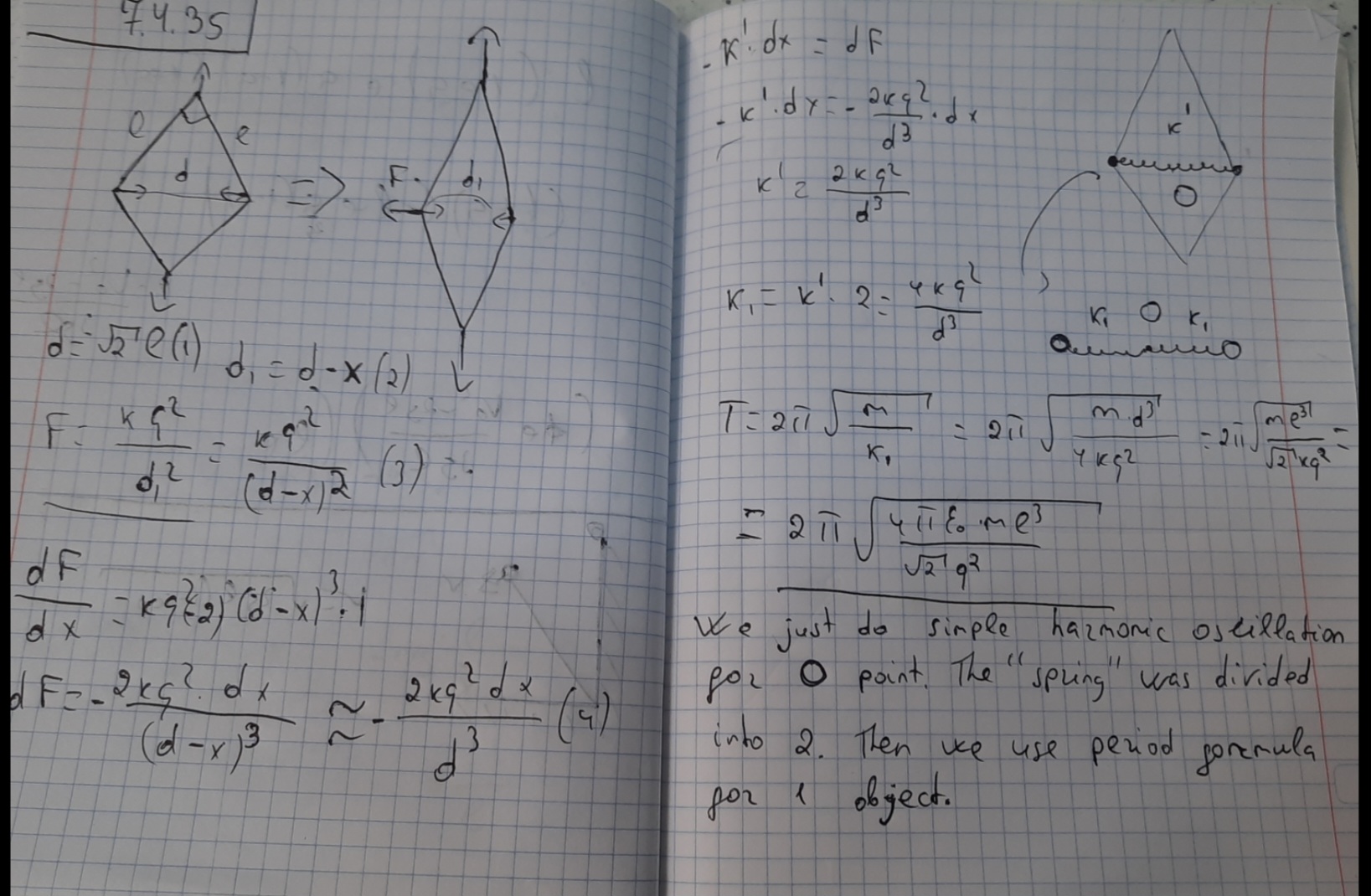
| k' is stifness of spring | | k' is stifness of spring |
| | | |
| $$ | | $$ |
| k'×dx=dF | | k'×dx=dF |
| $$ | | $$ |
| $$ | | $$ |
| k'=2×k×q×q×dx/d\wedge3 | | k'=2×k×q×q×dx/d\wedge3 |
| $$ | | $$ |
| But the spring located between 2 object.We need period one of them | | But the spring located between 2 object.We need period one of them |
| | | |
| The period formula | | The period formula |
| $$ | | $$ |
| T=2×\Pi×\sqrt(m/K) | | T=2×\Pi×\sqrt(m/K) |
| $$ | | $$ |
| But the spring is between 2 object | | But the spring is between 2 object |
| We need use half of spring | | We need use half of spring |
| so | | so |
| $$ | | $$ |
| K=k'×2 | | K=k'×2 |
| $$ | | $$ |
| The period is | | The period is |
| $$ | | $$ |
| T=2×\Pi×\sqrt(m×d\wedge3/(4×k×q×q)) | | T=2×\Pi×\sqrt(m×d\wedge3/(4×k×q×q)) |
| $$ | | $$ |
|  | |  |
| | | |
| Energy way | | Energy way |
| | | |
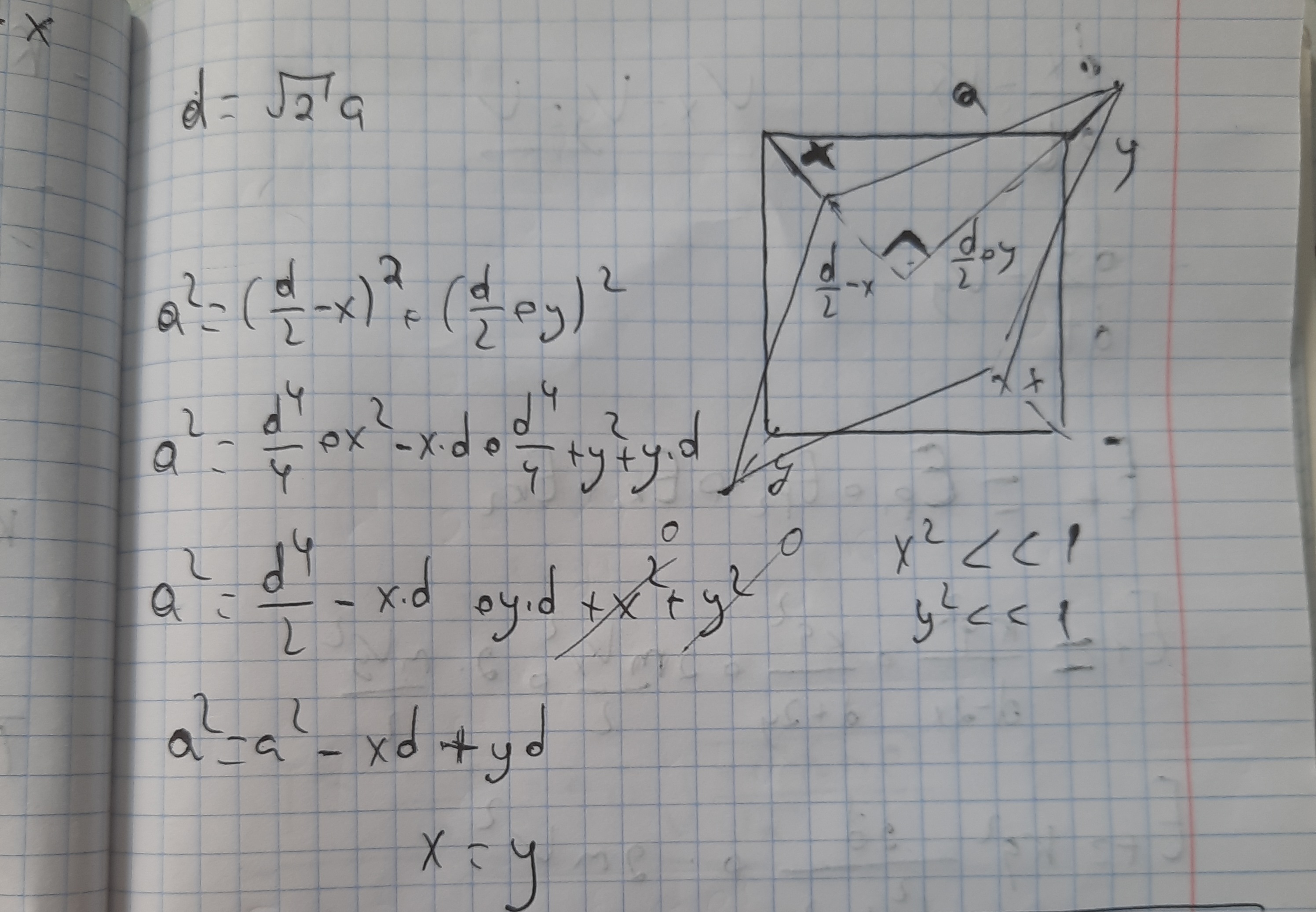
| First We need to find out relationship between elongation and sohrtening. | | First We need to find out relationship between elongation and sohrtening. |
| | | |
| The sollution | | The sollution |
|  | |  |
| | | |
| again | | again |
| | | |
| $$ | | $$ |
| d=a×\sqrt2 | | d=a×\sqrt2 |
| $$ | | $$ |
| then | | then |
| $$ | | $$ |
| a\wedge2=(d/2-x)\wedge2+(d/2+y)\wedge2 | | a\wedge2=(d/2-x)\wedge2+(d/2+y)\wedge2 |
| $$ | | $$ |
| | | |
| $$ | | $$ |
| a×a=a×a+d×y-d×x | | a×a=a×a+d×y-d×x |
| $$ | | $$ |
| so | | so |
| $$ | | $$ |
| x=y | | x=y |
| $$ | | $$ |
| $$ | | $$ |
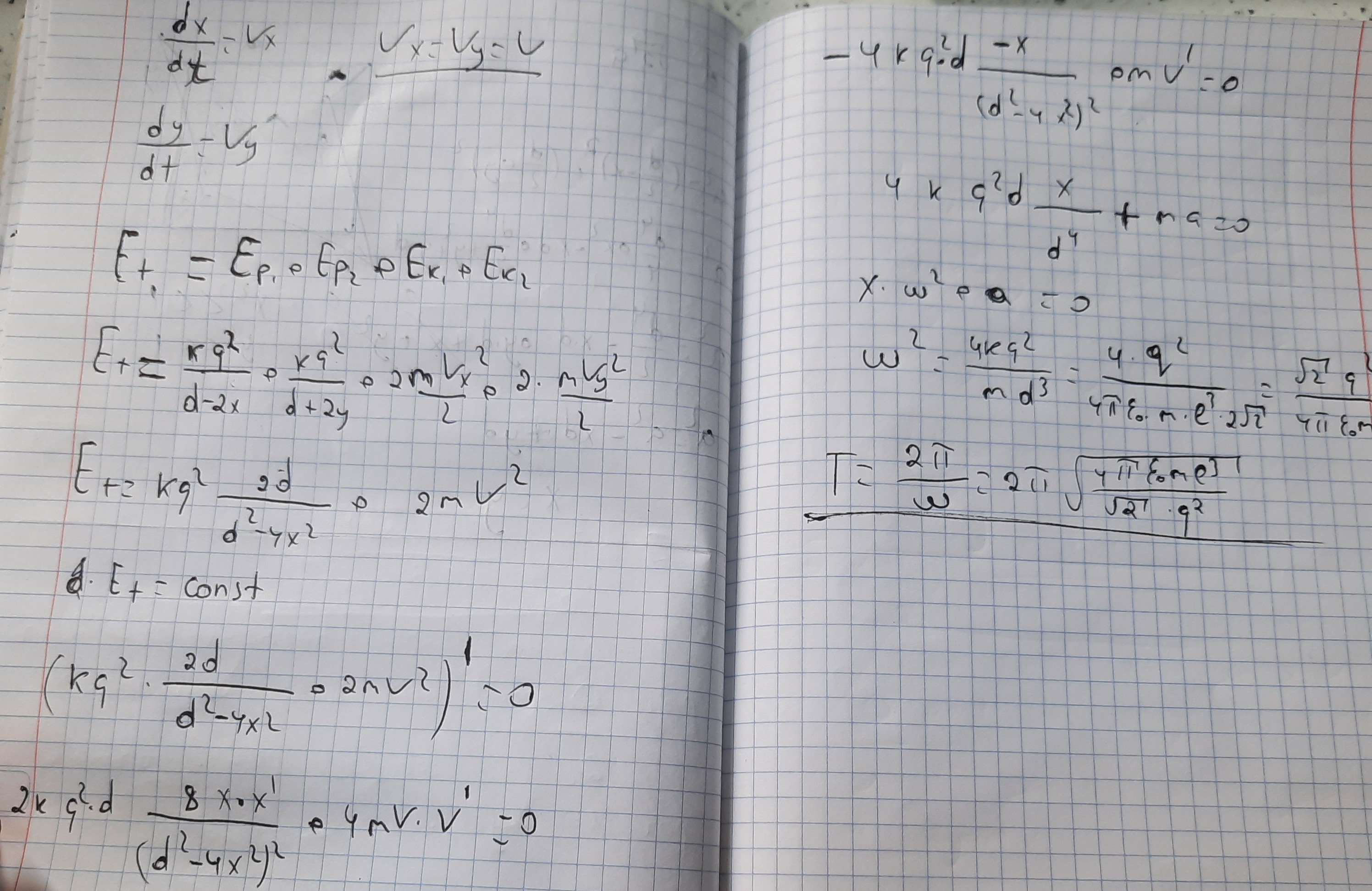
| dx/dt=Vx | | dx/dt=Vx |
| $$ | | $$ |
| $$ | | $$ |
| dy/dt=Vy | | dy/dt=Vy |
| $$ | | $$ |
|  | |  |
| $$ | | $$ |
| Vx=Vy=V | | Vx=Vy=V |
| $$ | | $$ |
| $$ | | $$ |
| Et=Ep1+Ep2+Ek1+Ek2 | | Et=Ep1+Ep2+Ek1+Ek2 |
| $$ | | $$ |
| $$ | | $$ |
| Et=k×q×q/(d-2x)+k×q×q/(+2y)+m×Vx×Vx+m×Vy×Vy | | Et=k×q×q/(d-2x)+k×q×q/(+2y)+m×Vx×Vx+m×Vy×Vy |
| $$ | | $$ |
| $$ | | $$ |
| Et=const | | Et=const |
| $$ | | $$ |
| $$ | | $$ |
| (Et)'=0 | | (Et)'=0 |
| $$ | | $$ |
| $$ | | $$ |
| 2×k×q×q×8×x×x'/(d×d-4×x×x)\wedge2+4×m×V×V'=0 | | 2×k×q×q×8×x×x'/(d×d-4×x×x)\wedge2+4×m×V×V'=0 |
| $$ | | $$ |
| $$ | | $$ |
| 4×k×q×q×x/(d×d×d)+m×a=0 | | 4×k×q×q×x/(d×d×d)+m×a=0 |
| $$ | | $$ |
| $$ | | $$ |
| \omega=\sqrt(\sqrt(2)×q×q/(4×\Pi×\varepsilon×m×l×l×l)) | | \omega=\sqrt(\sqrt(2)×q×q/(4×\Pi×\varepsilon×m×l×l×l)) |
| $$ | | $$ |
| Answer | | Answer |
| $$ | | $$ |
| T=2×\Pi/\omega | | T=2×\Pi/\omega |
| $$ | | $$ |
| $$ | | $$ |
| T=2×\Pi×\sqrt(4×\Pi×\varepsilon×m×l×l/\sqrt(2)×q×q) | | T=2×\Pi×\sqrt(4×\Pi×\varepsilon×m×l×l/\sqrt(2)×q×q) |
| $$ | | $$ |
