Edits to “Statement”, “Solution”, “Answer”

en/7.4.24.md
+5 −4
| @@ -1,14 +1,15 @@ | |||
| ### Statement | |||
| − | $24.$ | ||
| + | $7.4.24.$ Inside a smooth non-conducting sphere of mass $M$ and radius $R$, there are two identical beads of mass $m$ with charge $q$. Distance between beads $l$. Find the maximum speed of the sphere if the beads are released. | ||
| ### Solution | |||
| − | [Your solution should be placed here] | ||
| + | 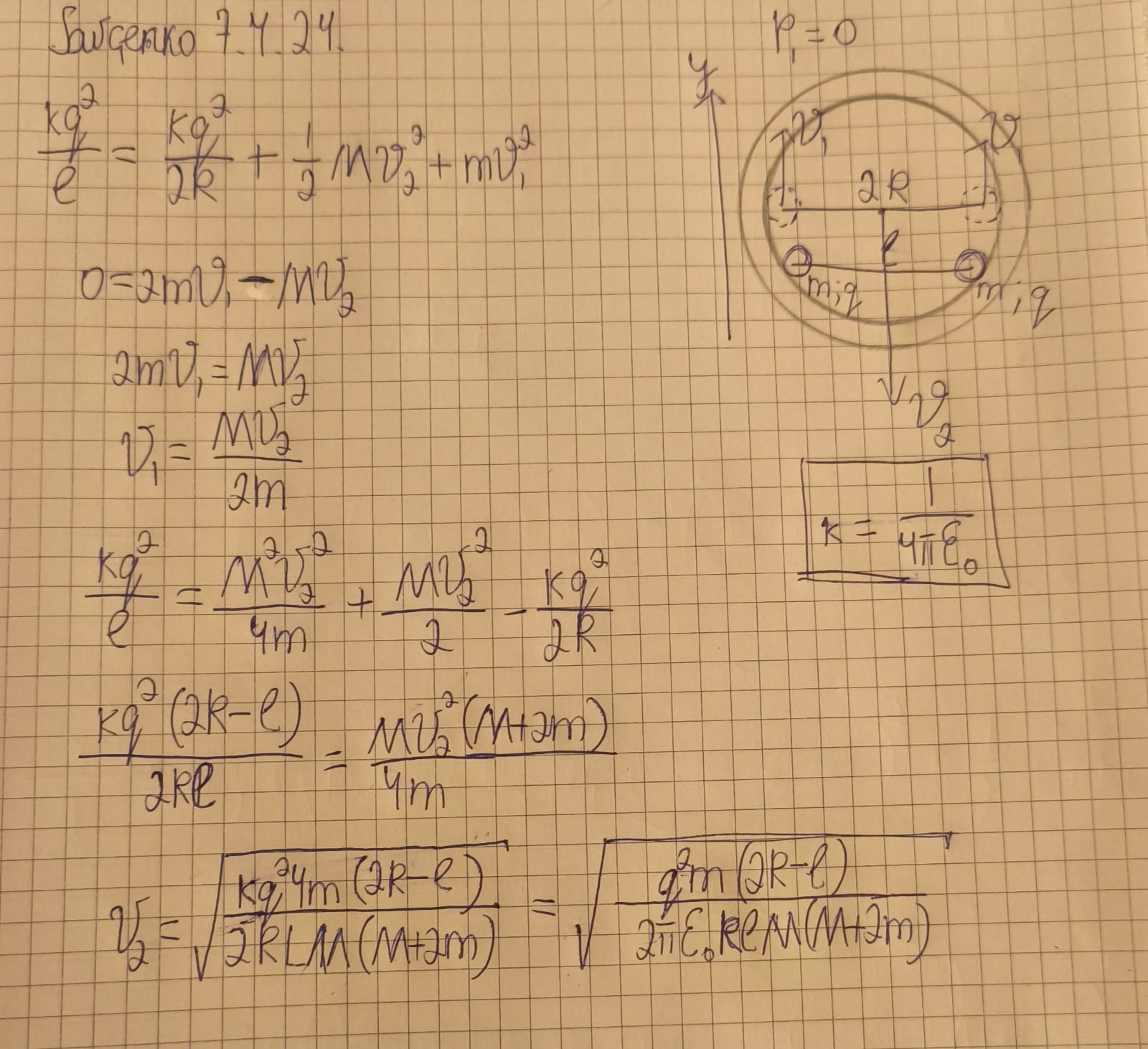 | ||
| − | |||
| #### Answer | |||
| − | [Insert a concise answer or boxed result] | ||
| + | $$ | ||
| + | v=\sqrt{q^2m(2R-l)/[2\pi\varepsilon_0RlM(M+2m)]} | ||
| + | $$ | ||
| @@ -1,14 +1,15 @@ | |||
| ### Statement | ### Statement | ||
| $24.$ | $7.4.24.$ Inside a smooth non-conducting sphere of mass $M$ and radius $R$, there are two identical beads of mass $m$ with charge $q$. Distance between beads $l$. Find the maximum speed of the sphere if the beads are released. | ||
| ### Solution | ### Solution | ||
| [Your solution should be placed here] | |||
|  | |||
| #### Answer | #### Answer | ||
| [Insert a concise answer or boxed result] | $$ | ||
| v=\sqrt{q^2m(2R-l)/[2\pi\varepsilon_0RlM(M+2m)]} | |||
| $$ | |||