Edits to “Statement”, “Solution”, “Answer”

en/13.3.16.md
+7 −3
| @@ -1,11 +1,15 @@ | |||
| ### Statement | |||
| − | $16.$ | ||
| + | $13.3.16.$ The tip of a cone with an angle of $2\alpha$ is viewed through a lens with a focal length $f$ located at a distance a from the tip of the cone $(a < f)$. How is the angle of the cone visible through the lens? The axis of the lens passes through the axis of symmetry of the cone. | ||
| ### Solution | |||
| − | [Your solution should be placed here] | ||
| + | 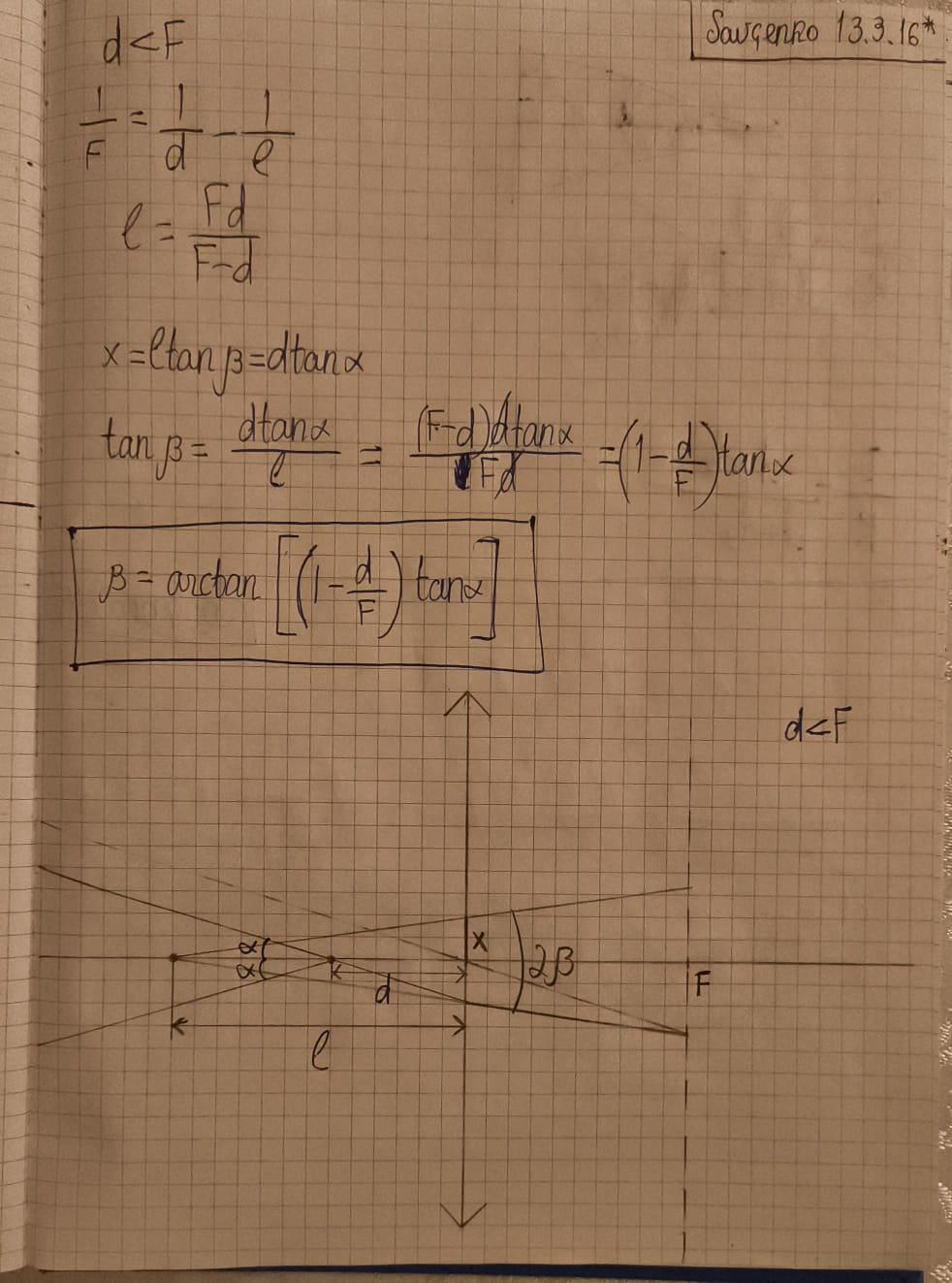 | ||
| + | |||
| + | |||
| #### Answer | |||
| − | [Insert a concise answer or boxed result] | ||
| + | $$ | ||
| + | \operatorname{tg}\alpha^{\prime}=(1-\alpha/f)\operatorname{tg}\alpha. | ||
| + | $$ | ||
| @@ -1,11 +1,15 @@ | |||
| ### Statement | ### Statement | ||
| $16.$ | $13.3.16.$ The tip of a cone with an angle of $2\alpha$ is viewed through a lens with a focal length $f$ located at a distance a from the tip of the cone $(a < f)$. How is the angle of the cone visible through the lens? The axis of the lens passes through the axis of symmetry of the cone. | ||
| ### Solution | ### Solution | ||
| [Your solution should be placed here] | |||
|  | |||
| #### Answer | #### Answer | ||
| [Insert a concise answer or boxed result] | $$ | ||
| \operatorname{tg}\alpha^{\prime}=(1-\alpha/f)\operatorname{tg}\alpha. | |||
| $$ | |||