Edit to “Solution”

en/7.4.38.md
+1 −1
| ### Statement | |||
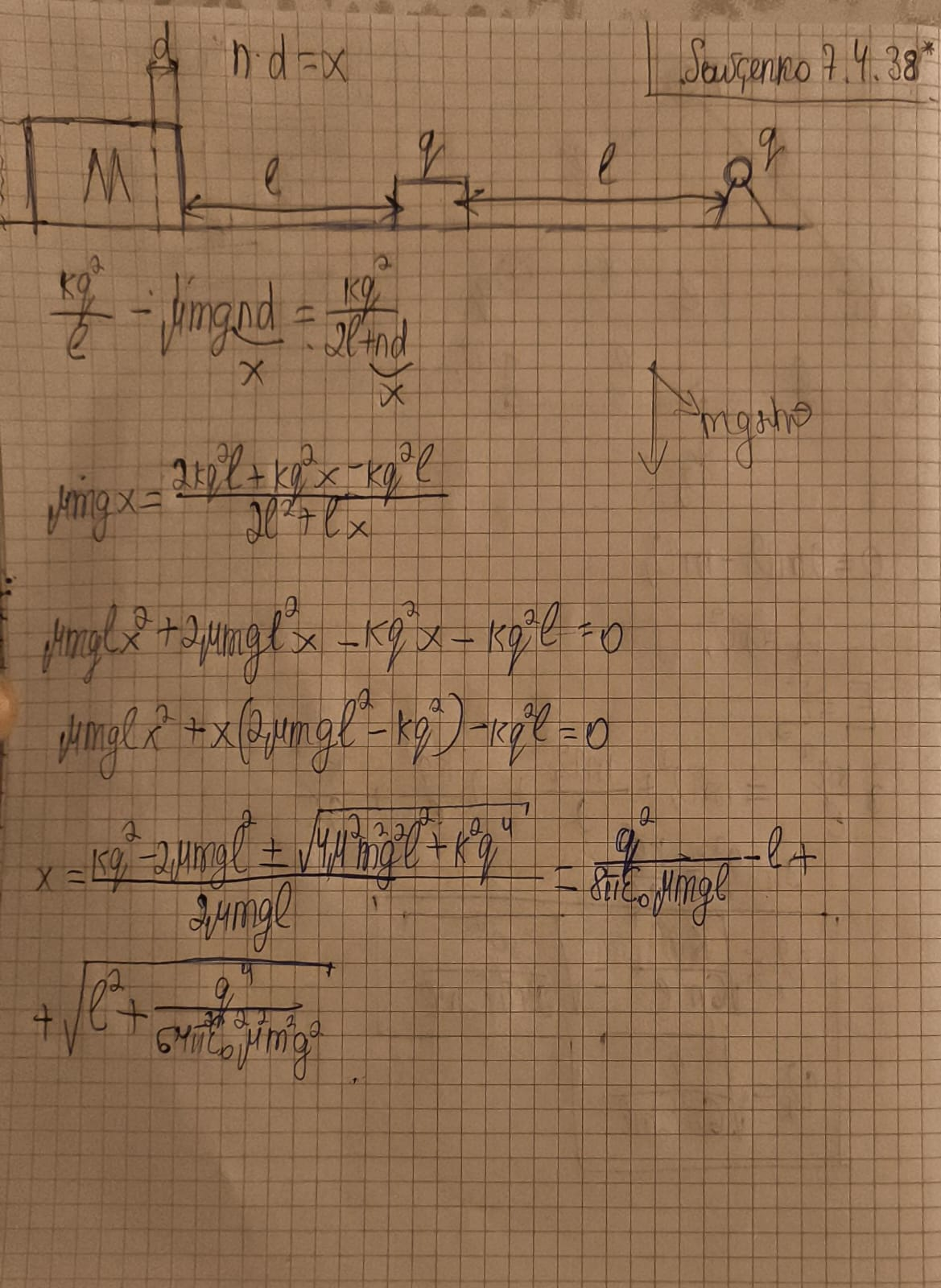
| $7.4.38^*.$ The body is held on the table by the charge $q$. To the right of it, at a distance $l$, a point charge of the same name $q$ is attached. On the left, at the same distance, rests a bar of mass $M$, which has a coefficient of friction $\mu$ with the table. The body is released, and it begins to slide without friction on the table, elastically hitting the bar, without transferring its charge to it when hitting it. How far will the bar move as a result of all body impacts? | |||
| @@ -6,7 +6,7 @@Statement | |||
| ### Solution | |||
| − |  | ||
| #### Answer | |||
| $$ | |||
| x=\sqrt{l^2+l_0^2}-l+l_0,\mathrm{~where~}l_0=q^2/(8\pi\varepsilon_0\mu Mg). | |||
| $$ | |||
| unchanged lines 3 | |||
| ### Statement | ### Statement | ||
| $7.4.38^*.$ The body is held on the table by the charge $q$. To the right of it, at a distance $l$, a point charge of the same name $q$ is attached. On the left, at the same distance, rests a bar of mass $M$, which has a coefficient of friction $\mu$ with the table. The body is released, and it begins to slide without friction on the table, elastically hitting the bar, without transferring its charge to it when hitting it. How far will the bar move as a result of all body impacts? | $7.4.38^*.$ The body is held on the table by the charge $q$. To the right of it, at a distance $l$, a point charge of the same name $q$ is attached. On the left, at the same distance, rests a bar of mass $M$, which has a coefficient of friction $\mu$ with the table. The body is released, and it begins to slide without friction on the table, elastically hitting the bar, without transferring its charge to it when hitting it. How far will the bar move as a result of all body impacts? | ||
| @@ -6,7 +6,7 @@Statement | |||
| ### Solution | ### Solution | ||
|  | ||
| #### Answer | #### Answer | ||
| $$ | $$ | ||
| x=\sqrt{l^2+l_0^2}-l+l_0,\mathrm{~where~}l_0=q^2/(8\pi\varepsilon_0\mu Mg). | x=\sqrt{l^2+l_0^2}-l+l_0,\mathrm{~where~}l_0=q^2/(8\pi\varepsilon_0\mu Mg). | ||
| $$ | $$ | ||
| unchanged lines 3 | |||