Edit to “Solution”
en/4.1.13.md
+1 −97
| ### Statement | |||
| $4.1.13^*$ A cube of side $a$, made of a material of density $\rho$, is found on container's bottom that forms an angle $\alpha$ with the horizon. Find the force which the cube acts over bottom, if a liquid of density $\rho_0$ fills the container. The superior side of cube is at distance $h$ from the liquid's surface. Between the container's bottom and the cube there is no liquid. The atmospheric pressure is $P$ and the acceleration due to gravity is $g$. | |||
| 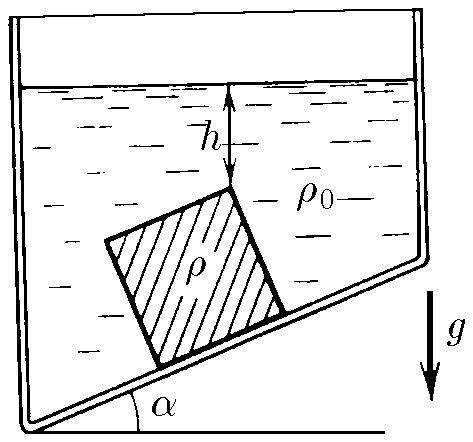 | |||
| @@ -6,100 +6,4 @@Statement | |||
| ### Solution | |||
| − | Let's define the $y$-axis perpendicular to bottom and the $x$-axis parallel to it. At $y$-axis there is no buoyancy force because between bottom and the cube there is no liquid. | ||
| − | |||
| − | 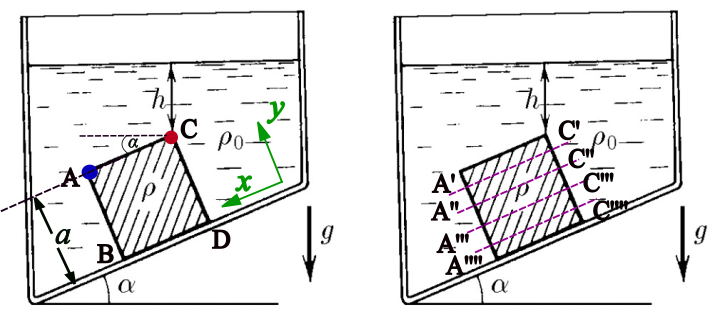 | ||
| − | |||
| − | |||
| − | |||
| − | $$ | ||
| − | P_A = P + \rho_0 g(h+a\sin{\alpha}) | ||
| − | $$ | ||
| − | |||
| − | $$ | ||
| − | P_C = P + \rho_0 gh | ||
| − | $$ | ||
| − | |||
| − | If both equations are rested, | ||
| − | |||
| − | $$ | ||
| − | P_A-P_C = \rho ga\sin{\alpha} \tag{1} | ||
| − | $$ | ||
| − | |||
| − | Note that difference of pressures between any point over side $AB$ and any point over $CD$ is expressed by $(1)$ (for any two points at same $y$ and at $a$ distance one from the other). If $(1)$ is multiplied by the side area $a^2$, buoyancy force can be found for $x$-axis | ||
| − | |||
| − | $$ | ||
| − | F_x = \rho g a^3 \sin{\alpha} \tag{2} | ||
| − | $$ | ||
| − | |||
| − | Applying Newton's Second Law for $x$-axis, also considering friction force | ||
| − | |||
| − | $$ | ||
| − | mg\sin{\alpha} = f_r + F_x | ||
| − | $$ | ||
| − | |||
| − | As $m = \rho a^3$ and according $(2)$ | ||
| − | |||
| − | $$ | ||
| − | \boxed{f_r = a^3 g (\rho -\rho_0)\sin{\alpha}} | ||
| − | $$ | ||
| − | |||
| − | This force is "felt" by bottom in opposed direction of $x$-axis. Now, pressure force $F_p$ which acts in $y$-axis, generated by above water mass and the atmospher, must be found. | ||
| − | |||
| − | 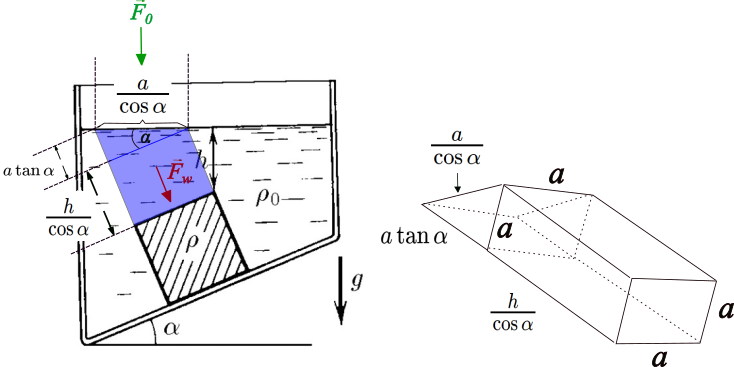 | ||
| − | |||
| − | Atmospheric-pressure force is | ||
| − | |||
| − | $$ | ||
| − | F_0 = \frac{Pa^2}{\cos{\alpha}} | ||
| − | $$ | ||
| − | |||
| − | but the cube doesn't "feel" that force, else a component of it ($F_{0y}$). | ||
| − | |||
| − | $$ | ||
| − | F_{0y} = F_0\cos{\alpha} = Pa^2 \tag{3} | ||
| − | $$ | ||
| − | |||
| − | The pressure exerted by water mass is | ||
| − | |||
| − | $$ | ||
| − | F_w = m_w g \cos{\alpha} = \rho_0 V_w g \cos{\alpha} \tag{4} | ||
| − | $$ | ||
| − | |||
| − | This volume of water $V_w$ is | ||
| − | |||
| − | $$ | ||
| − | V_w = \frac{a^2h}{\cos{\alpha}} + \frac{a^3\tan{\alpha}}{2} \tag{5} | ||
| − | $$ | ||
| − | |||
| − | Putting $(5)$ into $(4)$ | ||
| − | |||
| − | $$ | ||
| − | F_w = \rho_0 g a^3\left(\frac{h}{a}+\frac{\sin{\alpha}}{2}\right) \tag{6} | ||
| − | $$ | ||
| − | |||
| − | The pressure force over superior side of cube is | ||
| − | |||
| − | $$ | ||
| − | F_p = F_{0y} + F_w \tag{7} | ||
| − | $$ | ||
| − | |||
| − | Substituting $(3)$ and $(6)$ into $(7)$ | ||
| − | |||
| − | $$ | ||
| − | F_p = Pa^2 + \rho_0 g a^3\left(\frac{h}{a}+\frac{\sin{\alpha}}{2}\right) \tag{8} | ||
| − | $$ | ||
| − | |||
| − | Applying Newton Second Law for $y$-axis | ||
| − | |||
| − | $$ | ||
| − | N = mg\cos{\alpha}+F_p = \rho a^3g\cos{\alpha}+F_p \tag{9} | ||
| − | $$ | ||
| − | |||
| − | and according to $(8)$ | ||
| − | |||
| − | $$ | ||
| − | \boxed{N = a^3\rho_0 g \left(\frac{\rho}{\rho_0}\cos{\alpha}+\frac{1}{2}\sin{\alpha}+\frac{h}{a}\right)+Pa^2} | ||
| − | $$ | ||
| − | |||
| − | This normal force is directed in opposed direction of $y$-axis. Friction force $f_r$ is the parallel reaction force $F_{||}$ and normal force is the perpendicular one $F_{\perp}$. | ||
| + | force is 0. stupid find the answer yourself | ||
| ### Statement | ### Statement | ||
| $4.1.13^*$ A cube of side $a$, made of a material of density $\rho$, is found on container's bottom that forms an angle $\alpha$ with the horizon. Find the force which the cube acts over bottom, if a liquid of density $\rho_0$ fills the container. The superior side of cube is at distance $h$ from the liquid's surface. Between the container's bottom and the cube there is no liquid. The atmospheric pressure is $P$ and the acceleration due to gravity is $g$. | $4.1.13^*$ A cube of side $a$, made of a material of density $\rho$, is found on container's bottom that forms an angle $\alpha$ with the horizon. Find the force which the cube acts over bottom, if a liquid of density $\rho_0$ fills the container. The superior side of cube is at distance $h$ from the liquid's surface. Between the container's bottom and the cube there is no liquid. The atmospheric pressure is $P$ and the acceleration due to gravity is $g$. | ||
|  |  | ||
| @@ -6,100 +6,4 @@Statement | |||
| ### Solution | ### Solution | ||
| Let's define the $y$-axis perpendicular to bottom and the $x$-axis parallel to it. At $y$-axis there is no buoyancy force because between bottom and the cube there is no liquid. | force is 0. stupid find the answer yourself | ||
|  | |||
| $$ | |||
| P_A = P + \rho_0 g(h+a\sin{\alpha}) | |||
| $$ | |||
| $$ | |||
| P_C = P + \rho_0 gh | |||
| $$ | |||
| If both equations are rested, | |||
| $$ | |||
| P_A-P_C = \rho ga\sin{\alpha} \tag{1} | |||
| $$ | |||
| Note that difference of pressures between any point over side $AB$ and any point over $CD$ is expressed by $(1)$ (for any two points at same $y$ and at $a$ distance one from the other). If $(1)$ is multiplied by the side area $a^2$, buoyancy force can be found for $x$-axis | |||
| $$ | |||
| F_x = \rho g a^3 \sin{\alpha} \tag{2} | |||
| $$ | |||
| Applying Newton's Second Law for $x$-axis, also considering friction force | |||
| $$ | |||
| mg\sin{\alpha} = f_r + F_x | |||
| $$ | |||
| As $m = \rho a^3$ and according $(2)$ | |||
| $$ | |||
| \boxed{f_r = a^3 g (\rho -\rho_0)\sin{\alpha}} | |||
| $$ | |||
| This force is "felt" by bottom in opposed direction of $x$-axis. Now, pressure force $F_p$ which acts in $y$-axis, generated by above water mass and the atmospher, must be found. | |||
|  | |||
| Atmospheric-pressure force is | |||
| $$ | |||
| F_0 = \frac{Pa^2}{\cos{\alpha}} | |||
| $$ | |||
| but the cube doesn't "feel" that force, else a component of it ($F_{0y}$). | |||
| $$ | |||
| F_{0y} = F_0\cos{\alpha} = Pa^2 \tag{3} | |||
| $$ | |||
| The pressure exerted by water mass is | |||
| $$ | |||
| F_w = m_w g \cos{\alpha} = \rho_0 V_w g \cos{\alpha} \tag{4} | |||
| $$ | |||
| This volume of water $V_w$ is | |||
| $$ | |||
| V_w = \frac{a^2h}{\cos{\alpha}} + \frac{a^3\tan{\alpha}}{2} \tag{5} | |||
| $$ | |||
| Putting $(5)$ into $(4)$ | |||
| $$ | |||
| F_w = \rho_0 g a^3\left(\frac{h}{a}+\frac{\sin{\alpha}}{2}\right) \tag{6} | |||
| $$ | |||
| The pressure force over superior side of cube is | |||
| $$ | |||
| F_p = F_{0y} + F_w \tag{7} | |||
| $$ | |||
| Substituting $(3)$ and $(6)$ into $(7)$ | |||
| $$ | |||
| F_p = Pa^2 + \rho_0 g a^3\left(\frac{h}{a}+\frac{\sin{\alpha}}{2}\right) \tag{8} | |||
| $$ | |||
| Applying Newton Second Law for $y$-axis | |||
| $$ | |||
| N = mg\cos{\alpha}+F_p = \rho a^3g\cos{\alpha}+F_p \tag{9} | |||
| $$ | |||
| and according to $(8)$ | |||
| $$ | |||
| \boxed{N = a^3\rho_0 g \left(\frac{\rho}{\rho_0}\cos{\alpha}+\frac{1}{2}\sin{\alpha}+\frac{h}{a}\right)+Pa^2} | |||
| $$ | |||
| This normal force is directed in opposed direction of $y$-axis. Friction force $f_r$ is the parallel reaction force $F_{||}$ and normal force is the perpendicular one $F_{\perp}$. | |||