Statement
2.7.6. A thin-walled cylinder of radius $R$ $\omega$ $\mu$
Solution
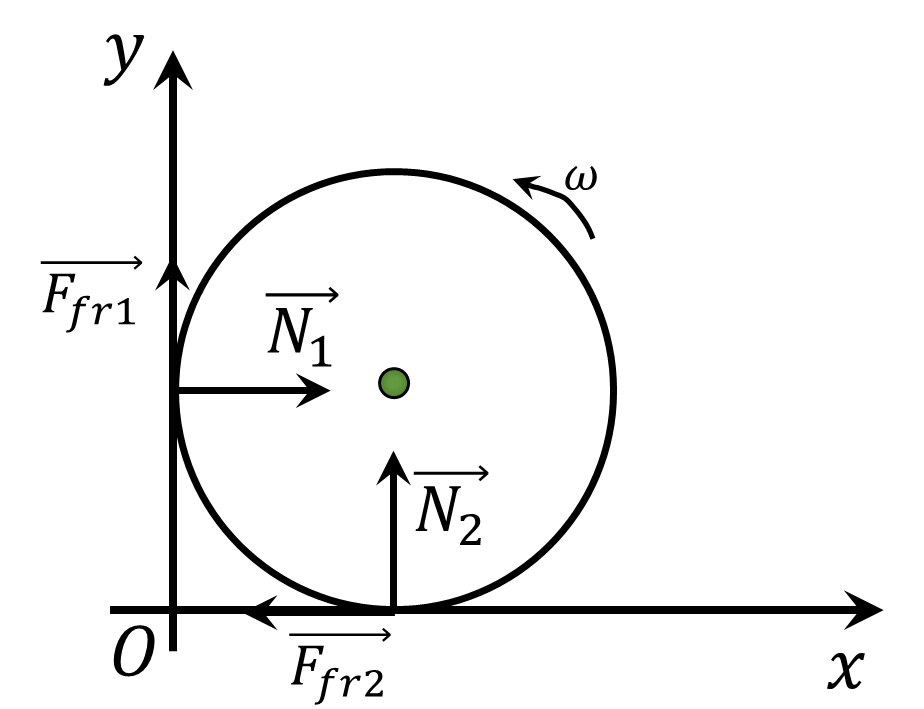
Forces acting on the cylinder
Conditions of equilibrium:
$$\left\{\begin{matrix} O'X\text{: }F_{fr2} = N_1 \\ O'Y\text{: }F_{fr1}+N_2 = mg \\ \end{matrix}\right.$$
From where
$$\left\{\begin{matrix} \mu N_2=N_1 \\ \mu N_1+N_2=mg \\ \end{matrix}\right.$$
Let's find friction force
$$F_{fr}=F_{fr1}+F_{fr2}$$
$$F_{fr}=\mu (N_1+N_2)=\mu N_2(1+\mu )$$
Considering, $mg = N_2(1+\mu^2)$
$$N=\frac{mg}{1+\mu^2}$$
According to rotational motion dynamics, the sum of moments of external forces can be written as
$$M=I\varepsilon = mR^2=F_{fr} R$$
From where, absolute value of angular acceleration is found as
$$\varepsilon = \frac{M}{I} = \frac{F_{fr}}{mR}$$
$$\varepsilon = \frac{\mu (1+\mu )N_2 }{mR}$$
$$\varepsilon = \frac{\mu (1+\mu )}{1+\mu^2} \frac{g}{R}$$
The angle by which the cylinder will rotate to the moment of total stop is
$$\varphi=\frac{\omega^2t}{2\varepsilon }$$
Until the total stop, the cylinder will make $N$
$$\varphi=2\pi N$$
From where
$$N=\frac{\omega^2t}{4\pi\varepsilon }$$
$$\boxed{N=\frac{1+\mu^{2}}{4\pi\mu (1+\mu )}\frac{\omega^{2}R}{g}}$$
Answer
$$N=\omega^{2}R(1+\mu^{2})/[4\pi g\mu (1+\mu )]$$