Edit to “Solution”
en/2.7.6.md
+1 −1
| ### Statement | |||
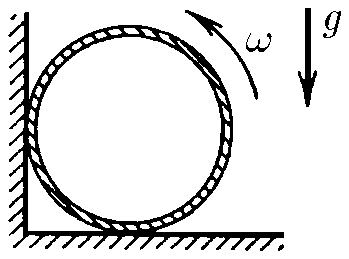
| $2.7.6.$ A thin-walled cylinder of radius $R$ was spun up to an angular velocity $\omega$ and placed in a corner, as shown in the figure. The coefficient of friction between the corner walls and the cylinder is $\mu$. How many revolutions will the cylinder make before it comes to a complete stop? | |||
|  | |||
| ### Solution | |||
| 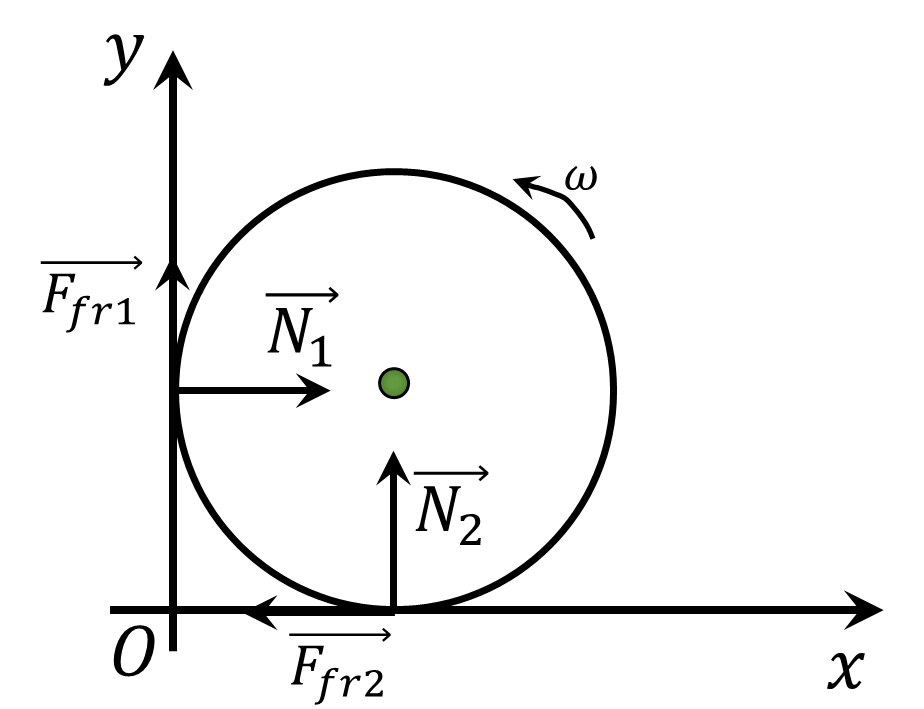 | |||
| Conditions of equilibrium: | |||
| $$ | |||
| \left\\{\begin{matrix} O'X\text{: }F_{fr2} = N_1 \\\ O'Y\text{: }F_{fr1}+N_2 = mg \\\ \end{matrix}\right. | |||
| $$ | |||
| From where | |||
| $$ | |||
| \left\\{\begin{matrix} \mu N_2=N_1 \\\ \mu N_1+N_2=mg \\\ \end{matrix}\right. | |||
| $$ | |||
| Let's find friction force | |||
| $$ | |||
| F_{fr}=F_{fr1}+F_{fr2} | |||
| $$ | |||
| $$ | |||
| F_{fr}=\mu (N_1+N_2)=\mu N_2(1+\mu ) | |||
| $$ | |||
| Considering, $mg = N_2(1+\mu^2)$: | |||
| $$ | |||
| N=\frac{mg}{1+\mu^2} | |||
| $$ | |||
| @@ -39,7 +39,7 @@Solution | |||
| According to rotational motion dynamics, the sum of moments of external forces can be written as | |||
| $$ | |||
| − | M=I\varepsilon = mR^2=F_{fr} R | ||
| + | M=I\varepsilon = mR^2\varepsilon=F_{fr} R | ||
| $$ | |||
| From where, absolute value of angular acceleration is found as | |||
| $$ | |||
| \varepsilon = \frac{M}{I} = \frac{F_{fr}}{mR} | |||
| $$ | |||
| $$ | |||
| \varepsilon = \frac{\mu (1+\mu )N_2 }{mR} | |||
| $$ | |||
| $$ | |||
| \varepsilon = \frac{\mu (1+\mu )}{1+\mu^2} \frac{g}{R} | |||
| $$ | |||
| The angle by which the cylinder will rotate to the moment of total stop is | |||
| $$ | |||
| \varphi=\frac{\omega^2t}{2\varepsilon } | |||
| $$ | |||
| Until the total stop, the cylinder will make $N$ total turnovers | |||
| $$ | |||
| \varphi=2\pi N | |||
| $$ | |||
| From where | |||
| $$ | |||
| N=\frac{\omega^2t}{4\pi\varepsilon } | |||
| $$ | |||
| $$ | |||
| \boxed{N=\frac{1+\mu^{2}}{4\pi\mu (1+\mu )}\frac{\omega^{2}R}{g}} | |||
| $$ | |||
| #### Answer | |||
| $$ | |||
| N=\omega^{2}R(1+\mu^{2})/[4\pi g\mu (1+\mu )] | |||
| $$ | |||
| unchanged lines 40 | |||
| ### Statement | ### Statement | ||
| $2.7.6.$ A thin-walled cylinder of radius $R$ was spun up to an angular velocity $\omega$ and placed in a corner, as shown in the figure. The coefficient of friction between the corner walls and the cylinder is $\mu$. How many revolutions will the cylinder make before it comes to a complete stop? | $2.7.6.$ A thin-walled cylinder of radius $R$ was spun up to an angular velocity $\omega$ and placed in a corner, as shown in the figure. The coefficient of friction between the corner walls and the cylinder is $\mu$. How many revolutions will the cylinder make before it comes to a complete stop? | ||
|  |  | ||
| ### Solution | ### Solution | ||
|  |  | ||
| Conditions of equilibrium: | Conditions of equilibrium: | ||
| $$ | $$ | ||
| \left\\{\begin{matrix} O'X\text{: }F_{fr2} = N_1 \\\ O'Y\text{: }F_{fr1}+N_2 = mg \\\ \end{matrix}\right. | \left\\{\begin{matrix} O'X\text{: }F_{fr2} = N_1 \\\ O'Y\text{: }F_{fr1}+N_2 = mg \\\ \end{matrix}\right. | ||
| $$ | $$ | ||
| From where | From where | ||
| $$ | $$ | ||
| \left\\{\begin{matrix} \mu N_2=N_1 \\\ \mu N_1+N_2=mg \\\ \end{matrix}\right. | \left\\{\begin{matrix} \mu N_2=N_1 \\\ \mu N_1+N_2=mg \\\ \end{matrix}\right. | ||
| $$ | $$ | ||
| Let's find friction force | Let's find friction force | ||
| $$ | $$ | ||
| F_{fr}=F_{fr1}+F_{fr2} | F_{fr}=F_{fr1}+F_{fr2} | ||
| $$ | $$ | ||
| $$ | $$ | ||
| F_{fr}=\mu (N_1+N_2)=\mu N_2(1+\mu ) | F_{fr}=\mu (N_1+N_2)=\mu N_2(1+\mu ) | ||
| $$ | $$ | ||
| Considering, $mg = N_2(1+\mu^2)$: | Considering, $mg = N_2(1+\mu^2)$: | ||
| $$ | $$ | ||
| N=\frac{mg}{1+\mu^2} | N=\frac{mg}{1+\mu^2} | ||
| $$ | $$ | ||
| @@ -39,7 +39,7 @@Solution | |||
| According to rotational motion dynamics, the sum of moments of external forces can be written as | According to rotational motion dynamics, the sum of moments of external forces can be written as | ||
| $$ | $$ | ||
| M=I\varepsilon = mR^2=F_{fr} R | M=I\varepsilon = mR^2\varepsilon=F_{fr} R | ||
| $$ | $$ | ||
| From where, absolute value of angular acceleration is found as | From where, absolute value of angular acceleration is found as | ||
| $$ | $$ | ||
| \varepsilon = \frac{M}{I} = \frac{F_{fr}}{mR} | \varepsilon = \frac{M}{I} = \frac{F_{fr}}{mR} | ||
| $$ | $$ | ||
| $$ | $$ | ||
| \varepsilon = \frac{\mu (1+\mu )N_2 }{mR} | \varepsilon = \frac{\mu (1+\mu )N_2 }{mR} | ||
| $$ | $$ | ||
| $$ | $$ | ||
| \varepsilon = \frac{\mu (1+\mu )}{1+\mu^2} \frac{g}{R} | \varepsilon = \frac{\mu (1+\mu )}{1+\mu^2} \frac{g}{R} | ||
| $$ | $$ | ||
| The angle by which the cylinder will rotate to the moment of total stop is | The angle by which the cylinder will rotate to the moment of total stop is | ||
| $$ | $$ | ||
| \varphi=\frac{\omega^2t}{2\varepsilon } | \varphi=\frac{\omega^2t}{2\varepsilon } | ||
| $$ | $$ | ||
| Until the total stop, the cylinder will make $N$ total turnovers | Until the total stop, the cylinder will make $N$ total turnovers | ||
| $$ | $$ | ||
| \varphi=2\pi N | \varphi=2\pi N | ||
| $$ | $$ | ||
| From where | From where | ||
| $$ | $$ | ||
| N=\frac{\omega^2t}{4\pi\varepsilon } | N=\frac{\omega^2t}{4\pi\varepsilon } | ||
| $$ | $$ | ||
| $$ | $$ | ||
| \boxed{N=\frac{1+\mu^{2}}{4\pi\mu (1+\mu )}\frac{\omega^{2}R}{g}} | \boxed{N=\frac{1+\mu^{2}}{4\pi\mu (1+\mu )}\frac{\omega^{2}R}{g}} | ||
| $$ | $$ | ||
| #### Answer | #### Answer | ||
| $$ | $$ | ||
| N=\omega^{2}R(1+\mu^{2})/[4\pi g\mu (1+\mu )] | N=\omega^{2}R(1+\mu^{2})/[4\pi g\mu (1+\mu )] | ||
| $$ | $$ | ||
| unchanged lines 40 | |||