Edits to “Statement”, “Solution”
en/13.4.14.md
+9 −3
| @@ -1,12 +1,18 @@ | |||
| ### Statement | |||
| − | $13.4.14.$ | ||
| − | |||
| + | $13.4.14.$The point light source S is located at a distance a < 4f from the flat screen. | ||
| + | How will the illumination of the screen change at point A if a lens with a focal | ||
| + | length of $f$ is placed between the source and the screen, at a distance of $x$ 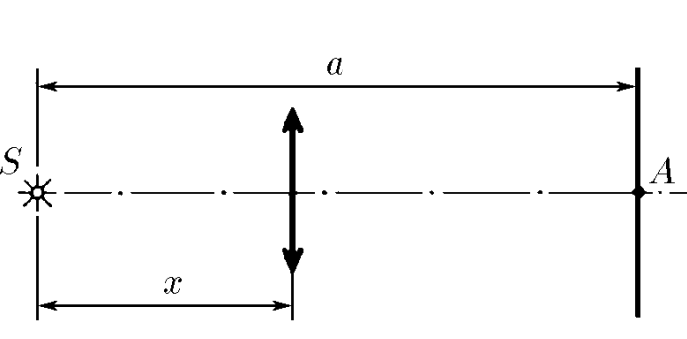from | ||
| + | the source? At what $x$ is the maximum illumination at point A? | ||
| ### Solution | |||
| + | first of all the thin lens equation: | ||
| + | $-\frac{1}{f} + \frac{1}{x} = \frac{1}{F}$ . The distance from center to image is $ f = \frac{Fx}{F-x}$ , F - focal length.The flux conservation , $\int \vec{E} \cdot \vec{dS} = P= const.$ , yields the following relation $E4\pi x^{2}=E_{0}4\pi f^{2}$, from which it is obtained the intensity of the flux in point at which the rays are emitted . Now second time applying the flux conservation(Gauss's law) yields: | ||
| + | $Ea^{2} = E_{1}(a-f)^{2}$ , which gives : | ||
| + | $E_{0}(\frac{Fx}{F-x})^{2} \frac{a^{2}}{x^{2}}\frac{(F-x)^{2}}{ ((F-x)-Fx)^2 }$,simplifying yields : | ||
| − | $e= MC$ | ||
| + | $E_{1}=\frac{E_{0}F^{2}}{((F-x)-Fx)^2}$ | ||
| #### Answer | |||
| [Insert a concise answer or boxed result] | |||
| @@ -1,12 +1,18 @@ | |||
| ### Statement | ### Statement | ||
| $13.4.14.$ |
$13.4.14.$The point light source S is located at a distance a < 4f from the flat screen. | ||
| How will the illumination of the screen change at point A if a lens with a focal | |||
| length of $f$ is placed between the source and the screen, at a distance of $x$ from | |||
| the source? At what $x$ is the maximum illumination at point A? | |||
| ### Solution | ### Solution | ||
| first of all the thin lens equation: | |||
| $-\frac{1}{f} + \frac{1}{x} = \frac{1}{F}$ . The distance from center to image is $ f = \frac{Fx}{F-x}$ , F - focal length.The flux conservation , $\int \vec{E} \cdot \vec{dS} = P= const.$ , yields the following relation $E4\pi x^{2}=E_{0}4\pi f^{2}$, from which it is obtained the intensity of the flux in point at which the rays are emitted . Now second time applying the flux conservation(Gauss's law) yields: | |||
| $Ea^{2} = E_{1}(a-f)^{2}$ , which gives : | |||
| $E_{0}(\frac{Fx}{F-x})^{2} \frac{a^{2}}{x^{2}}\frac{(F-x)^{2}}{ ((F-x)-Fx)^2 }$,simplifying yields : | |||
| $e= MC$ | $E_{1}=\frac{E_{0}F^{2}}{((F-x)-Fx)^2}$ | ||
| #### Answer | #### Answer | ||
| [Insert a concise answer or boxed result] | [Insert a concise answer or boxed result] | ||