Edits to “Statement”, “Solution”, “Answer”

en/2.4.11.md
+45 −3
| @@ -1,13 +1,55 @@ | |||
| ### Statement | |||
| − | $2.4.11.$ | ||
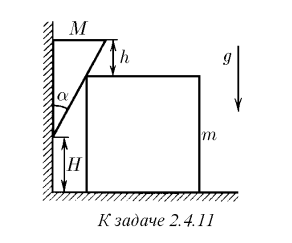
| + | $2.4.11.$ A wedge of mass M with an angle α at the apex fits snugly to the vertical | ||
| + | wall and rests on a bar of mass m located on the horizontal plane. The top of | ||
| + | the wedge is at a height H above this plane, and the end of the wedge is at a | ||
| + | height h < H above the upper surface of the bar. The bar is first held in this | ||
| + | position, and then released. Find the speed at the moment the wedge falls on the horizontal plane. Ignore the friction. | ||
| + |  | ||
| ### Solution | |||
| − |  | ||
| + | Stage 1. Motion with the Block in Contact | ||
| + | A. Velocity relationship | ||
| + | Because the wedge slides against a frictionless vertical wall while its slanted face remains in contact with the block, we can write the relation between the speed of the wedge and the speed of the block: | ||
| + | \begin{equation*} | ||
| + | V_b = V_w \cot\alpha | ||
| + | \end{equation*} | ||
| + | This relation holds throughout the period when the wedge and block remain in contact. | ||
| + | |||
| + | B. Conservation of energy | ||
| + | |||
| + | \begin{equation*} | ||
| + | Mgh = \frac{1}{2}MV_w^2 + \frac{1}{2}m(V_w \cot\alpha)^2 | ||
| + | \end{equation*} | ||
| + | |||
| + | Solve for \( V_w \): | ||
| + | |||
| + | \begin{equation*} | ||
| + | V_w^2 = \frac{2Mgh}{M + m\cot^2\alpha} | ||
| + | \end{equation*} | ||
| + | |||
| + | Stage 2. Free Fall After Separation | ||
| + | |||
| + | After separation, the wedge is no longer in contact with the block and is free to fall from its current height. In order to reach the floor, the wedge must fall an additional distance of \( (H - h) \). Using the kinematic relation for free fall: | ||
| + | |||
| + | \begin{equation*} | ||
| + | v_M^2 = V_w^2 + 2g(H - h) | ||
| + | \end{equation*} | ||
| + | |||
| + | After substituting the expression for \( V_w \) we get: | ||
| + | |||
| + | \begin{equation*} | ||
| + | v_M = \sqrt{\frac{2Mgh}{M + m\cot^2\alpha} + 2g(H - h)} | ||
| + | \end{equation*} | ||
| + | |||
| + | |||
| + | |||
| #### Answer | |||
| − | [Insert a concise answer or boxed result] | ||
| + | \begin{equation*} | ||
| + | v_M = \sqrt{\frac{2Mgh}{M + m\cot^2\alpha} + 2g(H - h)} | ||
| + | \end{equation*} | ||
| @@ -1,13 +1,55 @@ | |||
| ### Statement | ### Statement | ||
| $2.4.11.$ |
$2.4.11.$ A wedge of mass M with an angle α at the apex fits snugly to the vertical | ||
| wall and rests on a bar of mass m located on the horizontal plane. The top of | |||
| the wedge is at a height H above this plane, and the end of the wedge is at a | |||
| height h < H above the upper surface of the bar. The bar is first held in this | |||
| position, and then released. Find the speed at the moment the wedge falls on the horizontal plane. Ignore the friction. | |||
|  | |||
| ### Solution | ### Solution | ||
|  | Stage 1. Motion with the Block in Contact | ||
| A. Velocity relationship | |||
| Because the wedge slides against a frictionless vertical wall while its slanted face remains in contact with the block, we can write the relation between the speed of the wedge and the speed of the block: | |||
| \begin{equation*} | |||
| V_b = V_w \cot\alpha | |||
| \end{equation*} | |||
| This relation holds throughout the period when the wedge and block remain in contact. | |||
| B. Conservation of energy | |||
| \begin{equation*} | |||
| Mgh = \frac{1}{2}MV_w^2 + \frac{1}{2}m(V_w \cot\alpha)^2 | |||
| \end{equation*} | |||
| Solve for \( V_w \): | |||
| \begin{equation*} | |||
| V_w^2 = \frac{2Mgh}{M + m\cot^2\alpha} | |||
| \end{equation*} | |||
| Stage 2. Free Fall After Separation | |||
| After separation, the wedge is no longer in contact with the block and is free to fall from its current height. In order to reach the floor, the wedge must fall an additional distance of \( (H - h) \). Using the kinematic relation for free fall: | |||
| \begin{equation*} | |||
| v_M^2 = V_w^2 + 2g(H - h) | |||
| \end{equation*} | |||
| After substituting the expression for \( V_w \) we get: | |||
| \begin{equation*} | |||
| v_M = \sqrt{\frac{2Mgh}{M + m\cot^2\alpha} + 2g(H - h)} | |||
| \end{equation*} | |||
| #### Answer | #### Answer | ||
| [Insert a concise answer or boxed result] | \begin{equation*} | ||
| v_M = \sqrt{\frac{2Mgh}{M + m\cot^2\alpha} + 2g(H - h)} | |||
| \end{equation*} | |||