Statement
7.1.27.
a. The electron enters an axisymmetric electric field created by stationary
charges and initially moves parallel to the field axis at a distance
Electron velocity
to the axis change slightly when moving in the field, then the momentum
acquired by the electron can be estimated by the formula
, where
q is the total electric charge inside a cylindrical region of radius r. Use the
Gauss theorem to derive this formula.
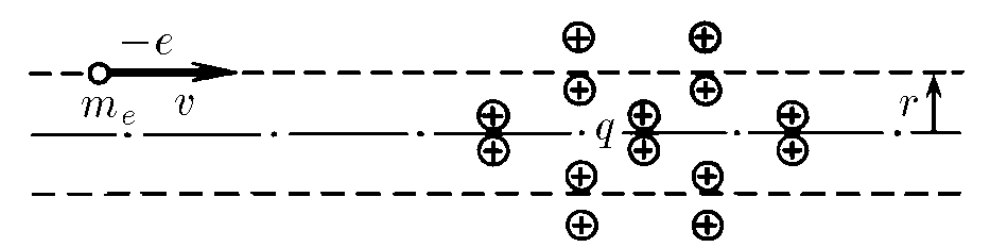
b. Determine the transverse momentum acquired by charge
past charge
velocity
c. Estimate the minimum distance from the nucleus of a nitrogen atom at
which an electron accelerated by a potential difference of
deflected by the nucleus by an angle of
Solution
(a)
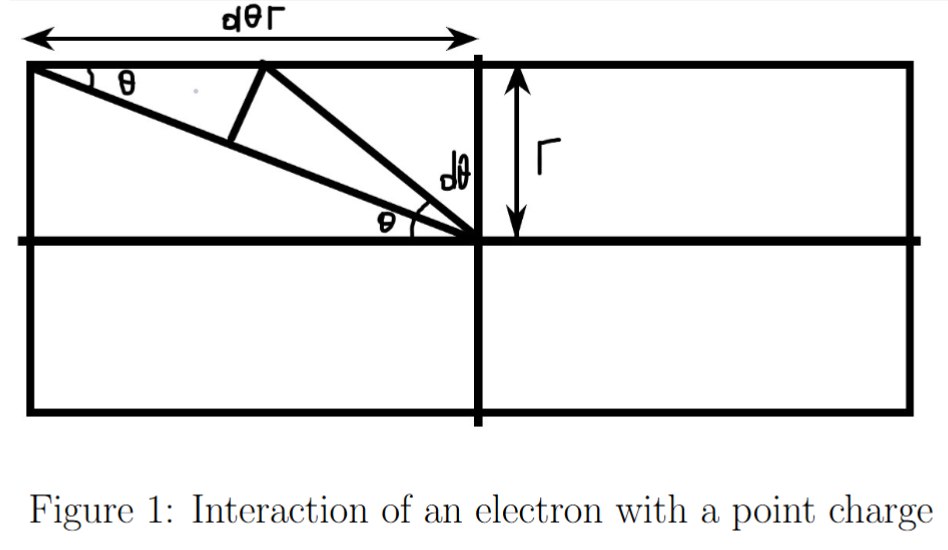
Since the electric field is axisymmetric, we will use superposition, where an electron interacts with a point charge q.
(b)
Let us use the answer of part (a), where instead of electron and particle q, there will be two point charges with the ratings of
(c)
Answer
(a)
(b)
(c)