Edits to “Statement”, “Solution”, “Answer”

en/2.1.27.md
+35 −11
| @@ -1,25 +1,49 @@ | |||
| ### Statement | |||
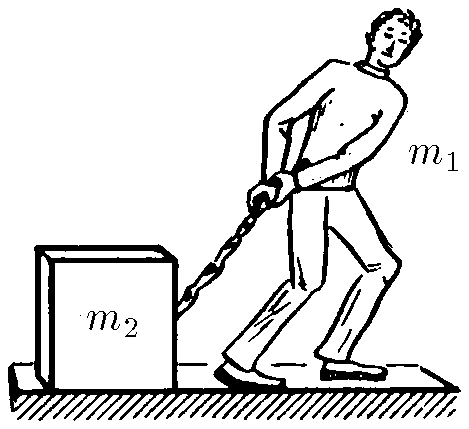
| $2.1.27.$ | |||
|  | |||
| − | A person of mass $m_1$, remaining in place, pulls a weight of mass $m_2$ with a | ||
| − | rope. The coefficient of friction between the horizontal plane and each object is equal to $\mu$. What | ||
| − | is the lowest tension force of the rope, $T$, at which the load will start to move from its place? At | ||
| − | what angle to the horizontal plane should the rope be directed? | ||
| + | A person of mass $m_1$, remaining in place, pulls a weight of mass $m_2$ with a rope. The coefficient of friction between the horizontal plane and each object is equal to $\mu$. What is the lowest tension force of the rope, $T$, at which the load will start to move from its place? At what angle to the horizontal plane should the rope be directed? | ||
| ### Solution | |||
| − |  | ||
| + | For the forces acting the person, with mass $m_1$, we have: | ||
| + | \begin{align*} | ||
| + | \sum F_x = f_{1,s} - T \cos \theta = m_1 \, a_{1,x} | ||
| + | \end{align*} | ||
| + | \begin{align*} | ||
| + | \sum F_y = n_1 - m_1 g - T \sin \theta = m_1 \, a_{1,y} | ||
| + | \end{align*} | ||
| − |  | ||
| + | and for the block, $m_2$, we have: | ||
| + | \begin{align*} | ||
| + | \sum F_x = T \cos \theta - f_{2,s} = m_2 \, a_{2,x} | ||
| + | \end{align*} | ||
| + | \begin{align*} | ||
| + | \sum F_y = n_2 - m_2 g + T \sin \theta = m_2 \, a_{2,y} | ||
| + | \end{align*} | ||
| − | 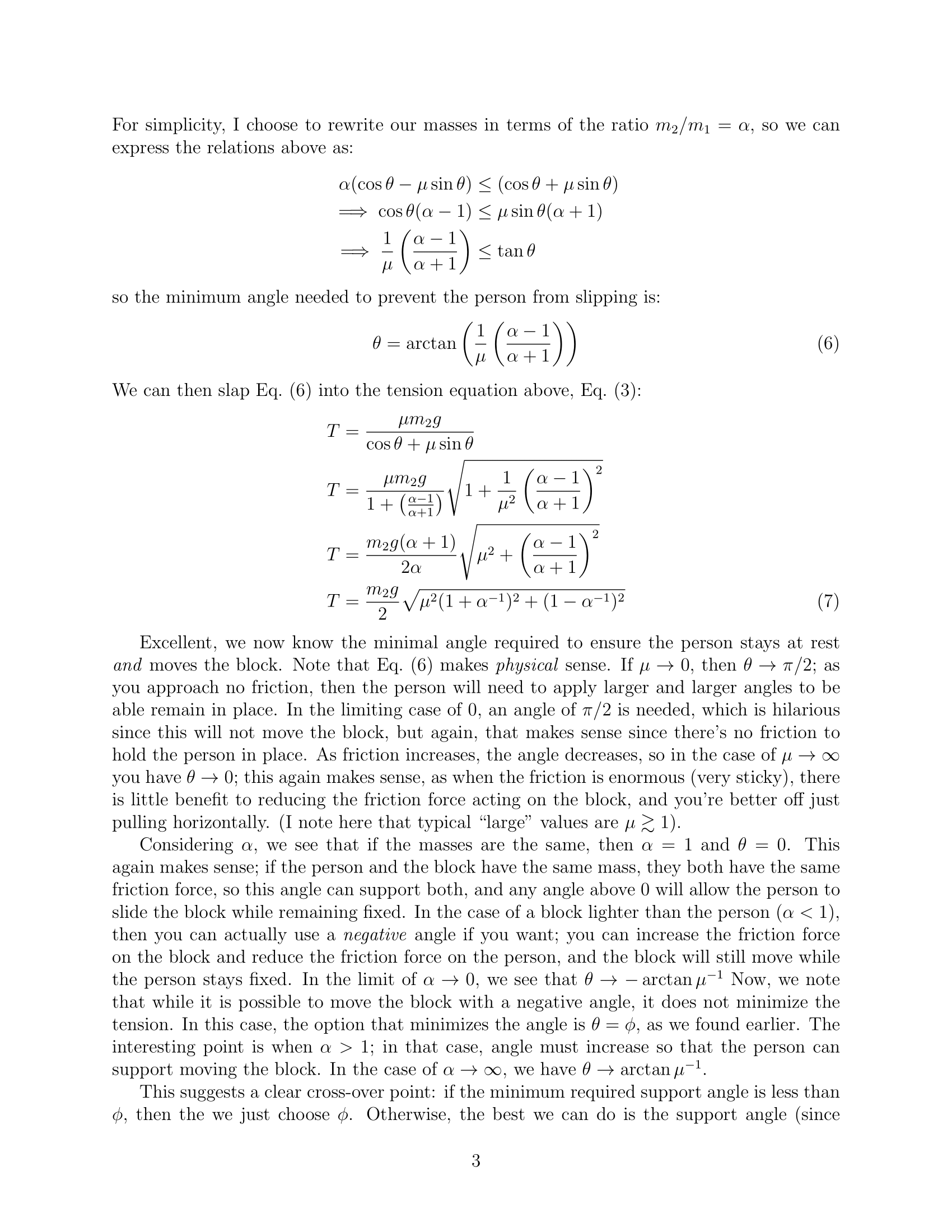 | ||
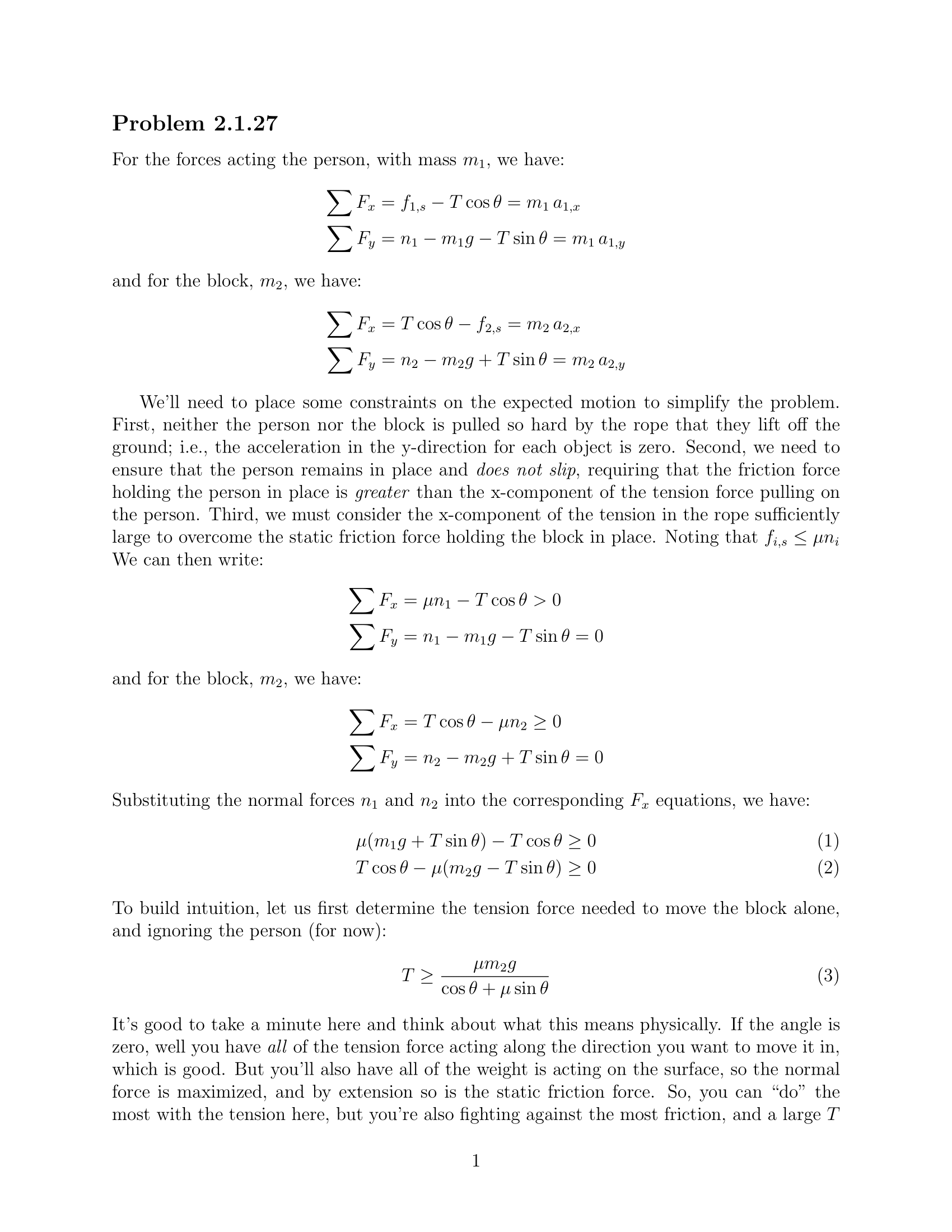
| + | We'll need to place some constraints on the expected motion to simplify the problem. First, neither the person nor the block is pulled so hard by the rope that they lift off the ground; i.e., the acceleration in the y-direction for each object is zero. Second, we need to ensure that the person remains in place and \emph{does not slip}, requiring that the friction force holding the person in place is \emph{greater} than the x-component of the tension force pulling on the person. Third, we must consider the x-component of the tension in the rope sufficiently large to overcome the static friction force holding the block in place. Noting that $f_{i,s} \leq \mu n_i$ We can then write: | ||
| + | \begin{align*} | ||
| + | \sum F_x &= \mu n_1 - T \cos \theta > 0 | ||
| + | \end{align*} | ||
| + | \begin{align*} | ||
| + | \sum F_y &= n_1 - m_1 g - T \sin \theta = 0 | ||
| + | \end{align*} | ||
| − |  | ||
| − | |||
| − | |||
| #### Answer | |||
| − | [Insert a concise answer or boxed result] | ||
| + | For $\mu^2 \geq \frac{\alpha - 1}{\alpha + 1}$: | ||
| + | \begin{align} | ||
| + | \boxed{ | ||
| + | T_r = \frac{1}{\sqrt{1+\mu^{-2}}} \quad , \quad \, \theta = \arctan \mu | ||
| + | } | ||
| + | \end{align} | ||
| + | |||
| + | For $\mu^2 \leq \frac{\alpha - 1}{\alpha + 1}$: | ||
| + | \begin{align} | ||
| + | \boxed{ | ||
| + | T_r = \frac{1}{2} \sqrt{\mu^2 (1+\alpha^{-1})^2 + (1-\alpha^{-1})^2 } \quad , \quad \theta = \arctan \left( \frac{1}{\mu} \left( \frac{\alpha - 1}{\alpha + 1} \right) \right) | ||
| + | } | ||
| + | \end{align} | ||
| @@ -1,25 +1,49 @@ | |||
| ### Statement | ### Statement | ||
| $2.1.27.$ | $2.1.27.$ | ||
|  |  | ||
| A person of mass $m_1$, remaining in place, pulls a weight of mass $m_2$ with a | A person of mass $m_1$, remaining in place, pulls a weight of mass $m_2$ with a rope. The coefficient of friction between the horizontal plane and each object is equal to $\mu$. What is the lowest tension force of the rope, $T$, at which the load will start to move from its place? At what angle to the horizontal plane should the rope be directed? | ||
| rope. The coefficient of friction between the horizontal plane and each object is equal to $\mu$. What | |||
| is the lowest tension force of the rope, $T$, at which the load will start to move from its place? At | |||
| what angle to the horizontal plane should the rope be directed? | |||
| ### Solution | ### Solution | ||
|  | For the forces acting the person, with mass $m_1$, we have: | ||
| \begin{align*} | |||
| \sum F_x = f_{1,s} - T \cos \theta = m_1 \, a_{1,x} | |||
| \end{align*} | |||
| \begin{align*} | |||
| \sum F_y = n_1 - m_1 g - T \sin \theta = m_1 \, a_{1,y} | |||
| \end{align*} | |||
|  | and for the block, $m_2$, we have: | ||
| \begin{align*} | |||
| \sum F_x = T \cos \theta - f_{2,s} = m_2 \, a_{2,x} | |||
| \end{align*} | |||
| \begin{align*} | |||
| \sum F_y = n_2 - m_2 g + T \sin \theta = m_2 \, a_{2,y} | |||
| \end{align*} | |||
|  | We'll need to place some constraints on the expected motion to simplify the problem. First, neither the person nor the block is pulled so hard by the rope that they lift off the ground; i.e., the acceleration in the y-direction for each object is zero. Second, we need to ensure that the person remains in place and \emph{does not slip}, requiring that the friction force holding the person in place is \emph{greater} than the x-component of the tension force pulling on the person. Third, we must consider the x-component of the tension in the rope sufficiently large to overcome the static friction force holding the block in place. Noting that $f_{i,s} \leq \mu n_i$ We can then write: | ||
| \begin{align*} | |||
| \sum F_x &= \mu n_1 - T \cos \theta > 0 | |||
| \end{align*} | |||
| \begin{align*} | |||
| \sum F_y &= n_1 - m_1 g - T \sin \theta = 0 | |||
| \end{align*} | |||
|  | |||
| #### Answer | #### Answer | ||
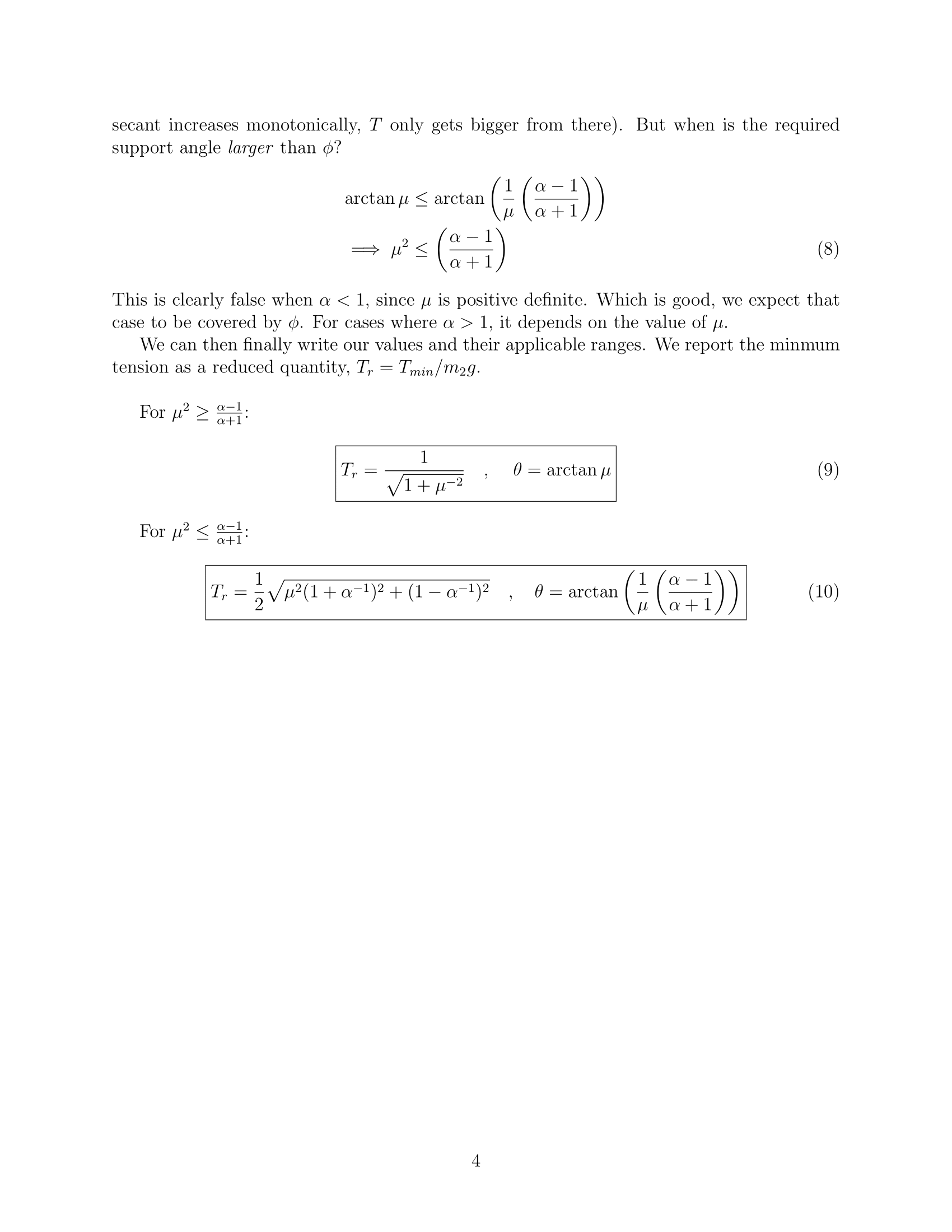
| [Insert a concise answer or boxed result] | For $\mu^2 \geq \frac{\alpha - 1}{\alpha + 1}$: | ||
| \begin{align} | |||
| \boxed{ | |||
| T_r = \frac{1}{\sqrt{1+\mu^{-2}}} \quad , \quad \, \theta = \arctan \mu | |||
| } | |||
| \end{align} | |||
| For $\mu^2 \leq \frac{\alpha - 1}{\alpha + 1}$: | |||
| \begin{align} | |||
| \boxed{ | |||
| T_r = \frac{1}{2} \sqrt{\mu^2 (1+\alpha^{-1})^2 + (1-\alpha^{-1})^2 } \quad , \quad \theta = \arctan \left( \frac{1}{\mu} \left( \frac{\alpha - 1}{\alpha + 1} \right) \right) | |||
| } | |||
| \end{align} | |||