Statement
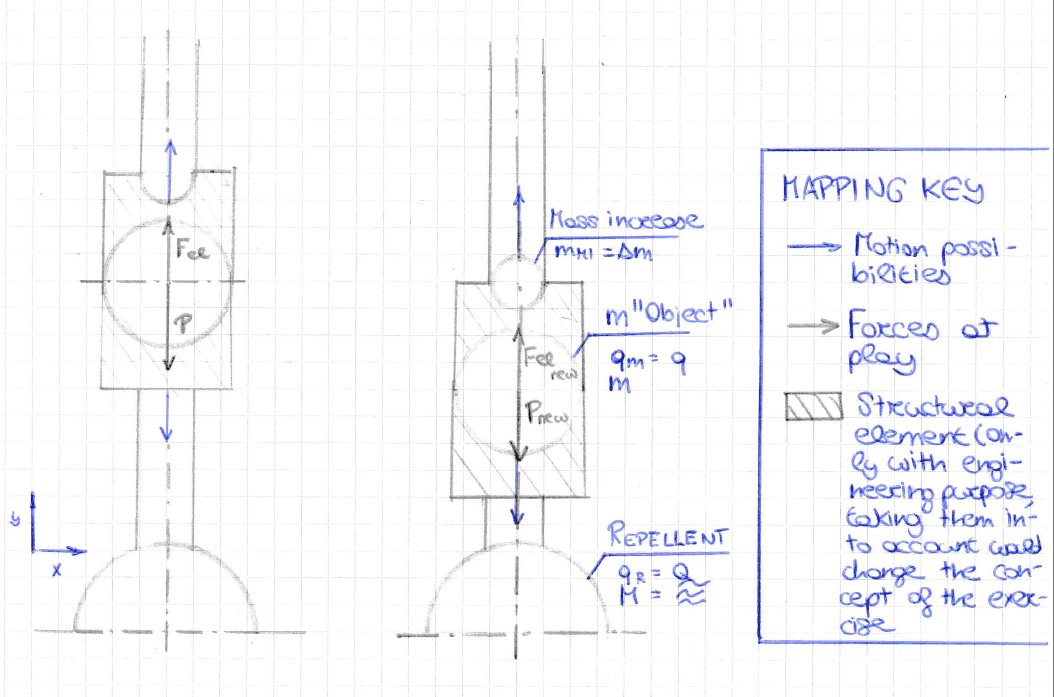
3.1.13. A small weight of mass ∆m is placed on the body of mass m in problem 3.1.12
(a) and released. Find the maximal velocity of the body with the weight.
Solution
According to Problem 3.1.13, in relation to Problem 3.1.12, we find the following configuration: a small charged body of mass
Evidently, this will alter the value of
After adding the mass:
The simplest way to solve this problem is with the Universal Energetic Conservation Law, by which
Expanding:
Since
the equation becomes:
Solving for
This can be proved by examining the motion it will produce. As no air drag or other forces act, we are working with a conservative force field, implying the body will describe an unrestrained Simple Harmonic Motion (SHM). According to the SHM velocity formula:
the maximum speed occurs at
The amplitude is the difference between the original equilibrium position and the new one:
Substituting this into the SHM formulas yields an equivalent expression to the one obtained using the Universal Energy Conservation Law, although doing so directly would require a Taylor expansion, complicating the problem.
Answer