| ### Statement | | ### Statement |
| | | |
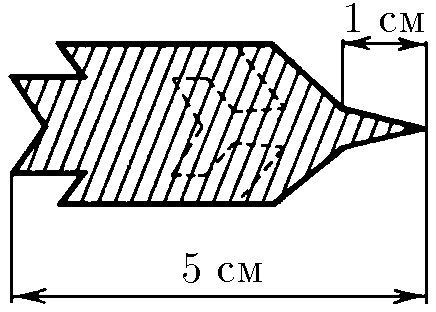
| $1.1.1.$ Figure$^{*)}$ shows a "blurred photograph" of a jet airplane in flight. The length of the airplane is $30 \text{ m}$, the length of its nose is $10 \text{ m}$. Determine from this "photograph" the speed of the airplane. The shutter exposure time is $0.1 \text{ s}$. The shape of the airplane is shown in the figure with a dashed line. | | $1.1.1.$ Figure$^{*)}$ shows a "blurred photograph" of a jet airplane in flight. The length of the airplane is $30 \text{ m}$, the length of its nose is $10 \text{ m}$. Determine from this "photograph" the speed of the airplane. The shutter exposure time is $0.1 \text{ s}$. The shape of the airplane is shown in the figure with a dashed line. |
|  | |  |
| | | |
| #### Solution | | #### Solution |
| | | |
|  | |  |
| | | |
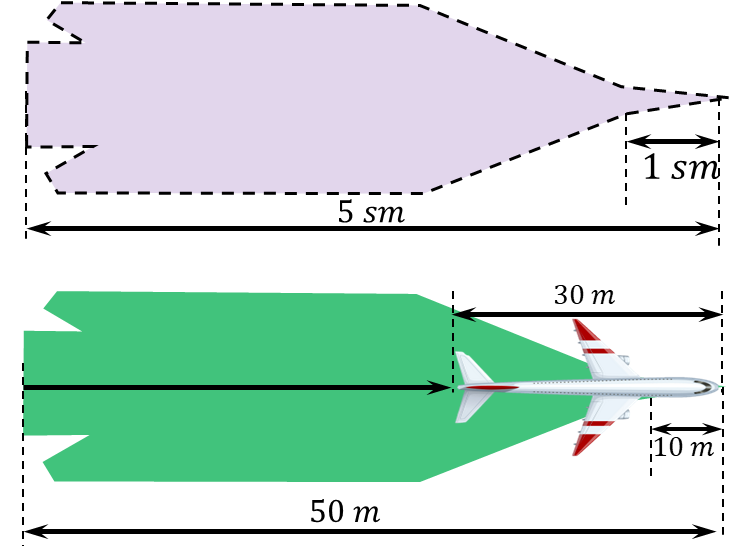
| To find the velocity of the airplane it is necessary to determine the vector of its displacement for the time $T$, during which the shutter of the camera is open. Let us select the initial point $1$ in the photograph and determine the distance it will move during the time $T$. The length of the airplane must be subtracted from the total length of the photograph. Taking into account the scale, the modulus of displacement will be | | To find the velocity of the airplane it is necessary to determine the vector of its displacement for the time $T$, during which the shutter of the camera is open. Let us select the initial point $1$ in the photograph and determine the distance it will move during the time $T$. The length of the airplane must be subtracted from the total length of the photograph. Taking into account the scale, the modulus of displacement will be |
| | | |
| $$ | | $$ |
| l=50-30 = 20 \text{ m} | | l=50-30 = 20 \text{ m} |
| $$ | | $$ |
| | | |
| For the $0.1 \text{ s}$ aiplane covered a distance of $20\text{ m}$, which corresponds to velocity of | | For the $0.1 \text{ s}$ aiplane covered a distance of $20\text{ m}$, which corresponds to velocity of |
| | | |
| $$ | | $$ |
| \boxed{v = \frac{l}{T} = 200\text{ m/s}} | | \boxed{v = \frac{l}{T} = 200\text{ m/s}} |
| $$ | | $$ |
| | | |
| #### O'zbekcha | | #### O'zbekcha |
| | | |
| $1.1.1.$ Rasmda*) uchayotgan reaktiv samolyotning | | $1.1.1.$ Rasmda*) uchayotgan reaktiv samolyotning |
| harakatdan ”siljigan” rasmi keltirilgan. Samolyot uzunligi $30 \text{ m}$ | | harakatdan ”siljigan” rasmi keltirilgan. Samolyot uzunligi $30 \text{ m}$ |
| burun qismining uzunligi $10 \text{ m}$. Mazkur ”siljigan” rasmga | | burun qismining uzunligi $10 \text{ m}$. Mazkur ”siljigan” rasmga |
| ko’ra samolyot tezligini aniqlang ($m/s$). Rasmga olishda fotoapparat ekspozitsiya vaqti $0.1 \text{ s}$. Samolyot shakli rasmda | | ko’ra samolyot tezligini aniqlang ($m/s$). Rasmga olishda fotoapparat ekspozitsiya vaqti $0.1 \text{ s}$. Samolyot shakli rasmda |
| shtrixlab ko’rsatilgan | | shtrixlab ko’rsatilgan |
|  | |  |
| | | |
| #### Yechim | | #### Yechim |
| | | |
|  | |  |
| Samolyotning tezligini aniqlash uchun kamera yopqichi ochiq bo‘lgan $T$ vaqt davomida uning siljish vektorini aniqlash zarur. Fotosuratda boshlang‘ich $1$ - nuqtani tanlaymiz va ushbu nuqta $T$ vaqt ichida qancha masofaga siljishini aniqlaymiz. Fotosuratdagi umumiy uzunlikdan samolyotning uzunligini ayirish kerak. Masshtabni hisobga olgan holda, siljishning moduli quyidagicha bo‘ladi: | | Samolyotning tezligini aniqlash uchun kamera yopqichi ochiq bo‘lgan $T$ vaqt davomida uning siljish vektorini aniqlash zarur. Fotosuratda boshlang‘ich $1$ - nuqtani tanlaymiz va ushbu nuqta $T$ vaqt ichida qancha masofaga siljishini aniqlaymiz. Fotosuratdagi umumiy uzunlikdan samolyotning uzunligini ayirish kerak. Masshtabni hisobga olgan holda, siljishning moduli quyidagicha bo‘ladi: |
| | | |
| $$ | | $$ |
