Edits to “Statement”, “Answer”

en/11.5.19.md
+3 −1
| @@ -1,6 +1,8 @@ | |||
| ### Statement | |||
| $11.5.19.$ [Insert the problem statement] | |||
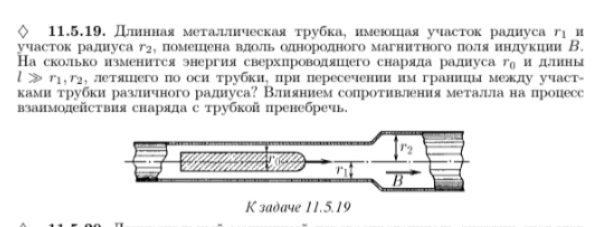
| + | A long metal tube has a section of radius radius r1 and a section or radius r2. It is placed along a uniform magnetic field that has the induction B. | ||
| + | How much energy of a superconductive bullet of radius r0 and length L that flies along the tube axis, change it when it crosses the boundary between tubes sections of various radius. Ignore friction and all other minor effects. | ||
| ### Solution | |||
|  | |||
|  | |||
| @@ -11,5 +13,5 @@Solution | |||
| #### Answer | |||
| − | |||
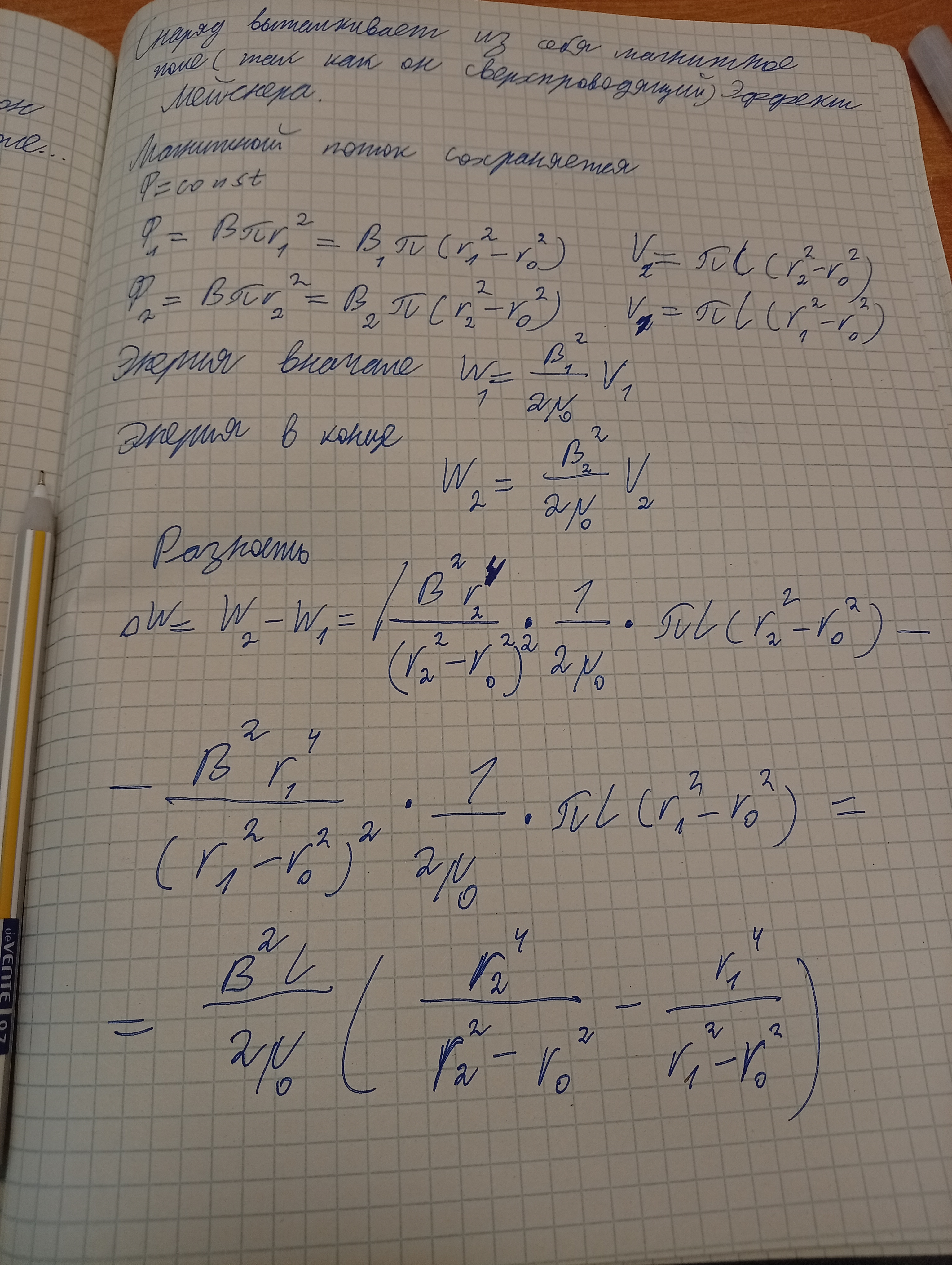
| + | (L*B^2/2*u)*((r2)^4/((r2)^2-(r0)^2)(r1)^4/(r1)^2-(r0)^2) | ||
| [Insert a concise answer or boxed result] | |||
| @@ -1,6 +1,8 @@ | |||
| ### Statement | ### Statement | ||
| $11.5.19.$ [Insert the problem statement] | $11.5.19.$ [Insert the problem statement] | ||
| A long metal tube has a section of radius radius r1 and a section or radius r2. It is placed along a uniform magnetic field that has the induction B. | |||
| How much energy of a superconductive bullet of radius r0 and length L that flies along the tube axis, change it when it crosses the boundary between tubes sections of various radius. Ignore friction and all other minor effects. | |||
| ### Solution | ### Solution | ||
|  |  | ||
|  |  | ||
| @@ -11,5 +13,5 @@Solution | |||
| #### Answer | #### Answer | ||
| (L*B^2/2*u)*((r2)^4/((r2)^2-(r0)^2)(r1)^4/(r1)^2-(r0)^2) | |||
| [Insert a concise answer or boxed result] | [Insert a concise answer or boxed result] | ||