Statement
5.8.5. The trajectory of an atom elastically reflected from the walls of a cube with
dimensions
{a.} What is the average speed at which the impact site will move along each
wall if the angle of incidence in the plane of the square is changed by ∆ ≪ 1?
At what values of ∆ will the trajectory of the atom be closed? not closed?
Determine the distance between adjacent parallel sections of the trajectories
in the first and second cases.
{b.} Why can we assume that the trajectory of an atom is usually not closed?
What isthe probability of detecting an atom in the square of the area S located
in the plane along which the atom moves in the case of an open trajectory?
{c.} How will an atom move if you change the angle of its incidence perpendic
ular to the plane of the square by ∆ ≪ 1? What is the probability of detecting
such an atom in a region inside the cube whose volume is equal to V ?

Solution
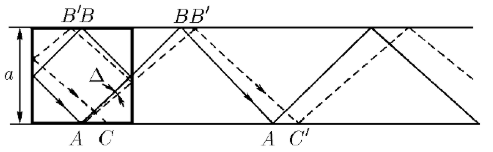
{a.} In the figure, the motion along the trajectory is unfolded by mirror reflections into motion between two parallel straight lines. The corresponding points of the trajectories are marked with the same letters. From this figure it follows:
where
f{b.} It is improbable that
{c.}
Answer
{a.} Look higher;
{b.} Look higher;
{c.}