Edits to “Statement”, “Solution”, “Answer”

en/12.2.4.md
+43 −4
| @@ -1,11 +1,50 @@ | |||
| ### Statement | |||
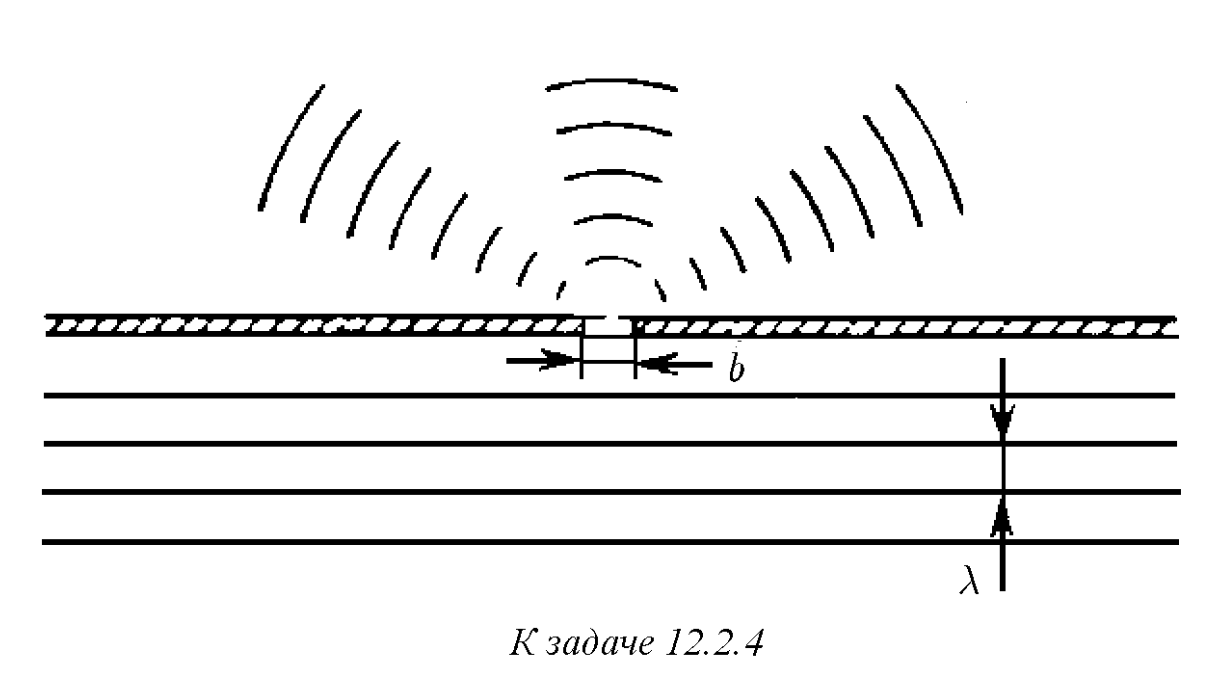
| + | $12.2.4$. Find the angles that determine the directions of radiation minima when a plane wave is incident perpendicularly on a slit of width $b$. The wavelength $\lambda < b$. | ||
| − | $12.2.4.$ [Insert the problem statement] | ||
| + |  | ||
| ### Solution | |||
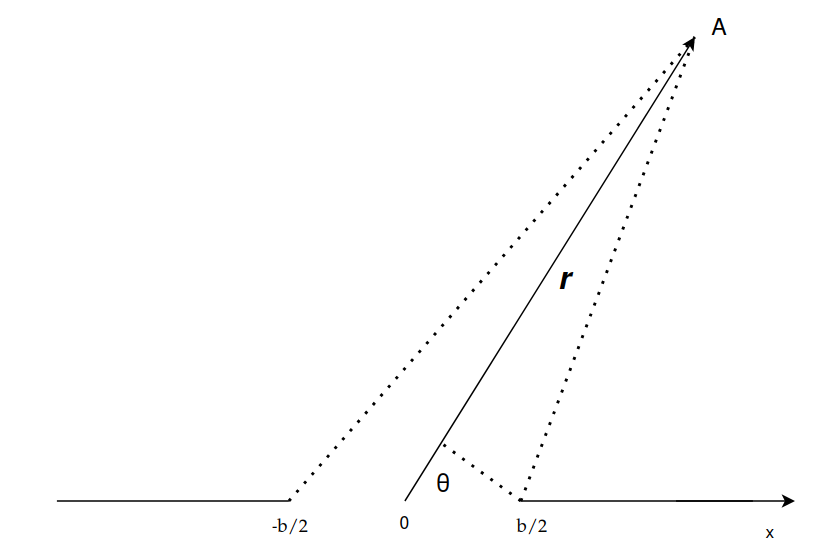
| + | According to the Huygens-Fresnel principle, each element of the slit area becomes a source of a spherical wave. The amplitude of oscillations at a certain point at a distance $r \gg b$ is the sum of the amplitudes of these waves. | ||
| + |  | ||
| − | 1 | ||
| − | |||
| + | Let $\Delta(x)$ be the path difference at point $A$ between the wave emitted from the center of the slit and the wave emitted from a point with coordinate $x$: | ||
| + | $$ | ||
| + | \Delta(x)=r-r(x)=r-(r^2+x^2-2xr\cos\theta)^{\frac{1}{2}} | ||
| + | $$ | ||
| + | Using standard approximations, | ||
| + | $$ | ||
| + | \Delta(x)\approx r-r\left(1-2x\cos\theta\right)^{\frac{1}{2}}\approx x\cos\theta | ||
| + | $$ | ||
| + | Let the phase of the wave emitted from the middle of the slit (by a segment of width $dx$) be 0; its equation is: | ||
| + | $$ | ||
| + | \psi (0, t)=\psi_0dx=A_0e^{i(\omega t-kr)} | ||
| + | $$ | ||
| + | Then | ||
| + | $$ | ||
| + | \psi (x, t)=A_0e^{i(\omega t-k(r+\Delta))}=\psi_0e^{-ikx\cos\theta}dx | ||
| + | $$ | ||
| + | The amplitude at point $A$ is: | ||
| + | $$ | ||
| + | A\propto\int_{-b/2}^{b/2}e^{-ixk\cos\theta}dx\propto\frac{e^{ik\frac{b}{2}\cos\theta}-e^{-ik\frac{b}{2}\cos\theta}}{ik\cos\theta} | ||
| + | $$ | ||
| + | Recall that $\sin u = \frac{e^{i u} - e^{-i u}}{2i}$: | ||
| + | $$ | ||
| + | A\propto 2\frac{\sin\left(k\frac{b}{2}\cos\theta\right)}{k\cos\theta} | ||
| + | $$ | ||
| + | Condition for minima: | ||
| + | $$ | ||
| + | A=0 \ \to k\frac{b}{2}\cos\theta=\pi m, \quad m\in Z | ||
| + | $$ | ||
| + | The wavenumber is $k=\frac{2\pi}{\lambda}$, so the minima correspond to angles: | ||
| + | $$ | ||
| + | b\cos\theta=\lambda m,\quad m\in Z | ||
| + | $$ | ||
| + | Savchenko uses the angle to the normal, so in his notation the same is: | ||
| + | $$ | ||
| + | \sin \alpha_k = \frac{k\lambda}{b},\quad k\in Z | ||
| + | $$ | ||
| #### Answer | |||
| − | [Insert a concise answer or boxed result] | ||
| + | $$ | ||
| + | \boxed{\sin \alpha_k = \frac{k\lambda}{b},\quad k\in Z} | ||
| + | $$ | ||
| @@ -1,11 +1,50 @@ | |||
| ### Statement | ### Statement | ||
| $12.2.4$. Find the angles that determine the directions of radiation minima when a plane wave is incident perpendicularly on a slit of width $b$. The wavelength $\lambda < b$. | |||
| $12.2.4.$ [Insert the problem statement] |  | ||
| ### Solution | ### Solution | ||
| According to the Huygens-Fresnel principle, each element of the slit area becomes a source of a spherical wave. The amplitude of oscillations at a certain point at a distance $r \gg b$ is the sum of the amplitudes of these waves. | |||
|  | |||
| 1 | Let $\Delta(x)$ be the path difference at point $A$ between the wave emitted from the center of the slit and the wave emitted from a point with coordinate $x$: | ||
| $$ | |||
| \Delta(x)=r-r(x)=r-(r^2+x^2-2xr\cos\theta)^{\frac{1}{2}} | |||
| $$ | |||
| Using standard approximations, | |||
| $$ | |||
| \Delta(x)\approx r-r\left(1-2x\cos\theta\right)^{\frac{1}{2}}\approx x\cos\theta | |||
| $$ | |||
| Let the phase of the wave emitted from the middle of the slit (by a segment of width $dx$) be 0; its equation is: | |||
| $$ | |||
| \psi (0, t)=\psi_0dx=A_0e^{i(\omega t-kr)} | |||
| $$ | |||
| Then | |||
| $$ | |||
| \psi (x, t)=A_0e^{i(\omega t-k(r+\Delta))}=\psi_0e^{-ikx\cos\theta}dx | |||
| $$ | |||
| The amplitude at point $A$ is: | |||
| $$ | |||
| A\propto\int_{-b/2}^{b/2}e^{-ixk\cos\theta}dx\propto\frac{e^{ik\frac{b}{2}\cos\theta}-e^{-ik\frac{b}{2}\cos\theta}}{ik\cos\theta} | |||
| $$ | |||
| Recall that $\sin u = \frac{e^{i u} - e^{-i u}}{2i}$: | |||
| $$ | |||
| A\propto 2\frac{\sin\left(k\frac{b}{2}\cos\theta\right)}{k\cos\theta} | |||
| $$ | |||
| Condition for minima: | |||
| $$ | |||
| A=0 \ \to k\frac{b}{2}\cos\theta=\pi m, \quad m\in Z | |||
| $$ | |||
| The wavenumber is $k=\frac{2\pi}{\lambda}$, so the minima correspond to angles: | |||
| $$ | |||
| b\cos\theta=\lambda m,\quad m\in Z | |||
| $$ | |||
| Savchenko uses the angle to the normal, so in his notation the same is: | |||
| $$ | |||
| \sin \alpha_k = \frac{k\lambda}{b},\quad k\in Z | |||
| $$ | |||
| #### Answer | #### Answer | ||
| [Insert a concise answer or boxed result] | $$ | ||
| \boxed{\sin \alpha_k = \frac{k\lambda}{b},\quad k\in Z} | |||
| $$ | |||