Edit to “Solution”

en/12.2.10.md
+3 −6
| @@ -1,16 +1,13 @@ | |||
| − | ## Will be completed | ||
| − | |||
| − | |||
| ### Statement | |||
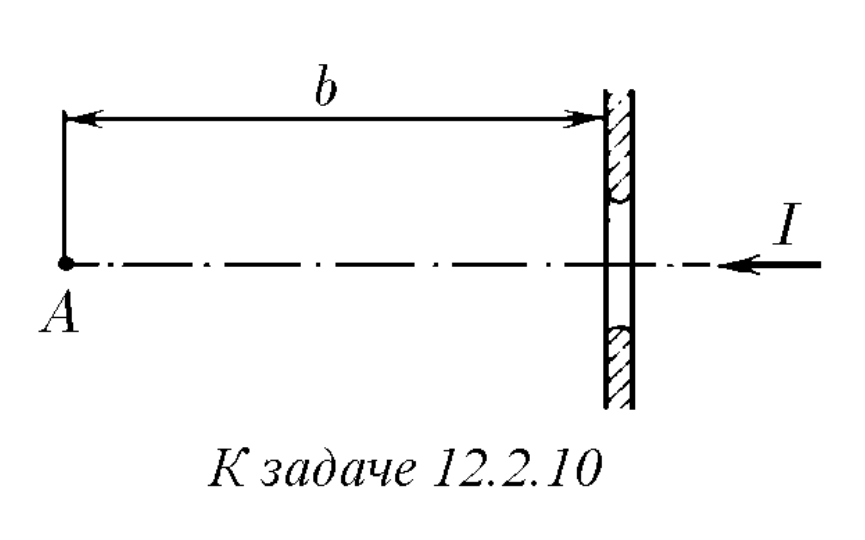
| $12.2.10.$ Plot the dependence of the light intensity at point $A$ on the radius of the hole that overlaps the parallel radiation flux with the wavelength $\lambda$. Distance from point $A$ to the center of hole $b$. Radiation intensity in stream $I$. | |||
|  | |||
| ### Solution | |||
| − |  | ||
| + | |||
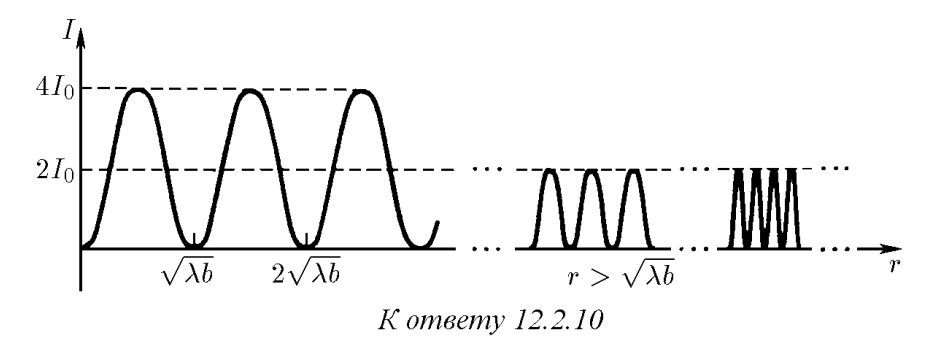
| The author's graph is incorrect; I will rebuild it soon. | |||
| There is an inaccuracy in the condition. Correct: "... from the radius of the hole in a plane that blocks a parallel flow of radiation ..." | |||
| As $R \to 0$, the hole acts as a point source of secondary waves. The intensity is close to zero and increases slowly. | |||
| As $R$ grows, we obtain the classic problem of Fresnel diffraction by an aperture. It is usually solved as follows: the plane wavefront is divided into annular zones such that the distances from the zone boundaries to point $A$ differ by $\lambda/2$: | |||
| 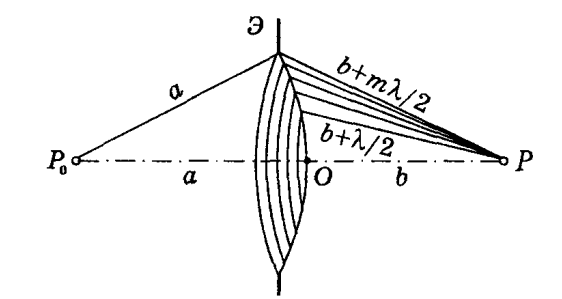 | |||
| Let's find the radii of the Fresnel zones: | |||
| $$ | |||
| @@ -24,10 +21,10 @@Solution | |||
| \sqrt{r_m^2 + b^2} - b = \frac{m\lambda}{2} \tag{1} | |||
| $$ | |||
| $$ | |||
| − | r_m \approx \sqrt{mb\lambda}, \quad m \in Z \tag{2} | ||
| + | r_m =\sqrt{mb\lambda+\left(\frac{m\lambda}{2}\right)^2}\approx \sqrt{mb\lambda}, \quad m \in Z \tag{2} | ||
| $$ | |||
| − | When the radius of the hole coincides with the boundary of an odd zone $(\sqrt{b\lambda}, \sqrt{3b\lambda})$, the secondary waves arrive in phase, | ||
| + | When the radius of the hole coincides with the boundary of an odd zone $(\sqrt{b\lambda}, \sqrt{3b\lambda})$, the secondary waves arrive in phase, therefore, at point A the amplitude doubles, and the intensity, proportional to the square of the amplitude, is $4I$. | ||
| When the hole covers an even number of zones (the boundary coincides with the end of the second, fourth, etc. zone), the waves from adjacent zones arrive in opposite phase and cancel each other, giving almost zero intensity (diffraction minimum). | |||
| As $R$ increases further, the hole radius covers more and more zones. The amplitude gradually decreases: the maxima become closer to $I$, and the minima no longer reach zero. This happens because the contribution of distant Fresnel zones is smaller than that of the near ones. | |||
| In the limit of large $R$ (geometrical optics), all incident radiation passes unobstructed, and the intensity at point $A$ tends to $I$. | |||
| The resulting dependence is a slowly decaying oscillation, starting from zero and asymptotically approaching $I$. | |||
| unchanged lines 5 | |||
| @@ -1,16 +1,13 @@ | |||
| ## Will be completed | |||
| ### Statement | ### Statement | ||
| $12.2.10.$ Plot the dependence of the light intensity at point $A$ on the radius of the hole that overlaps the parallel radiation flux with the wavelength $\lambda$. Distance from point $A$ to the center of hole $b$. Radiation intensity in stream $I$. | $12.2.10.$ Plot the dependence of the light intensity at point $A$ on the radius of the hole that overlaps the parallel radiation flux with the wavelength $\lambda$. Distance from point $A$ to the center of hole $b$. Radiation intensity in stream $I$. | ||
|  |  | ||
| ### Solution | ### Solution | ||
|  | |||
| The author's graph is incorrect; I will rebuild it soon. | The author's graph is incorrect; I will rebuild it soon. | ||
| There is an inaccuracy in the condition. Correct: "... from the radius of the hole in a plane that blocks a parallel flow of radiation ..." | There is an inaccuracy in the condition. Correct: "... from the radius of the hole in a plane that blocks a parallel flow of radiation ..." | ||
| As $R \to 0$, the hole acts as a point source of secondary waves. The intensity is close to zero and increases slowly. | As $R \to 0$, the hole acts as a point source of secondary waves. The intensity is close to zero and increases slowly. | ||
| As $R$ grows, we obtain the classic problem of Fresnel diffraction by an aperture. It is usually solved as follows: the plane wavefront is divided into annular zones such that the distances from the zone boundaries to point $A$ differ by $\lambda/2$: | As $R$ grows, we obtain the classic problem of Fresnel diffraction by an aperture. It is usually solved as follows: the plane wavefront is divided into annular zones such that the distances from the zone boundaries to point $A$ differ by $\lambda/2$: | ||
|  |  | ||
| Let's find the radii of the Fresnel zones: | Let's find the radii of the Fresnel zones: | ||
| $$ | $$ | ||
| @@ -24,10 +21,10 @@Solution | |||
| \sqrt{r_m^2 + b^2} - b = \frac{m\lambda}{2} \tag{1} | \sqrt{r_m^2 + b^2} - b = \frac{m\lambda}{2} \tag{1} | ||
| $$ | $$ | ||
| $$ | $$ | ||
| r_m \approx \sqrt{mb\lambda}, \quad m \in Z \tag{2} | r_m =\sqrt{mb\lambda+\left(\frac{m\lambda}{2}\right)^2}\approx \sqrt{mb\lambda}, \quad m \in Z \tag{2} | ||
| $$ | $$ | ||
| When the radius of the hole coincides with the boundary of an odd zone $(\sqrt{b\lambda}, \sqrt{3b\lambda})$, the secondary waves arrive in phase, |
When the radius of the hole coincides with the boundary of an odd zone $(\sqrt{b\lambda}, \sqrt{3b\lambda})$, the secondary waves arrive in phase, therefore, at point A the amplitude doubles, and the intensity, proportional to the square of the amplitude, is $4I$. | ||
| When the hole covers an even number of zones (the boundary coincides with the end of the second, fourth, etc. zone), the waves from adjacent zones arrive in opposite phase and cancel each other, giving almost zero intensity (diffraction minimum). | When the hole covers an even number of zones (the boundary coincides with the end of the second, fourth, etc. zone), the waves from adjacent zones arrive in opposite phase and cancel each other, giving almost zero intensity (diffraction minimum). | ||
| As $R$ increases further, the hole radius covers more and more zones. The amplitude gradually decreases: the maxima become closer to $I$, and the minima no longer reach zero. This happens because the contribution of distant Fresnel zones is smaller than that of the near ones. | As $R$ increases further, the hole radius covers more and more zones. The amplitude gradually decreases: the maxima become closer to $I$, and the minima no longer reach zero. This happens because the contribution of distant Fresnel zones is smaller than that of the near ones. | ||
| In the limit of large $R$ (geometrical optics), all incident radiation passes unobstructed, and the intensity at point $A$ tends to $I$. | In the limit of large $R$ (geometrical optics), all incident radiation passes unobstructed, and the intensity at point $A$ tends to $I$. | ||
| The resulting dependence is a slowly decaying oscillation, starting from zero and asymptotically approaching $I$. | The resulting dependence is a slowly decaying oscillation, starting from zero and asymptotically approaching $I$. | ||
| unchanged lines 5 | |||