| | | |
| #### Problem 13.2.20 | | #### Problem 13.2.20 |
| Light rays lying in a plane perpendicular to the axis of a glass semicylinder fall onto its flat surface at an angle of $45^{\circ}$. From which part of the lateral surface of the semicylinder will the light rays emerge? The refractive index of glass is $n$. | | Light rays lying in a plane perpendicular to the axis of a glass semicylinder fall onto its flat surface at an angle of $45^{\circ}$. From which part of the lateral surface of the semicylinder will the light rays emerge? The refractive index of glass is $n$. |
| | | |
| ### Solution | | ### Solution |
| | | |
| Before solving the problem, we need to understand its essence. | | Before solving the problem, we need to understand its essence. |
| | | |
| To do this, let us rephrase the question: "What is the range of the transmitting region on the curved surface of the cylinder from which light emerges?" | | To do this, let us rephrase the question: "What is the range of the transmitting region on the curved surface of the cylinder from which light emerges?" |
| | | |
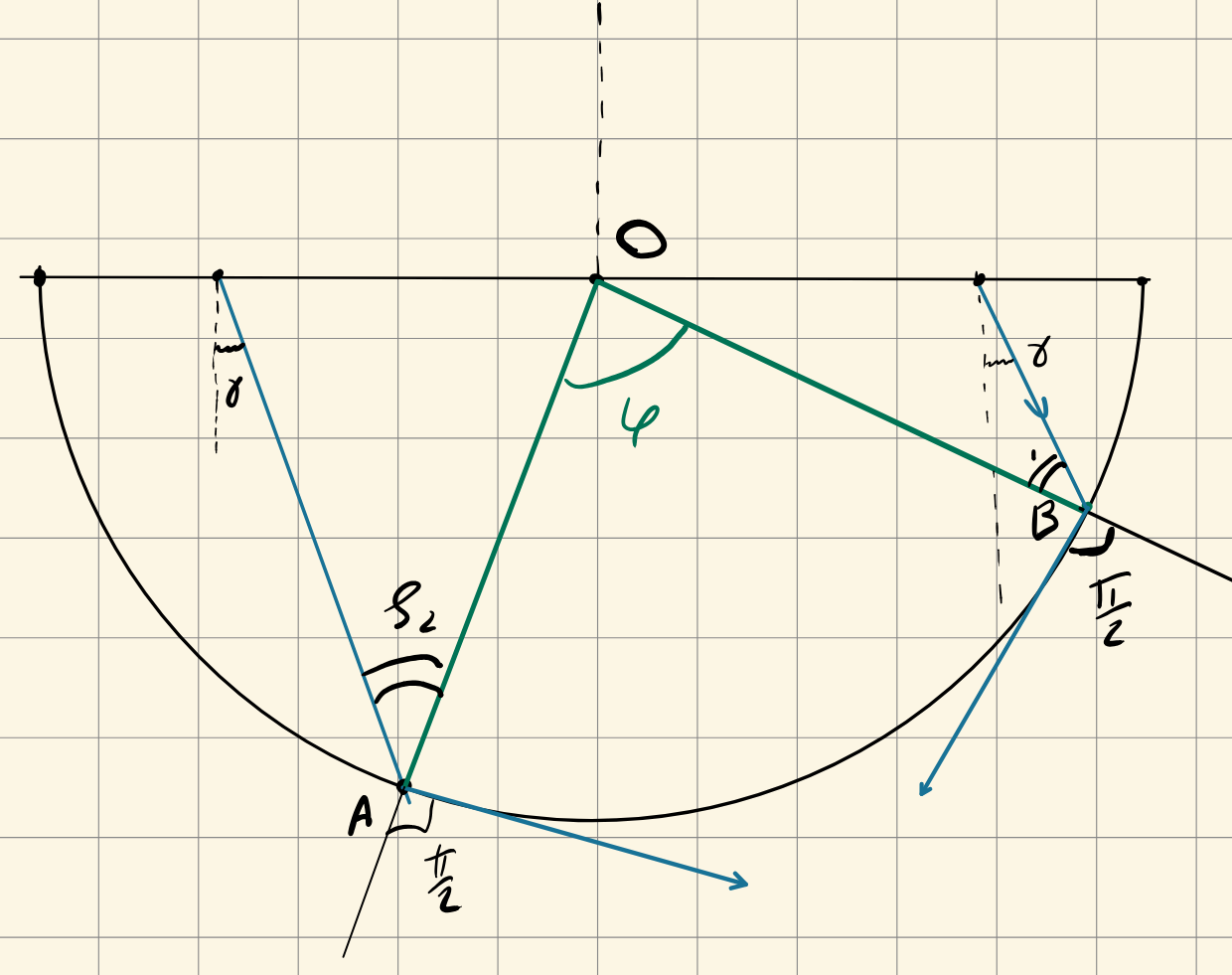
| Now we understand that we are required to find the angle between the two boundary points (by boundary points I mean the points on the cylinder where rays will not pass through). We will consider the semicircle of the cylinder — that is, a top view. | | Now we understand that we are required to find the angle between the two boundary points (by boundary points I mean the points on the cylinder where rays will not pass through). We will consider the semicircle of the cylinder — that is, a top view. |
| | | |
| #### (1) Finding the boundary points A and B. | | #### (1) Finding the boundary points A and B. |
| | | |
| Suppose we have a ray emerging from the interior of the semicircle to the outside. Then consider the projection onto the axis perpendicular to the tangent — i.e., onto the radius of the semicircle — and write Snell's law for this axis. | | Suppose we have a ray emerging from the interior of the semicircle to the outside. Then consider the projection onto the axis perpendicular to the tangent — i.e., onto the radius of the semicircle — and write Snell's law for this axis. |
| | | |
| \[ | | \[ |
| n \sin(\omega) = \sin(\sigma) | | n \sin(\omega) = \sin(\sigma) |
| \] | | \] |
| | | |
| Since the rays emerge when $\sigma \leq \frac{\pi}{2}$, we have two boundary points A and B with the same equation. Thus we get: | | Since the rays emerge when $\sigma \leq \frac{\pi}{2}$, we have two boundary points A and B with the same equation. Thus we get: |
| | | |
| \[ | | \[ |
| \Rightarrow \rho_{1} = \arcsin\left(\frac{1}{n}\right) = \rho_{2} \quad \text{or} \quad \rho_{1} = \rho_{2} \quad \text{(see Fig. 1).} | | \Rightarrow \rho_{1} = \arcsin\left(\frac{1}{n}\right) = \rho_{2} \quad \text{or} \quad \rho_{1} = \rho_{2} \quad \text{(see Fig. 1).} |
| \] | | \] |
| | | |
| \[ | | \[ |
| \boxed{\rho_{1} = \rho_{2} = \rho = \arcsin\left(\frac{1}{n}\right)} | | \boxed{\rho_{1} = \rho_{2} = \rho = \arcsin\left(\frac{1}{n}\right)} |
| \] | | \] |
|  | |  |
| | | |
| | | |
| #### (2) We have found the main boundary points A and B. Now, through geometry, we need to find $\phi$. | | #### (2) We have found the main boundary points A and B. Now, through geometry, we need to find $\phi$. |
| | | |
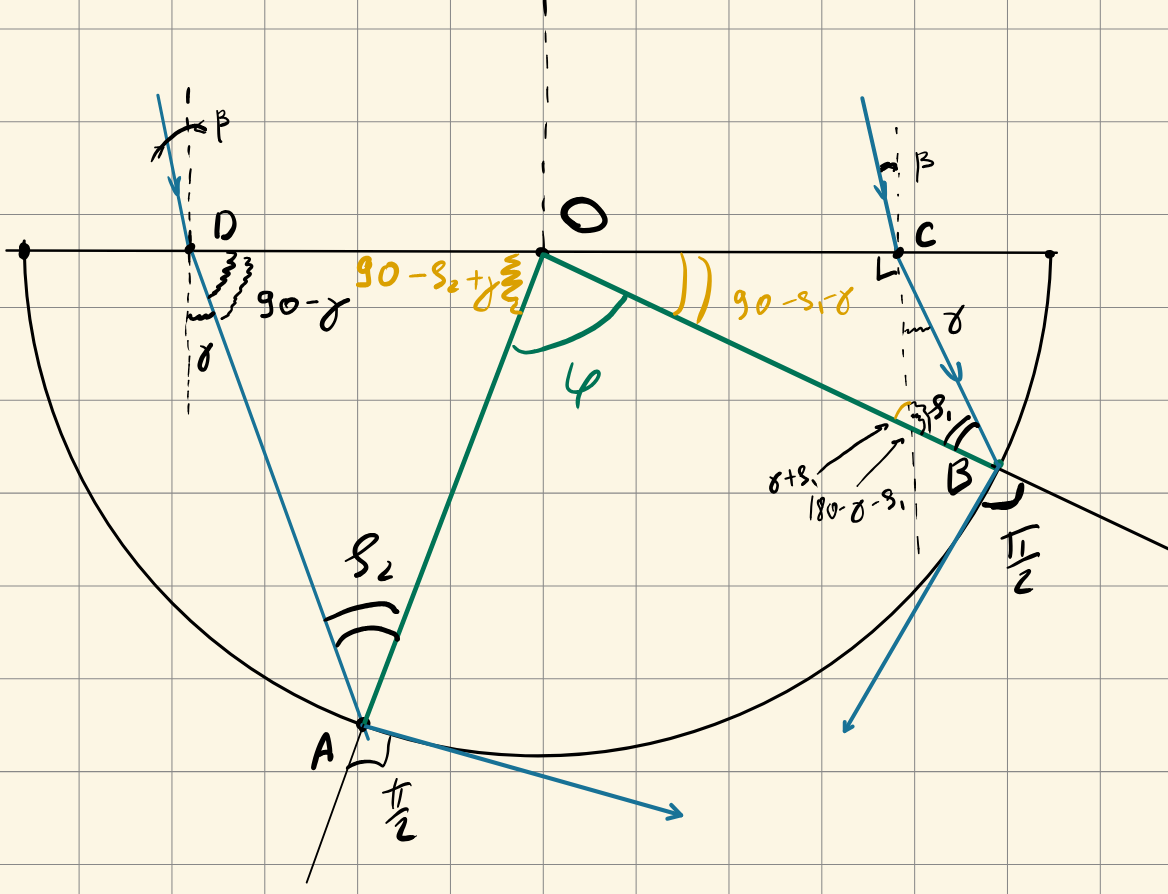
| From points D and C, draw rays from the external medium to points A and B respectively. | | From points D and C, draw rays from the external medium to points A and B respectively. |
| Then we have triangles $\triangle DOA$ and $\triangle CBO$, where the angles $\rho_{1}$ and $\rho_{2}$ are known, and the angles ODA and OCB are equal to $\frac{\pi}{2} - \gamma$, where $\gamma$ is the angle of the refracted ray from the external medium into the cylinder (see Fig. 2). | | Then we have triangles $\triangle DOA$ and $\triangle CBO$, where the angles $\rho_{1}$ and $\rho_{2}$ are known, and the angles ODA and OCB are equal to $\frac{\pi}{2} - \gamma$, where $\gamma$ is the angle of the refracted ray from the external medium into the cylinder (see Fig. 2). |
| | | |
| \[ | | \[ |
| \sin(\beta) = n \sin(\gamma) \quad \Rightarrow \quad \gamma = \arcsin\left(\frac{1}{n\sqrt{2}}\right) | | \sin(\beta) = n \sin(\gamma) \quad \Rightarrow \quad \gamma = \arcsin\left(\frac{1}{n\sqrt{2}}\right) |
| \] | | \] |
| ($\beta$ from the condition is $45^{\circ}$). | | ($\beta$ from the condition is $45^{\circ}$). |
| | | |
| Then from geometry, we find: | | Then from geometry, we find: |
| | | |
| \[ | | \[ |
| \begin{cases} | | \begin{cases} |
| \angle DOA = \dfrac{\pi}{2} - \rho + \gamma \\\\ | | \angle DOA = \dfrac{\pi}{2} - \rho + \gamma \\\\ |
| \angle COB = \dfrac{\pi}{2} - \rho - \gamma | | \angle COB = \dfrac{\pi}{2} - \rho - \gamma |
| \end{cases} | | \end{cases} |
| \] | | \] |
| | | |
|  | |  |
| | | |
| #### (3) Now we find $\phi$: | | #### (3) Now we find $\phi$: |
| | | |
| \[ | | \[ |
| \phi = \pi - (\angle DOA + \angle COB) = \pi - \left( \frac{\pi}{2} - \rho + \gamma + \frac{\pi}{2} - \rho - \gamma \right) = 2\rho = 2\arcsin\left(\frac{1}{n}\right) | | \phi = \pi - (\angle DOA + \angle COB) = \pi - \left( \frac{\pi}{2} - \rho + \gamma + \frac{\pi}{2} - \rho - \gamma \right) = 2\rho = 2\arcsin\left(\frac{1}{n}\right) |
| \] | | \] |
| | | |
| | | |
| ### Answer : | | ### Answer : |
| \[ | | \[ |
| \boxed{\phi = 2\arcsin\left(\frac{1}{n}\right)} | | \boxed{\phi = 2\arcsin\left(\frac{1}{n}\right)} |
| \] | | \] |
