| ### Statement | | ### Statement |
| | | |
| $12.2.11.$ | | $12.2.11.$ |
| | | |
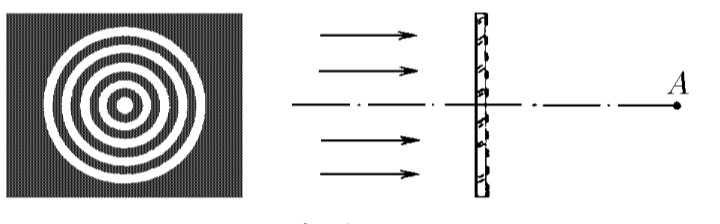
| The drawing shows a flat glass plate with blackened ring sections. This | | The drawing shows a flat glass plate with blackened ring sections. This |
| plate overlapped a parallel beam of monochromatic light with a wavelength | | plate overlapped a parallel beam of monochromatic light with a wavelength |
| λ. It turned out that the blackened rings of the plate coincided with even | | λ. It turned out that the blackened rings of the plate coincided with even |
| Fresnel zones for the axial point A. How did the light intensity change at this | | Fresnel zones for the axial point A. How did the light intensity change at this |
| point? | | point? |
| b. A parallel beam of monochromatic light was blocked by a plate in which the | | b. A parallel beam of monochromatic light was blocked by a plate in which the |
| blackened ring sections were replaced by layers of a dielectric that changes the | | blackened ring sections were replaced by layers of a dielectric that changes the |
| phase of the passing wave by π. How did the light intensity change at point | | phase of the passing wave by π. How did the light intensity change at point |
| A in this case? | | A in this case? |
| | | |
|  | |  |
| | | |
| ### Solution | | ### Solution |
| | | |
| Data: | | Data: |
| | | |
| Parallel beam of monochromatic light of wavelength $\lambda$ | | Parallel beam of monochromatic light of wavelength $\lambda$ |
| | | |
| Observation point A on the axis. | | Observation point A on the axis. |
| | | |
| The plate has rings that coincide with the Fresnel zones. | | The plate has rings that coincide with the Fresnel zones. |
| | | |
| It is considered that the plate covers the first m = 9 Fresnel zones. | | It is considered that the plate covers the first m = 9 Fresnel zones. |
| | | |
| Reference amplitude (without plate): | | Reference amplitude (without plate): |
| With the entire wavefront open, the amplitude at A is half of the first zone: | | With the entire wavefront open, the amplitude at A is half of the first zone: |
| | | |
| $A_{\text{free}} \approx \frac{A_1}{2}$ | | $A_{\text{free}} \approx \frac{A_1}{2}$ |
| | | |
| and the corresponding intensity is | | and the corresponding intensity is |
| | | |
| $ I_0 \propto \left(\frac{A_1}{2}\right)^2 = \frac{A_1^2}{4}$ | | $ I_0 \propto \left(\frac{A_1}{2}\right)^2 = \frac{A_1^2}{4}$ |
| | | |
| | | |
| Case (a): Opaque plate on even zones | | Case (a): Opaque plate on even zones |
| | | |
| The plate has the even zones blackened out (blocked): 2, 4, 6, 8. | | The plate has the even zones blackened out (blocked): 2, 4, 6, 8. |
| The odd zones remain open: 1, 3, 5, 7, 9 (five zones). | | The odd zones remain open: 1, 3, 5, 7, 9 (five zones). |
| Intensity: | | Intensity: |
| | | |
| $I_a \propto (5 A_1)^2 = 25 A_1^2$ | | $I_a \propto (5 A_1)^2 = 25 A_1^2$ |
| | | |
| Compared with the intensity without the plate: | | Compared with the intensity without the plate: |
| | | |
| $\frac{I_a}{I_0} = \frac{25 A_1^2}{A_1^2/4} = 25 \times 4 = 100$ | | $\frac{I_a}{I_0} = \frac{25 A_1^2}{A_1^2/4} = 25 \times 4 = 100$ |
| | | |
| $\boxed{\text{The intensity increases by a factor of 100.}}$ | | $\boxed{\text{The intensity increases by a factor of 100.}}$ |
| | | |
| --- | | --- |
| | | |
| Case (b): Phase plate (phase shift \pi) on even zones | | Case (b): Phase plate (phase shift \pi) on even zones |
| | | |
| The rings that were previously opaque are replaced by dielectric layers that add a phase shift of \pi to the wave passing through. | | The rings that were previously opaque are replaced by dielectric layers that add a phase shift of \pi to the wave passing through. |
| | | |
| · The odd zones (1, 3, 5, 7, 9) pass with no phase change. | | · The odd zones (1, 3, 5, 7, 9) pass with no phase change. |
| · The even zones (2, 4, 6, 8) would normally arrive with a phase shift of $\pi $due to the path difference, but the layer adds another \pi, so they end up in phase with the odd ones. | | · The even zones (2, 4, 6, 8) would normally arrive with a phase shift of $\pi $due to the path difference, but the layer adds another \pi, so they end up in phase with the odd ones. |
| | | |
| Now all zones (9 in total) contribute constructively: | | Now all zones (9 in total) contribute constructively: |
| | | |
| $A_b = 9 A_1$ | | $A_b = 9 A_1$ |
| | | |
| Intensity: | | Intensity: |
| | | |
| $I_b \propto (9 A_1)^2 = 81 A_1^2$ | | $I_b \propto (9 A_1)^2 = 81 A_1^2$ |
| | | |
| Compared with the intensity without the plate: | | Compared with the intensity without the plate: |
| | | |
| $\frac{I_b}{I_0} = \frac{81 A_1^2}{A_1^2/4} = 81 \times 4 = 324$ | | $\frac{I_b}{I_0} = \frac{81 A_1^2}{A_1^2/4} = 81 \times 4 = 324$ |
| | | |
| $\boxed{\text{The intensity increases by a factor of 324.}}$ | | $\boxed{\text{The intensity increases by a factor of 324.}}$ |
| | | |
| #### Answer | | #### Answer |
| | | |
| $\boxed{\text{The intensity increases by a factor of 324.}}$ | | $\boxed{\text{The intensity increases by a factor of 324.}}$ |
| | | |
| $\boxed{\text{The intensity increases by a factor of 100.}}$ | | $\boxed{\text{The intensity increases by a factor of 100.}}$ |
