Edits to “Statement”, “Solution”, “Answer”

en/6.5.8.md
+43 −3
| @@ -1,11 +1,51 @@ | |||
| ### Statement | |||
| − | $6.5.8.$ | ||
| + | $6.5.8.$ | ||
| + | $a. \ $ A charge $q$ is placed in the center of a uniformly charged hemisphere with a surface charge density $\sigma$. With what force does this charge act on the hemisphere? on half of the hemisphere $(1)$? on the fourth part of it $(2)$? Determine the electric field strength from these parts of the sphere at its center. | ||
| + | |||
| + | $b. \ $ Determine the electric field strength in the center of a uniformly charged hemisphere of radius $R$ with a volume charge density $\rho$. | ||
| + | |||
| + | 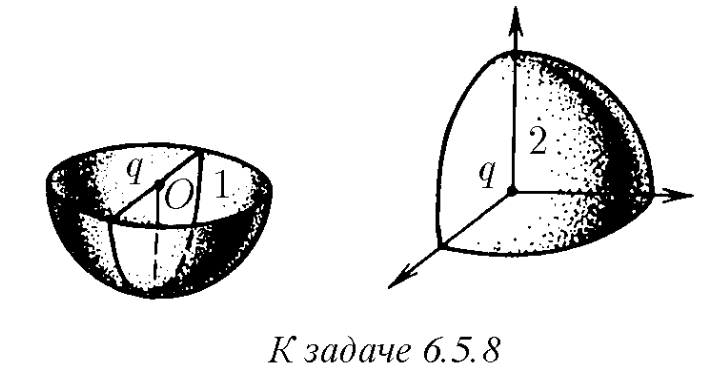 | ||
| + | |||
| ### Solution | |||
| + | Immediately: | ||
| + | $$ | ||
| + | \vec F = q \vec E | ||
| + | $$ | ||
| + | Therefore, it is sufficient to find either the force or the field, and then the other can be trivially obtained. This is useful because it is easiest to calculate the force directly, and not from the field of a spherical segment acting on the charge, but rather the other way around: | ||
| + | $$ | ||
| + | \vec{dF} = \frac{q}{4\pi\varepsilon_0 R^2} \sigma \, \vec{dS}. | ||
| + | $$ | ||
| + | For our shapes, integrating the projections gives, in general, | ||
| + | $$ | ||
| + | F = \frac{q\sigma}{4\pi\varepsilon_0 R^2} \sqrt{S_x^2 + S_y^2 + S_z^2}. | ||
| + | $$ | ||
| + | Now place the origin at the centre of the sphere, with the $xy$ plane along one of the cuts, and after simple calculations we obtain (let $S = \pi R^2$): | ||
| + | $$ | ||
| + | F_1 = \frac{q\sigma}{4\pi\varepsilon_0 R^2} \sqrt{0^2 + 0^2 + S^2} = \frac{q\sigma}{4\varepsilon_0}, | ||
| + | $$ | ||
| + | $$ | ||
| + | F_2 = \frac{q\sigma}{4\pi\varepsilon_0 R^2} \sqrt{0^2 + (S/2)^2 + (S/2)^2} = \frac{\sqrt{2}\, q\sigma}{8\varepsilon_0}, | ||
| + | $$ | ||
| + | $$ | ||
| + | F_3 = \frac{q\sigma}{4\pi\varepsilon_0 R^2} \sqrt{(S/4)^2 + (S/4)^2 + (S/4)^2} = \frac{\sqrt{3}\, q\sigma}{16\varepsilon_0}. | ||
| + | $$ | ||
| + | It is important to remember here that the projection here is not the shadow of the figure. We are working with the normals to the surface. The same results can be obtained by integrating in spherical coordinates. | ||
| − | 1 | ||
| + | Solving part (b), we use the result for a hemisphere. Divide the hemisphere into concentric hemispherical shells of thickness $dR$: | ||
| + | $$ | ||
| + | E = \int_0^R \frac{\rho}{4\varepsilon_0} dR = \frac{R\rho}{4\varepsilon_0}. | ||
| + | $$ | ||
| #### Answer | |||
| − | [Insert a concise answer or boxed result] | ||
| + | $$ | ||
| + | a. \ F_1=\frac{q\sigma}{4\varepsilon_0}, \quad F_2=\frac{\sqrt{2}q\sigma}{8\varepsilon_0}, \quad F_3=\frac{\sqrt{3}q\sigma}{16\varepsilon_0} | ||
| + | $$ | ||
| + | $$ | ||
| + | E_1=\frac{\sigma}{4\varepsilon_0}, \quad E_2=\frac{\sqrt{2}\sigma}{8\varepsilon_0}, \quad E_3=\frac{\sqrt{3}\sigma}{16\varepsilon_0} | ||
| + | $$ | ||
| + | $$ | ||
| + | b. \ E=\frac{R\rho}{4\varepsilon_0} | ||
| + | $$ | ||
| @@ -1,11 +1,51 @@ | |||
| ### Statement | ### Statement | ||
| $6.5.8.$ |
$6.5.8.$ | ||
| $a. \ $ A charge $q$ is placed in the center of a uniformly charged hemisphere with a surface charge density $\sigma$. With what force does this charge act on the hemisphere? on half of the hemisphere $(1)$? on the fourth part of it $(2)$? Determine the electric field strength from these parts of the sphere at its center. | |||
| $b. \ $ Determine the electric field strength in the center of a uniformly charged hemisphere of radius $R$ with a volume charge density $\rho$. | |||
|  | |||
| ### Solution | ### Solution | ||
| Immediately: | |||
| $$ | |||
| \vec F = q \vec E | |||
| $$ | |||
| Therefore, it is sufficient to find either the force or the field, and then the other can be trivially obtained. This is useful because it is easiest to calculate the force directly, and not from the field of a spherical segment acting on the charge, but rather the other way around: | |||
| $$ | |||
| \vec{dF} = \frac{q}{4\pi\varepsilon_0 R^2} \sigma \, \vec{dS}. | |||
| $$ | |||
| For our shapes, integrating the projections gives, in general, | |||
| $$ | |||
| F = \frac{q\sigma}{4\pi\varepsilon_0 R^2} \sqrt{S_x^2 + S_y^2 + S_z^2}. | |||
| $$ | |||
| Now place the origin at the centre of the sphere, with the $xy$ plane along one of the cuts, and after simple calculations we obtain (let $S = \pi R^2$): | |||
| $$ | |||
| F_1 = \frac{q\sigma}{4\pi\varepsilon_0 R^2} \sqrt{0^2 + 0^2 + S^2} = \frac{q\sigma}{4\varepsilon_0}, | |||
| $$ | |||
| $$ | |||
| F_2 = \frac{q\sigma}{4\pi\varepsilon_0 R^2} \sqrt{0^2 + (S/2)^2 + (S/2)^2} = \frac{\sqrt{2}\, q\sigma}{8\varepsilon_0}, | |||
| $$ | |||
| $$ | |||
| F_3 = \frac{q\sigma}{4\pi\varepsilon_0 R^2} \sqrt{(S/4)^2 + (S/4)^2 + (S/4)^2} = \frac{\sqrt{3}\, q\sigma}{16\varepsilon_0}. | |||
| $$ | |||
| It is important to remember here that the projection here is not the shadow of the figure. We are working with the normals to the surface. The same results can be obtained by integrating in spherical coordinates. | |||
| 1 | Solving part (b), we use the result for a hemisphere. Divide the hemisphere into concentric hemispherical shells of thickness $dR$: | ||
| $$ | |||
| E = \int_0^R \frac{\rho}{4\varepsilon_0} dR = \frac{R\rho}{4\varepsilon_0}. | |||
| $$ | |||
| #### Answer | #### Answer | ||
| [Insert a concise answer or boxed result] | $$ | ||
| a. \ F_1=\frac{q\sigma}{4\varepsilon_0}, \quad F_2=\frac{\sqrt{2}q\sigma}{8\varepsilon_0}, \quad F_3=\frac{\sqrt{3}q\sigma}{16\varepsilon_0} | |||
| $$ | |||
| $$ | |||
| E_1=\frac{\sigma}{4\varepsilon_0}, \quad E_2=\frac{\sqrt{2}\sigma}{8\varepsilon_0}, \quad E_3=\frac{\sqrt{3}\sigma}{16\varepsilon_0} | |||
| $$ | |||
| $$ | |||
| b. \ E=\frac{R\rho}{4\varepsilon_0} | |||
| $$ | |||