Edits to “Statement”, “Solution”, “Answer”

en/14.5.18.md
+41 −4
| @@ -1,11 +1,48 @@ | |||
| ### Statement | |||
| − | $14.5.18.$ [Insert the problem statement] | ||
| + | $14.5.18.$ Determine the minimum energy of an electron and a positron which, having equal velocities directed at an angle $\alpha$ to each other, can produce a proton–antiproton pair: $e^+ + e^- \rightarrow p + \bar{p}$. | ||
| + | $^*$ There is a minor misprint in the equation in the problem statement. | ||
| + | |||
| + | 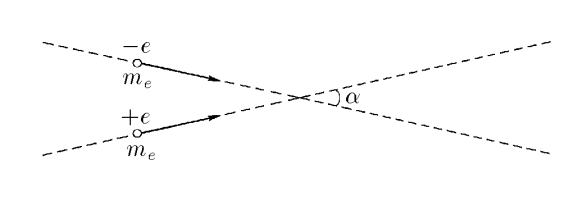 | ||
| + | |||
| ### Solution | |||
| − | 1 | ||
| + | Let $\mathcal{E}$ be the required energy. Write the relativistic invariant for the initial state: | ||
| + | $$ | ||
| + | I = 4\mathcal{E}^2 - (\vec{p}_{e^+} + \vec{p}_{e^-})^2 c^2 \tag{1} | ||
| + | $$ | ||
| + | Note that the sum of momenta is a vector sum! It is also important that the invariant is not equal to the square of the sum of the rest energies of the electron and positron. Indeed, by definition | ||
| + | $$ | ||
| + | I = M_{\text{sys}}^2 c^4 = \biggl(\sum_i E_i\biggr)^{2} - \biggl(\sum_i \mathbf{p}_i\biggr)^{2} c^2, | ||
| + | $$ | ||
| + | and the directions of the momenta of the particles entering the system affect the result. Put differently: the rest mass of a system is not necessarily equal to the sum of the rest masses of its components. But let us return to the problem. | ||
| − | #### Answer | ||
| + | Let $p_{e^+} = p_{e^-} = p$, and for each particle | ||
| + | $$ | ||
| + | \mathcal{E}^2 = p^2 c^2 + m_e^2 c^4. \tag{2} | ||
| + | $$ | ||
| + | Then, carefully multiplying the vectors and using trigonometry: | ||
| + | $$ | ||
| + | I = 4\mathcal{E}^2 - 2p^2 c^2 (1 + \cos\alpha) = 4\mathcal{E}^2 - 4(\mathcal{E}^2 - m_e^2 c^4)\cos^2\frac{\alpha}{2}, | ||
| + | $$ | ||
| + | $$ | ||
| + | I = 4\mathcal{E}^2 \sin^2\frac{\alpha}{2} + 4m_e^2 c^4 \cos^2\frac{\alpha}{2}. \tag{3} | ||
| + | $$ | ||
| + | For the energy spent on pair production to be minimal, the final particles must be at rest relative to each other. In this particular case, the invariant is just the square of the sum of the rest energies of the particles: | ||
| + | $$ | ||
| + | I = (2m_p c^2)^2. \tag{4} | ||
| + | $$ | ||
| + | Equating (3) = (4) and transforming slightly: | ||
| + | $$ | ||
| + | \mathcal{E}^2 \sin^2\frac{\alpha}{2} = m_p^2 c^4 - m_e^2 c^4 \cos^2\frac{\alpha}{2}, | ||
| + | $$ | ||
| + | $$ | ||
| + | \mathcal{E} = m_p c^2 \sqrt{1 + \left(1 - \frac{m_e^2}{m_p^2} \right) \cot^2\frac{\alpha}{2} }. | ||
| + | $$ | ||
| + | We can analyse: for $\alpha = \pi$ (head‑on beams), $\mathcal{E} = m_p c^2$; for $\alpha = 0$, the reaction is impossible. | ||
| − | [Insert a concise answer or boxed result] | ||
| + | #### Answer | ||
| + | $$ | ||
| + | \boxed{\mathcal{E} = m_p c^2 \sqrt{1 + \left(1 - \frac{m_e^2}{m_p^2} \right) \cot^2\frac{\alpha}{2} }} | ||
| + | $$ | ||
| @@ -1,11 +1,48 @@ | |||
| ### Statement | ### Statement | ||
| $14.5.18.$ [Insert the problem statement] | $14.5.18.$ Determine the minimum energy of an electron and a positron which, having equal velocities directed at an angle $\alpha$ to each other, can produce a proton–antiproton pair: $e^+ + e^- \rightarrow p + \bar{p}$. | ||
| $^*$ There is a minor misprint in the equation in the problem statement. | |||
|  | |||
| ### Solution | ### Solution | ||
| 1 | Let $\mathcal{E}$ be the required energy. Write the relativistic invariant for the initial state: | ||
| $$ | |||
| I = 4\mathcal{E}^2 - (\vec{p}_{e^+} + \vec{p}_{e^-})^2 c^2 \tag{1} | |||
| $$ | |||
| Note that the sum of momenta is a vector sum! It is also important that the invariant is not equal to the square of the sum of the rest energies of the electron and positron. Indeed, by definition | |||
| $$ | |||
| I = M_{\text{sys}}^2 c^4 = \biggl(\sum_i E_i\biggr)^{2} - \biggl(\sum_i \mathbf{p}_i\biggr)^{2} c^2, | |||
| $$ | |||
| and the directions of the momenta of the particles entering the system affect the result. Put differently: the rest mass of a system is not necessarily equal to the sum of the rest masses of its components. But let us return to the problem. | |||
| #### Answer | Let $p_{e^+} = p_{e^-} = p$, and for each particle | ||
| $$ | |||
| \mathcal{E}^2 = p^2 c^2 + m_e^2 c^4. \tag{2} | |||
| $$ | |||
| Then, carefully multiplying the vectors and using trigonometry: | |||
| $$ | |||
| I = 4\mathcal{E}^2 - 2p^2 c^2 (1 + \cos\alpha) = 4\mathcal{E}^2 - 4(\mathcal{E}^2 - m_e^2 c^4)\cos^2\frac{\alpha}{2}, | |||
| $$ | |||
| $$ | |||
| I = 4\mathcal{E}^2 \sin^2\frac{\alpha}{2} + 4m_e^2 c^4 \cos^2\frac{\alpha}{2}. \tag{3} | |||
| $$ | |||
| For the energy spent on pair production to be minimal, the final particles must be at rest relative to each other. In this particular case, the invariant is just the square of the sum of the rest energies of the particles: | |||
| $$ | |||
| I = (2m_p c^2)^2. \tag{4} | |||
| $$ | |||
| Equating (3) = (4) and transforming slightly: | |||
| $$ | |||
| \mathcal{E}^2 \sin^2\frac{\alpha}{2} = m_p^2 c^4 - m_e^2 c^4 \cos^2\frac{\alpha}{2}, | |||
| $$ | |||
| $$ | |||
| \mathcal{E} = m_p c^2 \sqrt{1 + \left(1 - \frac{m_e^2}{m_p^2} \right) \cot^2\frac{\alpha}{2} }. | |||
| $$ | |||
| We can analyse: for $\alpha = \pi$ (head‑on beams), $\mathcal{E} = m_p c^2$; for $\alpha = 0$, the reaction is impossible. | |||
| [Insert a concise answer or boxed result] | #### Answer | ||
| $$ | |||
| \boxed{\mathcal{E} = m_p c^2 \sqrt{1 + \left(1 - \frac{m_e^2}{m_p^2} \right) \cot^2\frac{\alpha}{2} }} | |||
| $$ | |||