Edits to “Statement”, “Solution”, “Answer”

en/11.6.2.md
+23 −4
| @@ -1,11 +1,30 @@ | |||
| ### Statement | |||
| + | $11.6.2.$ $a.$ | ||
| − | $11.6.2.$ [Insert the problem statement] | ||
| + | A parallel‑plate capacitor moves with velocity $v$, as shown in the figure. The electric field strength between the plates is $E$. Determine the rate of change of the electric flux through the rectangular contour $abcd$ and the circulation of the magnetic induction around this contour. How are the sought quantities related to each other in SI? In CGS? | ||
| + | $b.$ Give examples confirming the proportionality of the circulation of the magnetic induction around a contour to the rate of change of the electric flux through the surface bounded by this contour. | ||
| + | |||
| ### Solution | |||
| + | 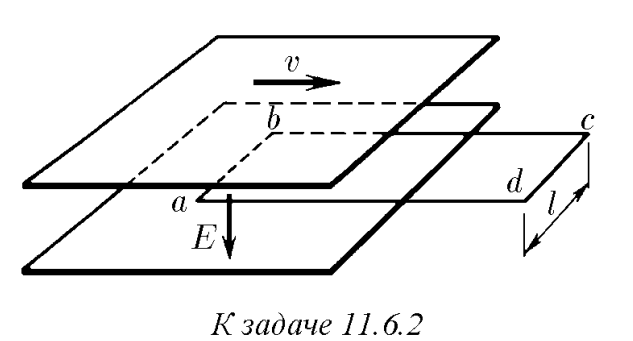 | ||
| + | $a.$ | ||
| + | $$ | ||
| + | \frac{dN}{dt} = E \frac{dS}{dt} = v l E. | ||
| + | $$ | ||
| + | Choose a surface passing through the capacitor: | ||
| + | $$ | ||
| + | C_B = \int \vec B \, d\vec l = \mu_0 \sum I = \mu_0 \frac{\sigma l \cdot v \, dt}{dt} = \mu_0 \varepsilon_0 v l E. | ||
| + | $$ | ||
| + | Using the solution of problem 11.6.1, this can be generalised for any surface: | ||
| + | $$ | ||
| + | C_B = \mu_0 \varepsilon_0 \frac{dN}{dt} \quad \text{(in SI)}, \qquad C_B = \frac{1}{c} \frac{dN}{dt} \quad \text{(in CGS)}. | ||
| + | $$ | ||
| + | $b.$ | ||
| + | Charging capacitor: | ||
| − | 1 | ||
| + | When a capacitor is charging, current flows in the wires, but there is no current between the plates. The changing electric field between the plates maintains the circulation of $B$ around a contour that does not intersect the conductor, equal to the circulation around a contour that does intersect the conductor: $C_B = \mu_0 I$ for a surface crossing the conductor. | ||
| #### Answer | |||
| − | |||
| − | [Insert a concise answer or boxed result] | ||
| + | $$ | ||
| + | \boxed { a. \ \frac{dN}{dt} = v l E, \quad C_B = \mu_0 \varepsilon_0 v l E, \quad C_B = \mu_0 \varepsilon_0 \frac{dN}{dt} \ \text{(in SI)}, \quad C_B = \frac{1}{c} \frac{dN}{dt} \ \text{(in CGS)}. } | ||
| + | $$ | ||
| @@ -1,11 +1,30 @@ | |||
| ### Statement | ### Statement | ||
| $11.6.2.$ $a.$ | |||
| $11.6.2.$ [Insert the problem statement] | A parallel‑plate capacitor moves with velocity $v$, as shown in the figure. The electric field strength between the plates is $E$. Determine the rate of change of the electric flux through the rectangular contour $abcd$ and the circulation of the magnetic induction around this contour. How are the sought quantities related to each other in SI? In CGS? | ||
| $b.$ Give examples confirming the proportionality of the circulation of the magnetic induction around a contour to the rate of change of the electric flux through the surface bounded by this contour. | |||
| ### Solution | ### Solution | ||
|  | |||
| $a.$ | |||
| $$ | |||
| \frac{dN}{dt} = E \frac{dS}{dt} = v l E. | |||
| $$ | |||
| Choose a surface passing through the capacitor: | |||
| $$ | |||
| C_B = \int \vec B \, d\vec l = \mu_0 \sum I = \mu_0 \frac{\sigma l \cdot v \, dt}{dt} = \mu_0 \varepsilon_0 v l E. | |||
| $$ | |||
| Using the solution of problem 11.6.1, this can be generalised for any surface: | |||
| $$ | |||
| C_B = \mu_0 \varepsilon_0 \frac{dN}{dt} \quad \text{(in SI)}, \qquad C_B = \frac{1}{c} \frac{dN}{dt} \quad \text{(in CGS)}. | |||
| $$ | |||
| $b.$ | |||
| Charging capacitor: | |||
| 1 | When a capacitor is charging, current flows in the wires, but there is no current between the plates. The changing electric field between the plates maintains the circulation of $B$ around a contour that does not intersect the conductor, equal to the circulation around a contour that does intersect the conductor: $C_B = \mu_0 I$ for a surface crossing the conductor. | ||
| #### Answer | #### Answer | ||
| $$ | |||
| [Insert a concise answer or boxed result] | \boxed { a. \ \frac{dN}{dt} = v l E, \quad C_B = \mu_0 \varepsilon_0 v l E, \quad C_B = \mu_0 \varepsilon_0 \frac{dN}{dt} \ \text{(in SI)}, \quad C_B = \frac{1}{c} \frac{dN}{dt} \ \text{(in CGS)}. } | ||
| $$ | |||