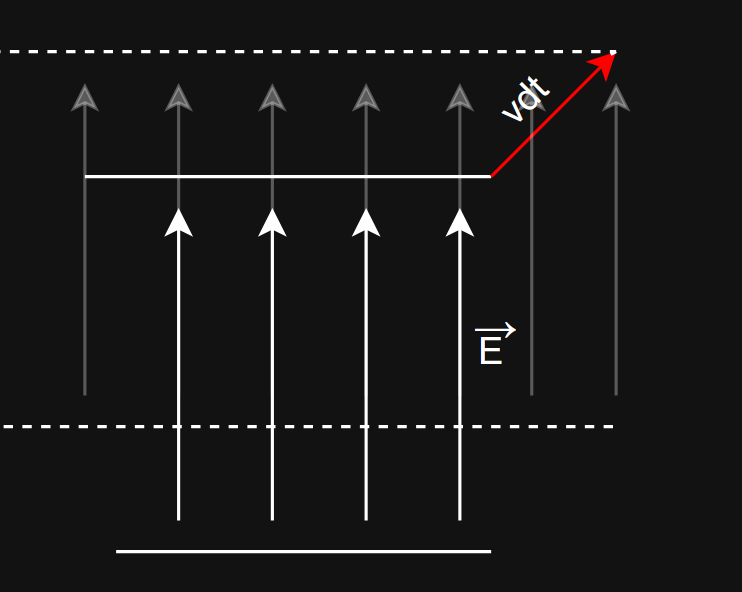
11.6.7. A parallel‑plate capacitor, with electric field strength $E$ inside it, moves with velocity $v$. The velocity makes an angle $\alpha$ with the plates. What is the magnetic induction inside the capacitor?
Solution
The magnetic field here can arise due to the change in the electric flux. This phenomenon is described by the equation used in the previous problems: $$\oint \vec B \, d\vec l = \mu_0 \varepsilon_0 \frac{d}{dt} \left( \int \vec E \, d\vec S \right). \tag{1}$$ Over a small time interval, the capacitor shifts by $v\,dt$ in the direction of the velocity. Choose a contour of width $l$ and small length $v\,dt$ as follows:
We see that during the time $dt$, the field through this contour changes from $0$ to $E$. Then, rewriting (1) in scalar form:
$$B \cdot l = \mu_0 \varepsilon_0 \frac{d(E \cdot l v \cos\alpha \\, dt)}{dt},$$$$B = \mu_0 \varepsilon_0 E v \cos\alpha. \tag{2}$$
P.S. From this it follows that when the capacitor moves perpendicularly to the plates, no magnetic field appears at all.
Answer
$$\boxed{B = \mu_0 \varepsilon_0 E v \cos\alpha}.$$