10.1.12∗. Electrons are emitted from one point with velocity $v$ along a uniform magnetic field of induction $B$, having a small angular spread $\delta\alpha$. Determine at what distance from the emission point the beam will have a minimum transverse size, and estimate that size.
Solution
Before solving this problem, I recommend to solve problem 10.1.10.
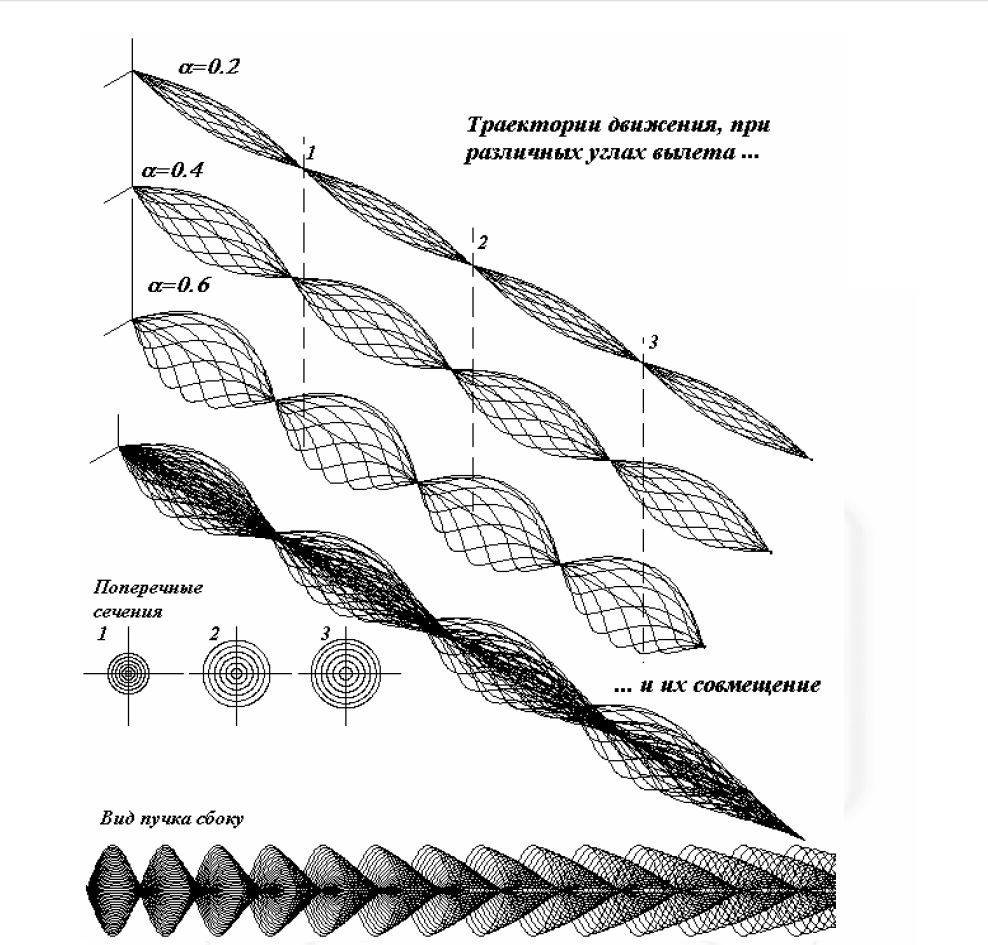
The illustration and idea of the solution are taken from the publication "Slobodyanyuk A.I. ‘Very Long Physics Problems’ Part 2. Problems 10–18". ("Слободянюк А.И. «Очень длинные физические задачи» Часть 2. Задачи 10 – 18" )
Each particle moves along a helical trajectory, whose radius depends on the particle's emission angle. Moreover, the helices are not coaxial; they all touch one straight line – the beam axis. If the angle between the particle velocity and the magnetic induction vector is small, then all helical trajectories have approximately the same pitch (Assumption 1), so at a distance equal to the helix pitch a focusing effect will be observed.
Consider a group of particles emitted at the same angle $\beta$ to the beam axis. Over some time $t$ they traverse an arc of a circle of angle $\varphi = \frac{2\pi t}{T}$ ($T$ is the cyclotron period) with radius $R = \frac{m_e v \sin\beta}{eB}$, move away from the beam axis by a distance $r = \left| 2R \sin\frac{\varphi}{2} \right|$, and shift along the axis by $x = vt \cos\beta$. From this we obtain:
$$r = \left| 2 \frac{m_e v \sin\beta}{eB} \sin\left( \frac{2\pi x}{2T v \cos\beta} \right) \right| = \left| 2 \frac{m_e v \sin\beta}{eB} \sin\left( \frac{eB x}{2 m_e v \cos\beta} \right) \right|. \tag{1}$$
$\beta \le \frac{\delta\alpha}{2}$, and the angle $\delta\alpha$ is small, so $\cos\beta \approx 1$,$\sin\beta \approx \beta$ (Assumption 2).
The beam width is determined by the particles emitted at the maximum angle $\beta = \frac{\delta\alpha}{2}$; thus the function describing the beam radius versus coordinate $x$ has the form
$$r(x) = \frac{m v (\delta\alpha)}{eB} \left| \sin\left( \frac{eB x}{2 m v} \right) \right|. \tag{2}$$
The minima of this function correspond to the "focal distances" of the system:
$$x_f = \frac{2\pi m v}{eB} k, \qquad k \in \mathbb{N}. \tag{3}$$
Note that for small $k$ Assumption 1 works better (see the figure), so the answer is given for $k=1$.
To determine the beam width in the focal region, it is necessary to take into account the dependence of the longitudinal velocity component on the emission angle. To do this, we refine Assumption 2 for the cosine: $\cos\beta \approx 1 - \frac{\beta^2}{2}$ (Assumption 3), and rewrite equation (1) for the focal region:
$$r(x) = \frac{2 m_e v \beta}{eB} \left| \sin\left( \frac{eB x_f}{2 m_e v (1 - \frac{\beta^2}{2})} \right) \right| = \frac{2 m_e v \beta}{eB} \left| \sin\left( \frac{\pi}{1 - \frac{\beta^2}{2}} \right) \right|. \tag{4}$$
The maximum value of this function corresponds to the maximum emission angle, so the beam width is given by