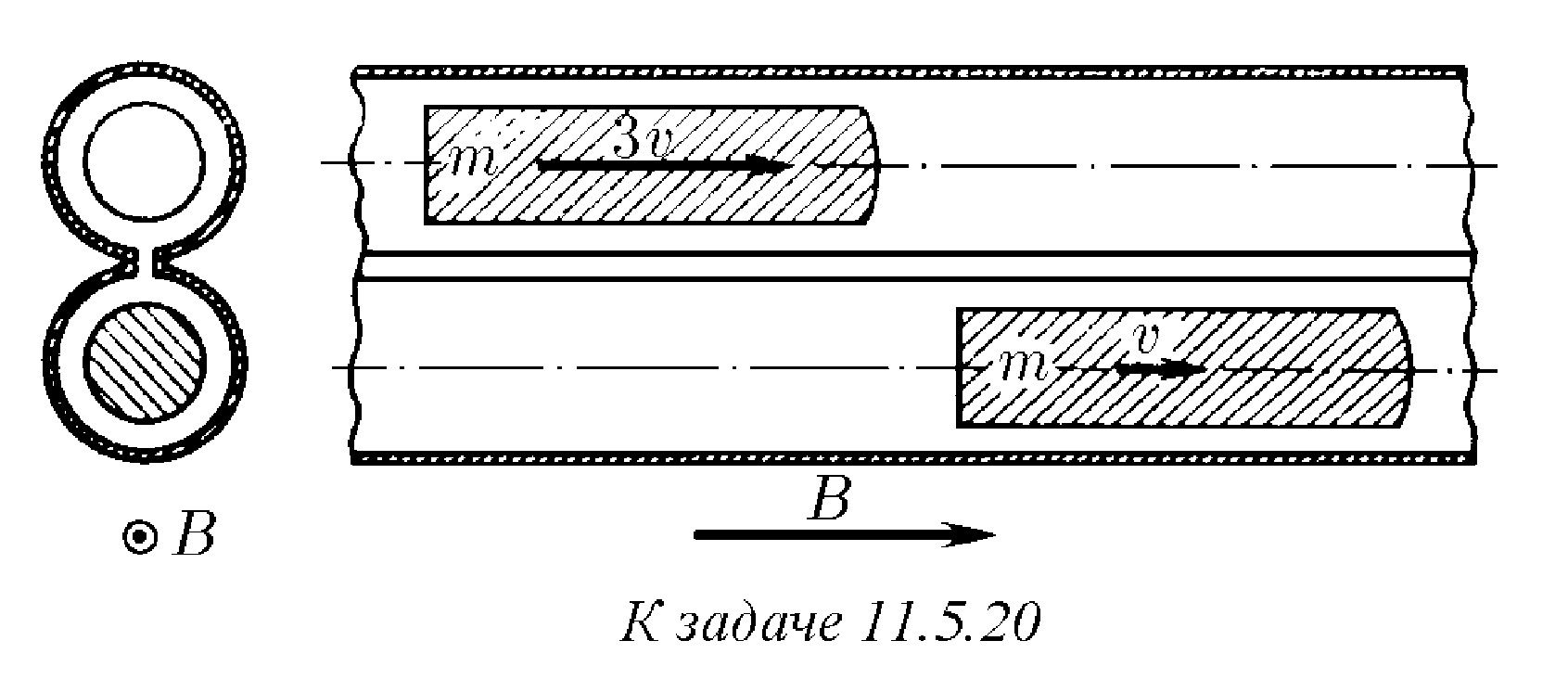
11.5.20. The two-channel magnetic energy redistributor of projectiles has the following design. Two metal pipes with a slot are connected by metal bridges as shown in the figure. The homogeneous magnetic field of induction $B$ is directed along the axis of the tubes. The same long superconducting projectiles move along the axis of each tube. One of the projectiles, which has a velocity of $3v$, catches up with the second projectile, which has a velocity of $v$. The length of each projectile is $l$, the cross section is $s$, and the mass is $m$. The cross section of each pipe is $S$. Determine the velocity of the projectiles after their interaction. Pipe resistance should be ignored.
For problem $11.5.20$
### Solution
Let's take a closer look at the picture. To do this, it is convenient to switch to the center-of-mass system, as the projectiles are moving towards each other with a velocity of $\upsilon$. In the part of the pipe that is free from projectiles, the energy per unit length is equal to: $$\omega_0 = \frac{B^2 S}{\mu_0}$$ In the cross-section of each projectile in both pipes, the induction has a different value, which is determined by the law of conservation of magnetic flux: $$B_1 = \frac{2BS}{2S - s}$$ Hence the energy per unit length in a cross-section with one projectile: $$\omega_1 = \frac{2B^2 S^2}{\mu_0 (2S - s)}$$ And finally, if there are two projectiles in the cross-section, the induction is: $$B_2 = \frac{BS}{S-s}$$ The energy per unit length is: $$\omega_2 = \frac{B^2 S^2}{\mu_0 (S - s)}$$ While the projectiles are moving without overlapping, the energy is equal to: $$U_1 = 2\omega_1l + \omega_0L$$ When the projectiles slightly overlap by an amount x, the energy is equal to: $$U_2 = 2\omega_1 (l-x) + \omega_2x + \omega_0 (L + x)$$ Let's find the change in the field energy: $$\Delta U = -2\omega_1 x + \omega_2 x + \omega_0 x$$ Substitute $x=l$ and find: $$\Delta U = \frac{B^2 S s^2 l}{\mu_0 (2S - s)(S-s)}$$ If there is enough speed in this system to prevent a complete overlap, then this is an equivalent of an absolutely elastic collision, but if not, then the speeds remain the same: When $$m \upsilon^2 < \frac{B^2 l S s^2}{\mu_0 (S - s)(2S - s)}$$ $${\upsilon_1}' = \upsilon$$ $${\upsilon_2}' = 3\upsilon$$ When $$m \upsilon^2 > \frac{B^2 l S s^2}{\mu_0 (S - s)(2S - s)}$$ $${\upsilon_1}' = 3 \upsilon$$ $${\upsilon_2}' =\upsilon$$
Answer
When $$m \upsilon^2 < \frac{B^2 l S s^2}{\mu_0 (S - s)(2S - s)}$$ $${\upsilon_1}' = \upsilon$$ $${\upsilon_2}' = 3\upsilon$$ When $$m \upsilon^2 > \frac{B^2 l S s^2}{\mu_0 (S - s)(2S - s)}$$ $${\upsilon_1}' = 3 \upsilon$$ $${\upsilon_2}' = \upsilon$$