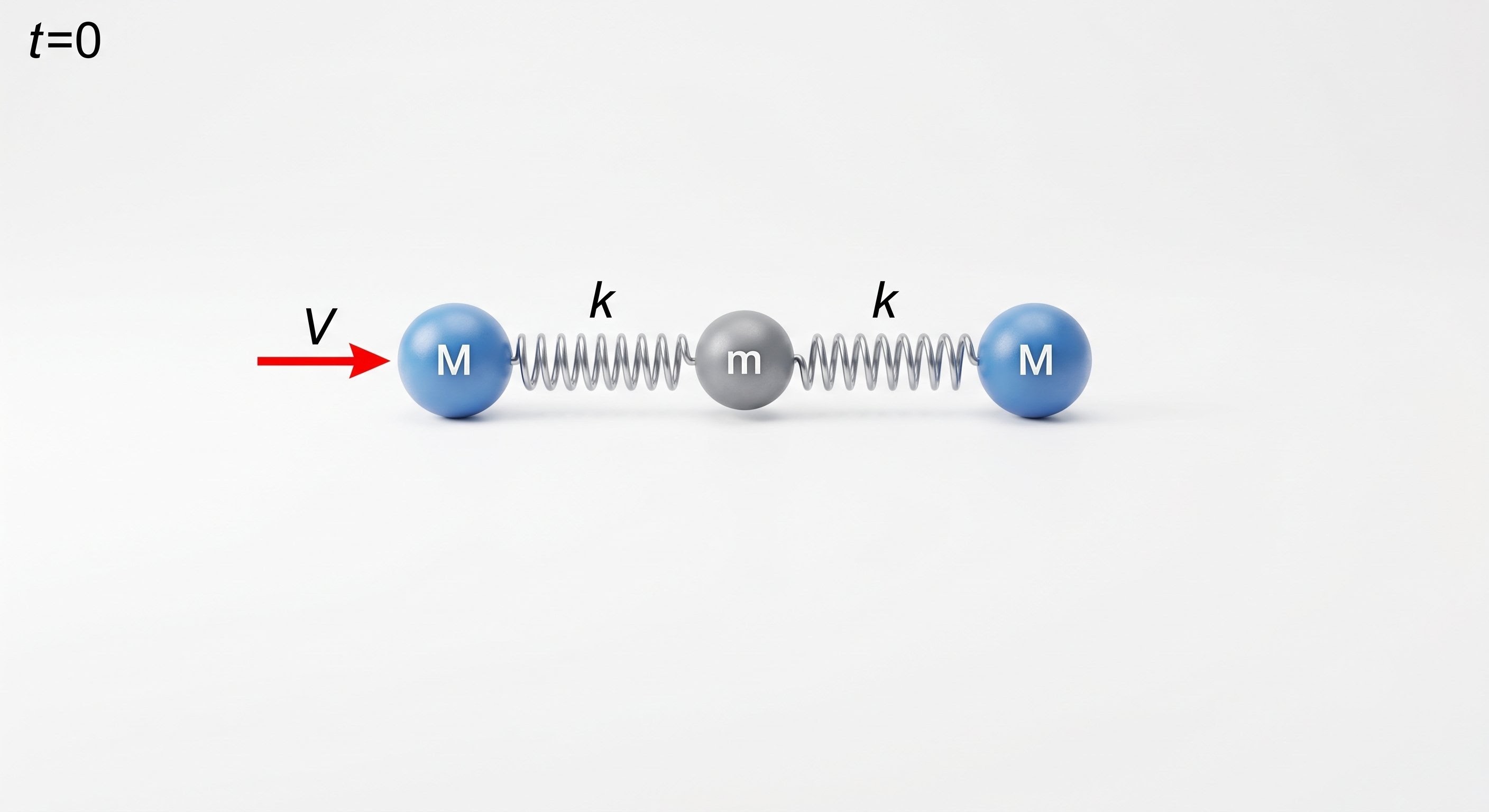
3.4.16∗. An oxygen atom in a carbon dioxide molecule is given a small velocity $v$ directed towards the carbon atom. Determine by how much the oxygen atom will approach the carbon atom. The mass of the oxygen atom is $M$, the mass of the carbon atom is $m$, and the stiffness of the bond between the atoms is $k$.
Solution
For problem $3.4.16$
The carbon dioxide molecule ($CO_2$) can be modeled as a system of three bodies: a central atom of mass $m$ (carbon) and two outer atoms of mass $M$ (oxygen), connected by two identical springs with a stiffness of $k$.
1. Transition to the center-of-mass frame (CM frame)
Let's find the velocity of the molecule's center of mass in the laboratory frame of reference after the left oxygen atom is given the velocity $v$: $$V_{cm} = \frac{Mv}{2M + m}$$
Let's transition to the inertial CM frame. In this frame, the velocities of the atoms immediately after the impact are:
Velocity of the left $O$:$v_1 = v - V_{cm} = \frac{v(M+m)}{2M+m}$
Velocity of the central $C$:$v_c = 0 - V_{cm} = -\frac{Mv}{2M+m}$
Velocity of the right $O$:$v_2 = 0 - V_{cm} = -\frac{Mv}{2M+m}$
2. Decomposition into normal modes
A system of three bodies on a single line has $3$ degrees of freedom. Subtracting $1$ degree of freedom corresponding to the translational motion of the entire molecule, we get exactly $2$ internal degrees of freedom. Therefore, any internal motion of the system can be represented as a superposition of exactly two independent normal modes of vibration. For the center of mass to remain stationary in each mode, they must have the following form:
Symmetric mode: the outer atoms move in antiphase with velocities $u_1$ and $-u_1$, while the central atom is at rest. Angular frequency: $$\omega_1 = \sqrt{\frac{k}{M}}$$
Asymmetric mode: the outer atoms move synchronously with velocity $u_2$, while the central atom moves towards them with velocity $u_c$. Angular frequency (taking into account the reduced mass): $$\omega_2 = \sqrt{\frac{k(2M+m)}{mM}}$$
3. Determination of initial mode amplitudes
From the superposition principle, the actual initial velocities in the CM frame are equal to the sum of the mode velocities. For the left O: $$u_1 + u_2 = \frac{v(M+m)}{2M+m}$$ For the right O: $$-u_1 + u_2 = -\frac{Mv}{2M+m}$$
Subtracting the equations, we find the initial velocity for the symmetric mode: $$2u_1 = v \implies u_1 = \frac{v}{2}$$ Adding the equations, we find the velocity of the outer atoms for the asymmetric mode: $$u_2 = \frac{mv}{2(2M+m)}$$ The velocity of the central atom in the second mode is equal to its total velocity in the CM frame: $$u_c = -\frac{Mv}{2M+m}$$
Mode amplitudes
The relative approach velocity between the left $O$ atom and the $C$ atom in the first (symmetric) mode is $v_{rel1} = u_1 = \frac{v}{2}$. Amplitude $A_1$: $$A_1 = \frac{v_{rel1}}{\omega_1} = \frac{v}{2}\sqrt{\frac{M}{k}}$$
The relative approach velocity between the left $O$ atom and the $C$ atom in the second (asymmetric) mode is: $$v_{rel2} = u_2 - u_c = \frac{mv}{2(2M+m)} - \left(-\frac{Mv}{2M+m}\right) = \frac{v(m+2M)}{2(2M+m)} = \frac{v}{2}$$ Amplitude $A_2$: $$A_2 = \frac{v_{rel2}}{\omega_2} = \frac{v}{2}\sqrt{\frac{mM}{k(2M+m)}}$$
4. Maximum approach distance
Since the frequencies $\omega_1$ and $\omega_2$ are incommensurable, at some point in time the phases of the oscillations will coincide, and the compression amplitudes of the left spring from both modes will add up. The maximum approach distance is equal to the sum of the amplitudes: $$\Delta x_{max} = A_1 + A_2 = \frac{v}{2}\sqrt{\frac{M}{k}} + \frac{v}{2}\sqrt{\frac{mM}{k(2M+m)}}$$