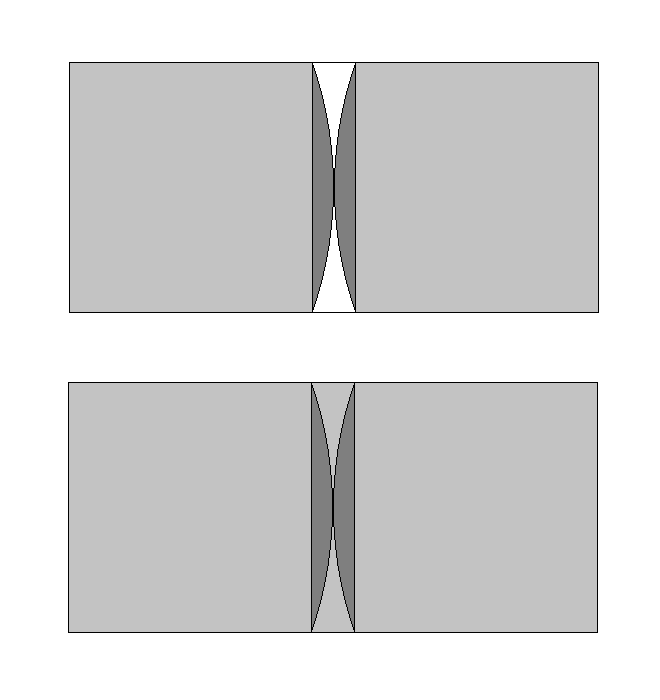
13.3.25∗. Two thin flat-convex lenses, each with a focal length equal to $f$ in the air, are placed in the frame so that their convex surfaces touch. Determine the focal length of such a system in a liquid with refractive index $n$. Assume that no liquid gets inside the frame. How will the response change if liquid gets between the lenses? Refractive index of the glass of which the lenses are made, $n_0$.
Solution
For problem $13.3.25$
When two planoconvex lenses with focal length $f=R/(n_0-1)$ in the air are placed next to each other, the focal length of the compound lenses becomes $f/2$. After submerging a frame containing the compound lenses under a liquid with refractive index $n$ (as in the top figure), the focal length of the compound lenses becomes $nf/2$ as a result of refraction at flat contact surface between the liquid and the compound lenses. When the liquid fills the space between the lenses (as in the bottom figure), the focal length $f'$ of the compound lenses satisfies the equation