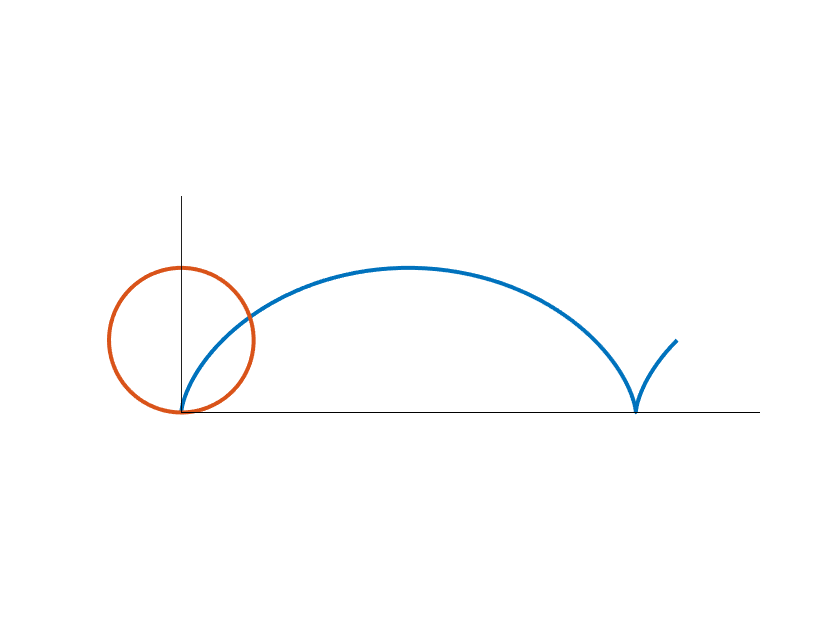
3.5.42∗. At time $t=0$, a particle of mass $m$ is subjected to a force $F_x=F_0\sin(\omega t)$ in the $x$-axis direction, and a force $F_y=F_0\cos(\omega t)$ in the $y$-axis direction. Find the trajectory of the particle if at the initial moment it is at rest. What is the average velocity of the particle over a large time? What initial velocity must the particle have in order to move in the presence of these forces on a circle? What is the radius of this circle?
For problem $3.5.42$
Solution
From $F_x=F_0\sin(\omega t)$ and $F_y=F_0\cos(\omega t)$ and the initial conditions $v_x=v_y=0$ and $x=y=0$ at $t=0$, we have
The last two equations are parametric equations of a cycloid (shown in blue), which is the trajectory of a point on the rim of a disk of radius $R=F_0/(m\omega^2)$ that rolls without slipping on the $x$-axis. Its average velocity is $F_0/(m\omega)$ in the positive $x$ direction. If the initial velocity is $v_0=F_0/(m\omega)$ in the negative $x$ direction, which is perpendicular to the initial force, then the time-dependent force will keep it in a circular orbit of radius $R$ (shown in red) as the equation $F_0=mv_0^2/R$ for centripetal force is satisfied.