Edits to “Statement”, “Solution”, “Answer”

en/13.3.20.md
+6 −6
| @@ -1,21 +1,21 @@ | |||
| ### Statement | |||
| − | $13.3.20.$ [Insert the problem statement] | ||
| + | $13.3.20.$ The system consists of two identical lenses with a common optical axis. Distance between lenses $l$, focal length of lenses $f$. Find the focal length of the system if $l\ll f$. | ||
| ### Solution | |||
| − |  | ||
| − | Suppose a light source is placed at the focal point of the optical system at $A$ which is at the distance $d$ from the left lens. The (virtual) image produced by the left lens must be at the focal point of the right lens at $B$ in order for parallel light rays to | ||
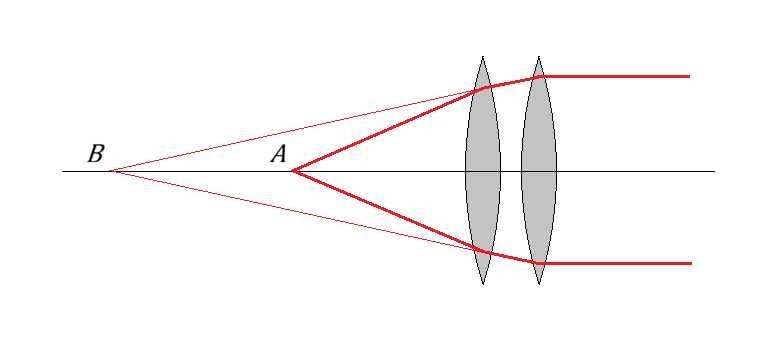
| + | Suppose a light source is placed at the focal point of the optical system at $A$, which is at the distance $d$ from the left lens. The (virtual) image produced by the left lens must be at the focal point of the right lens at $B$ in order for parallel light rays to emerge from the right lens. Thus, | ||
| − | \[\frac{1}{f}=\frac{1}{d}-\frac{1}{f-l}\qquad\Rightarrow\qquad d=\frac{f(f-l)}{2f-l}\] | ||
| + | \[\frac{1}{f}=\frac{1}{d}-\frac{1}{f-l}\qquad\Rightarrow\qquad d=\frac{f(f-l)}{2f-l}.\] | ||
| Consequently, | |||
| − | \[d=\frac{f(1-l/f)}{2(1-l/2f)}\approx\frac{f}{2}(1-\frac{l}{f} | ||
| + | \[d=\frac{f(1-l/f)}{2(1-l/2f)}\approx\frac{f}{2}\left(1-\frac{l}{f}\right)\left(1+\frac{l}{2f}\right)\approx\frac{f}{2}-\frac{l}{4}.\] | ||
| Therefore, the focal length of the system is $d+l=\frac{f}{2}+\frac{3l}{4}$. | |||
| #### Answer | |||
| − | [Insert a concise answer or boxed result] | ||
| + | $\frac{f}{2}+\frac{3l}{4}$ | ||
| @@ -1,21 +1,21 @@ | |||
| ### Statement | ### Statement | ||
| $13.3.20.$ [Insert the problem statement] | $13.3.20.$ The system consists of two identical lenses with a common optical axis. Distance between lenses $l$, focal length of lenses $f$. Find the focal length of the system if $l\ll f$. | ||
| ### Solution | ### Solution | ||
|  | ||
| Suppose a light source is placed at the focal point of the optical system at $A$ which is at the distance $d$ from the left lens. The (virtual) image produced by the left lens must be at the focal point of the right lens at $B$ in order for parallel light rays to |
Suppose a light source is placed at the focal point of the optical system at $A$, which is at the distance $d$ from the left lens. The (virtual) image produced by the left lens must be at the focal point of the right lens at $B$ in order for parallel light rays to emerge from the right lens. Thus, | ||
| \[\frac{1}{f}=\frac{1}{d}-\frac{1}{f-l}\qquad\Rightarrow\qquad d=\frac{f(f-l)}{2f-l}\] | \[\frac{1}{f}=\frac{1}{d}-\frac{1}{f-l}\qquad\Rightarrow\qquad d=\frac{f(f-l)}{2f-l}.\] | ||
| Consequently, | Consequently, | ||
| \[d=\frac{f(1-l/f)}{2(1-l/2f)}\approx\frac{f}{2}(1-\frac{l}{f} |
\[d=\frac{f(1-l/f)}{2(1-l/2f)}\approx\frac{f}{2}\left(1-\frac{l}{f}\right)\left(1+\frac{l}{2f}\right)\approx\frac{f}{2}-\frac{l}{4}.\] | ||
| Therefore, the focal length of the system is $d+l=\frac{f}{2}+\frac{3l}{4}$. | Therefore, the focal length of the system is $d+l=\frac{f}{2}+\frac{3l}{4}$. | ||
| #### Answer | #### Answer | ||
| [Insert a concise answer or boxed result] | $\frac{f}{2}+\frac{3l}{4}$ | ||